A hiring authority once told me three hundred dollars for a personality assessment was too much to spend on a candidate he could not be sure would work out. He was sitting on a project with millions of dollars riding on it. The arithmetic of that sentence is the whole problem. He was protecting a small, certain cost and exposing a large, uncertain one, and the reason he could do that with a straight face is that he had not looked clearly at what a wrong hire costs him. Hiring is where a leader's judgment becomes visible, and a leader who flinches at the small number while ignoring the large one is showing you exactly how he sees the people who will run his work.
Name the mechanism plainly. The wrong hire in a leadership role is a multiplier that runs through everything the role touches, far more than a single line item.
The cost runs far past the salary
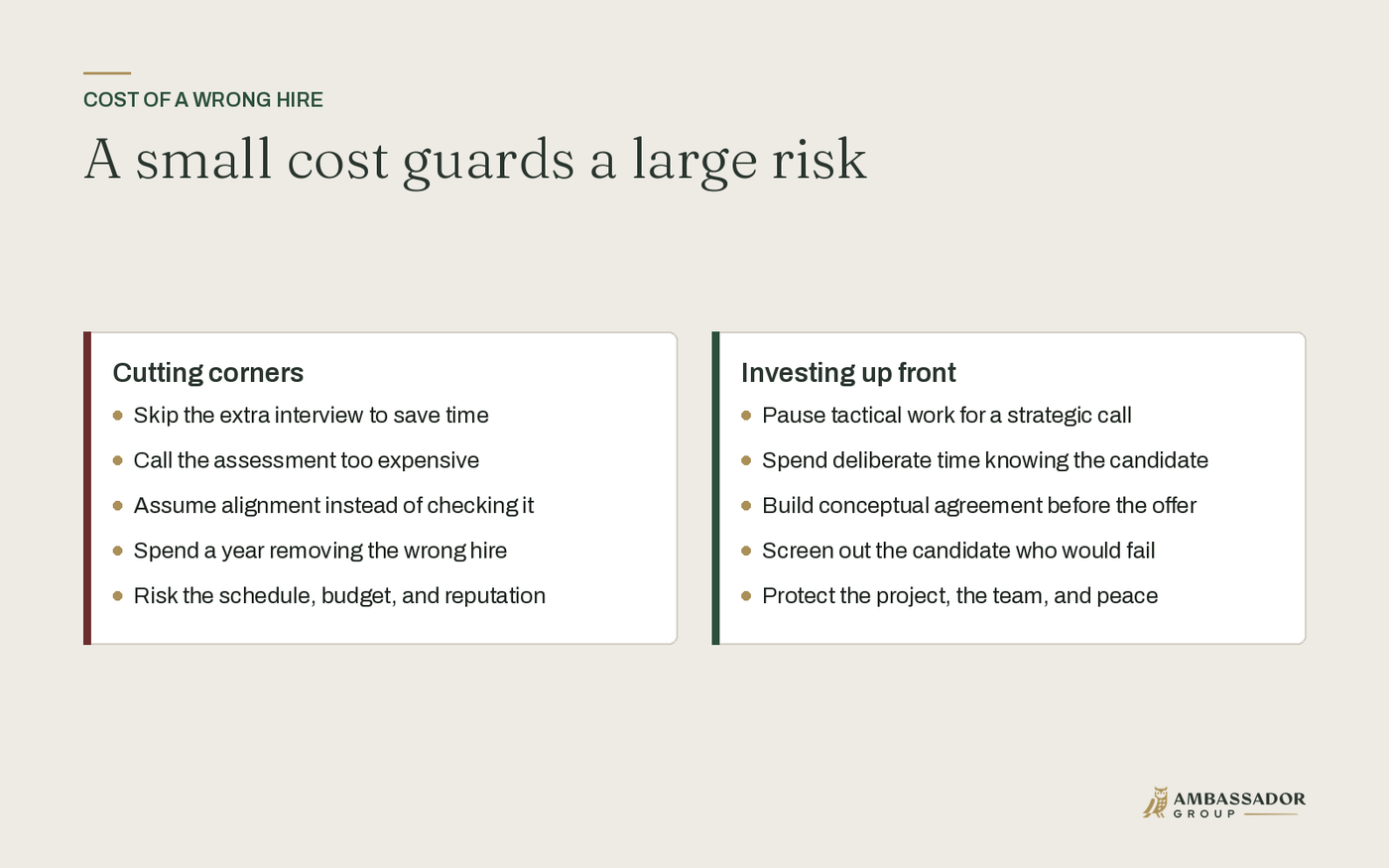
Put a misaligned project manager on a multimillion-dollar build and count the ways the damage spreads. Performance issues you do not catch until they have compounded. Training gaps that surface as rework. Communication breakdowns that ripple through the field. Behavioral problems that erode the team around them. Any one of these can put the schedule, the budget, or the relationship with the owner at risk. Push far enough and you are looking at exposure to a lawsuit, the loss of good people who did not sign up to carry someone else's weight, and a dent in the reputation you spend years building with customers.
That is the real ledger. Against it, the cost of one more interview or a single assessment is rounding error. The leader who calls the assessment expensive has quietly decided that a few hours and a few hundred dollars are worth more than the certainty of who he is putting in charge of his largest commitments. The old line holds: an ounce of prevention is worth a pound of cure. In hiring the ratio is steeper than that.
Hiring is strategic work wearing tactical clothes
The trap is that a vacancy feels like a task. Something broke, a person left, the schedule has a hole in it, and the instinct is to fill the hole the way you would close out any other open item. Move fast, check the box, get back to the real work.
But hiring sits at the top of the funnel. Get it right and a long line of good things follows on its own: a team that runs without you in every decision, a project that ships, a culture that holds under pressure. Get it wrong and you spend the rest of that person's tenure on damage mitigation, managing around a problem you created. The leadership capacity you put into a role shapes your own quality of life as a leader, in both directions. The right person lifts the weight off your shoulders. The wrong one becomes a weight you carry every day until you finally remove them, which costs more and takes longer than anyone wants to admit.
So the discipline is counterintuitive. When a hire is in front of you, put your tactical responsibilities on pause. Treat the interview team strategy as the strategic decision it is. Spend deliberate, careful time getting to know the candidate, because the few hours that feel like an indulgence under deadline are the cheapest insurance you will ever buy.
A vacancy held open one more month costs less than the wrong person you spend a year removing.
The obligation runs to the candidate too
There is a second reason to slow down, and it is not about protecting your project. You owe the diligence to the candidate as much as to yourself. Hiring someone who is not aligned with the company is not a neutral act that quietly fails to work out. It sets a person up to fail, and a person who fails in a role you put them in is partly your doing, not theirs alone.
This is why building real conceptual agreement matters before anyone says yes. The candidate needs to understand what the role truly is, what challenges it exists to solve, and whether their convictions line up with the company's direction. The same patient work that lets you screen out a candidate who is wrong for you is the work that lets you attract the rare one who is right, and that person almost always needs convincing rather than a bare offer. Conceptual agreement, built honestly on both sides, is what turns a yes into a commitment that lasts.
When a leader skips that work under pressure, the pain that made him rush is the same pain that makes the rush expensive. Backs against the wall, clock running loud, he assumes alignment instead of checking it, shortchanges the interview strategy, and calls the resulting mess a hiring problem. It was a process problem, and it was his.
Treat the decision the way the stakes deserve
You are working with people's lives, not playing with them. A candidate has one career and a finite amount of time to spend, and so does everyone already on your team. A hire made carelessly spends that time on a relationship that was never going to hold. A hire made with intention spends it on a match that returns far more than it cost, for the company and for the person.
So before the next search, take the small certain cost seriously precisely because it protects the large uncertain one. Run the extra interview. Spend the few hundred dollars. Build the agreement before you build the offer. Look honestly at whether you have done the work to know this person, because the project, the team, and your own peace as a leader all ride on an answer you are the only one who can give.