A leader who hires by gut will tell you he knows it when he sees it. He has sat through enough interviews to trust the feeling in his stomach, and the feeling has been right often enough to keep trusting it. The trouble is that the gut reads the candidate through the leader's own wiring, and a leader who cannot see himself clearly cannot see the person across the table clearly either. Hiring is where that blind spot stops being private and starts costing money, because the interview is the one place a leader's judgment gets tested against a stranger he is about to hand real authority.
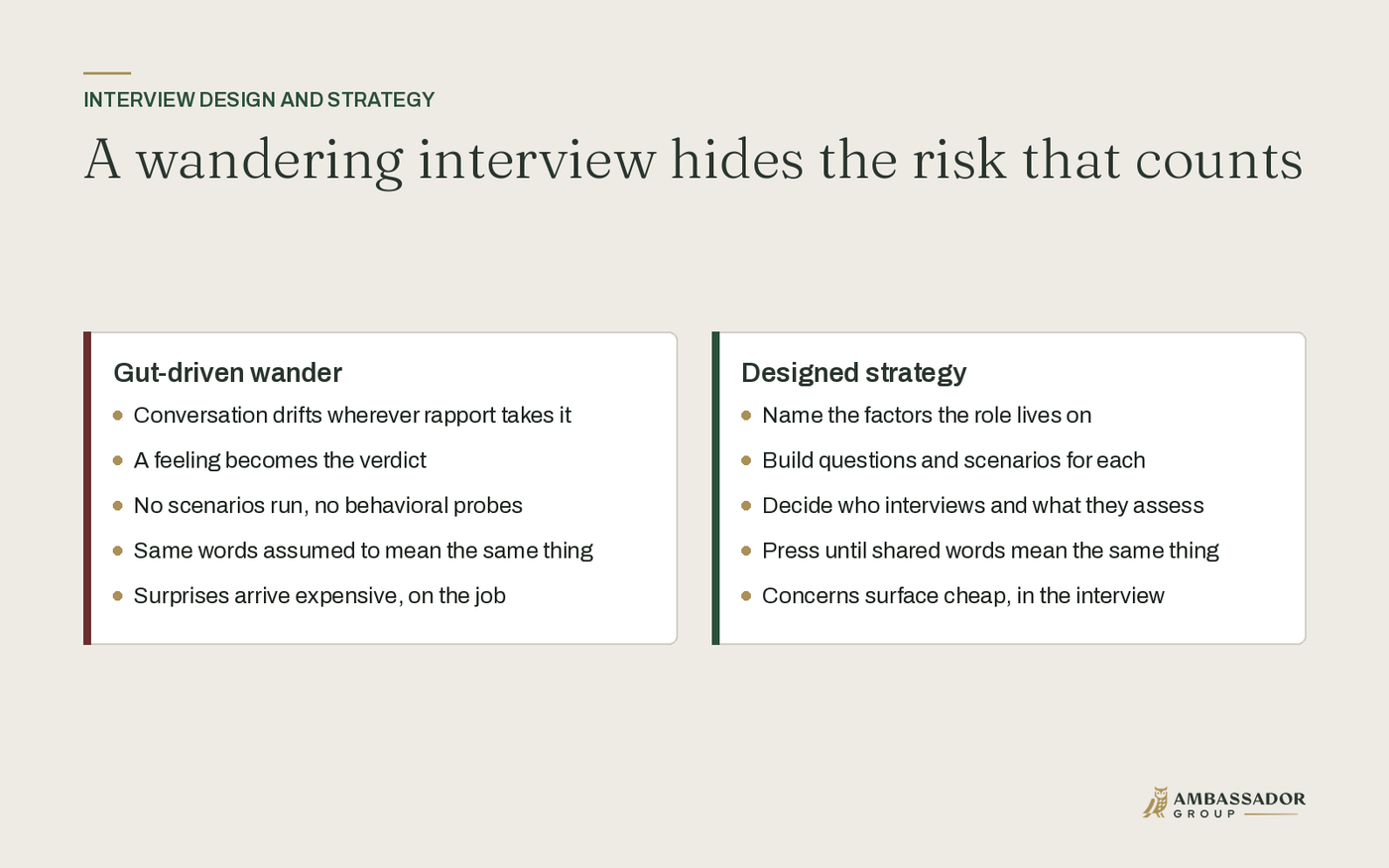
I watch a lot of interview processes, and the gut-driven ones share a shape. They wander. The conversation drifts wherever rapport takes it, the leader leaves feeling good or feeling off, and that feeling becomes the verdict. No deliberate questions, no scenarios run, no behavioral probes aimed at the traits the role demands. The candidate's experience, thought process, and philosophy never get examined against the specifics of the organization, because nobody decided in advance what those specifics were.
The wander leaves you blind where it counts
A wandering interview does not feel risky from the inside. It feels warm. The leader and the candidate like each other, the stories land, and everyone leaves optimistic. The risk is invisible until later, when the surprise arrives. Sometimes the surprise is good and the person turns out better than expected. More often the surprise runs the other way: the candidate's expectation for the job, or his execution of it, does not match what the leader assumed. The work gets done differently than imagined, or slower, or with a different sense of what good looks like.
When that gap shows up, the easy move is to blame the candidate. The leader feels misled, as if the person sold a version of himself that was not true. Sometimes that happens. But the responsibility for diagnosing the candidate sits with the interviewer, because the interviewer holds the broader knowledge. He knows what the organization rewards, where the pressure lands, which corners get cut on a hard week, and what the last person in the role got wrong. The candidate cannot vet himself against an organization he has never worked inside. Only the person who knows the building can run that comparison, and a gut feeling is not a comparison.
In construction, the same words hide different meanings
The problem sharpens in construction, where everyone uses the same vocabulary and means different things by it. A superintendent who says he runs a tight schedule might mean he updates a three-week look-ahead every Monday, or he might mean he keeps the dates in his head and yells when a date slips. A project manager who says he owns the budget might mean he builds the cost projection himself, or he might mean he forwards the accountant's report. Quality, ownership, communication, accountability: these words travel between an interview and a jobsite carrying whatever meaning the speaker grew up with. A leader who does not press on them hears agreement that was never there.
A wandering interview rewards the candidate who interviews well and tells you almost nothing about how he will run a job.
This is why the gut is a poor instrument for the work. The gut responds to fluency, confidence, and likeness. It is comfortable with the candidate who sounds like the leader and uneasy with the one who does not, regardless of whether either will perform. A deliberate interview corrects for that, because it forces the leader to ask the same hard questions of the smooth candidate and the awkward one, and to listen for substance under the words instead of warmth in the delivery.
A strategy is how you turn a gamble into a decision
A good interview strategy is a designed one, longer only where length earns it. Before the first conversation, the leader names the key factors the role lives or dies on, then decides how to interview to each of them. Which questions surface the trait. Which scenarios reveal the judgment. Which kinds of interviews, technical, behavioral, jobsite walkthrough, expose what a conference table hides. Who needs to be in those interviews, the field leader who will manage the person daily, the peer who will depend on his takeoffs, and what each of them is responsible for assessing. Then how the feedback gets collected, and what happens to it once it is in hand.
That last part is where most processes leak. Feedback gets gathered and then dissolves into a hallway opinion. A real strategy decides in advance what a yellow flag on a particular trait means: not an automatic no, but a question to carry into onboarding. If a strong candidate is thin on a specific skill, the plan names how the company will supplement that gap with training, mentorship, or a deliberate first ninety days. The interview stops being a verdict on whether the person is good and becomes a map of how to make a good person successful here.
Run it this way and the surprises shrink. Not to zero, because hiring is a human medium and humans stay complicated. But the gap between what the leader expected and what the candidate delivers narrows, because the leader interviewed to the things that matter instead of waiting for a feeling. The candidate who would have surprised you in month two surfaces the concern in the interview, where it is cheap to address, rather than on the job, where it is expensive to unwind.
The gut still has a place. It notices things a checklist misses, and a leader who has done the harder work of knowing himself can trust it more, because he knows which of his reactions are signal and which are his own preferences talking. The point is to put the gut downstream of a process, not in charge of one. Design the interview to the role, decide what the answers mean before you hear them, and the feeling in your stomach becomes one input among several instead of the whole verdict.
Look at your last hard interview and ask what you tested for, versus what you merely liked. The answer tells you whether you made a decision or rolled the dice, and you are the only one who can change which one you make next time.