Most reference checks are theater. The hiring leader calls three names the candidate supplied, the references say warm and unsurprising things, and everyone treats the warmth as confirmation. The whole exercise gets framed as a final yes-or-no vote on the hire, which is precisely the wrong job for it. A reference is a cross-reference, a way to test the picture you already formed against people who have watched the candidate work. A leader who knows what he is trying to learn can turn that call into real signal, and a leader who does not will keep collecting polite noise and calling it diligence.
The reframe starts with the purpose. The reference is not where the hire-or-no-hire decision gets made. That decision is yours, built from the interview and your own judgment about fit. The reference exists to corroborate or complicate the read you have already developed. Once that is the goal, the questions change, and so does what you can hear in the answers.
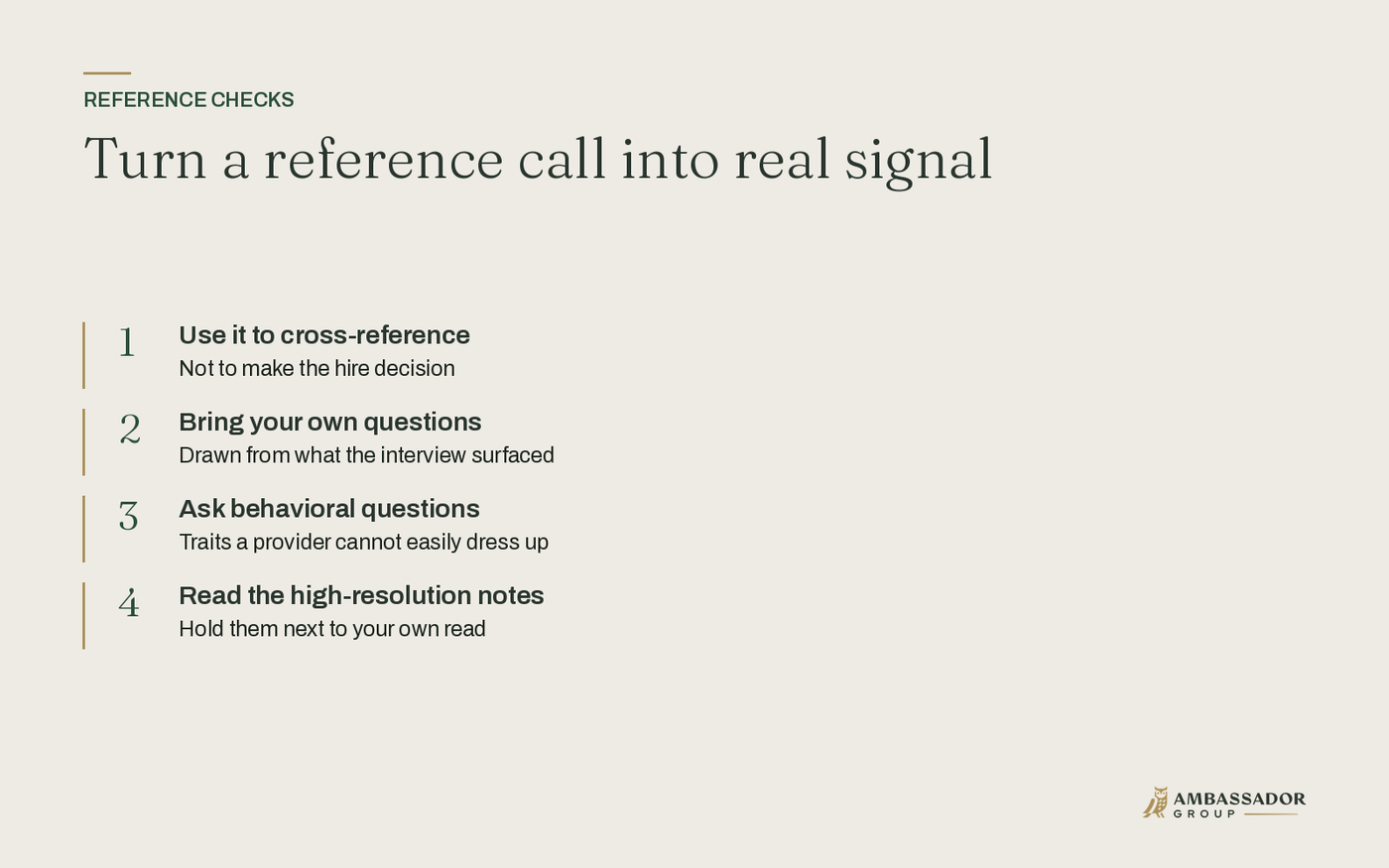
Bring your own questions
The most useful reference check is the one shaped by the specific candidate in front of you. After the interview, you carry a set of impressions and a set of doubts. Maybe this superintendent presents as calm under pressure, and you want to know whether that holds when a schedule collapses. Maybe an estimator struck you as detail-strong but conflict-avoidant, and you want to know how that played out with a subcontractor who pushed back. Those are your data points, and the reference call is where you check them against someone who has seen the behavior over time.
Generic reference questions cannot do this. Asking whether someone was a good employee invites the answer everyone gives. Bringing your own questions, drawn from what the interview surfaced, turns the call into a targeted instrument that either confirms your read or tells you where it was off. Either result is worth having before you commit.
Behavioral questions are harder to game
There is a reason most references default to praise. The reference provider knows the game. They were handed the call by the candidate, they want to help, and a question with an obvious right answer gets the obvious answer. Asking whether the person is hardworking, reliable, or a good communicator hands them the script.
Behavioral questions about personality work differently, because they do not have a right or wrong answer to perform toward. When you ask how a person handles a problem they cannot immediately solve, or what they are like when a project starts slipping, or how they respond to a direct disagreement, the reference provider cannot reach for the safe word. They have to describe an actual person doing actual things. Translating a behavioral assessment like a PXT into reference questions sharpens this further, because the questions probe traits the provider has no incentive and no easy way to dress up. What comes back is texture: the nuances of how someone performs on the job that almost never surface inside the interview itself.
A reference that only produces praise tells you the questions were too easy to answer, not that the candidate was easy to vouch for.
Read the resolution you get
A good reference process should hand you more than a verdict. It should give you high-resolution notes from each conversation, the kind of detail you can hold next to your own interview impressions and see where they line up and where they diverge. It should also give you the contact information for the references, so you can reach out directly when a thread is worth pulling yourself. The point is to widen your perspective on the person, not to outsource your conclusion about them.
When the notes corroborate your read, you commit with more confidence. When they complicate it, you have found the conversation worth having before an offer goes out rather than three months after a hire starts to struggle. A reference that surfaces a real concern early is doing exactly its job, even when the concern is inconvenient, because the alternative is discovering the same thing on a live project with a client watching.
The diligence is yours to own
Underneath the mechanics sits the same principle that runs through every part of hiring well. The quality of what you learn depends on the quality of what you ask, and the quality of what you ask depends on how clearly you understand what you are trying to find out. A leader who has done the work to know his own operation, his own gaps, and his own doubts about a candidate can build reference questions that earn real answers. A leader who has not will accept the warm and useless ones and mistake them for confirmation.
Gatekeeping who enters the business is among the most consequential things a leader does, and the reference call is one of the last gates before the offer. Used as a rubber stamp, it confirms nothing. Used as a cross-reference, with your own questions and behavioral depth, it can show you the person behind the interview presentation while there is still time to act on what you see. Decide what you need to verify before your next reference call, and the conversation will start returning answers worth the time it takes to make it.