When you bring in outside help for a high-stakes hire, that person becomes part of your decision-making structure, and the soundness of a hire depends far more on the structure than on the candidate. A leader who hands a critical role to someone with no framework for judging that person's work is outsourcing his own judgment to a stranger and hoping for the best. The way to keep that from happening is to know what good looks like before you delegate, because a leader who cannot evaluate the person evaluating his candidates cannot see either one clearly.
The failure mode is common enough to name. Recruiting often collapses into something purely transactional: fetching and filtering resumes, applying a generic screen, coordinating a few logistics. That is not harmless. It distorts the signal environment at the exact point where clarity matters most, the foundation of a decision about who joins your team and helps build your future. When the person feeding you candidates is incentivized to drive volume so he can earn his fee, he clouds your judgment precisely when you need it sharpest. So here are six questions worth asking, each one a probe into whether the recruiting function is being performed with the seriousness the decision deserves.
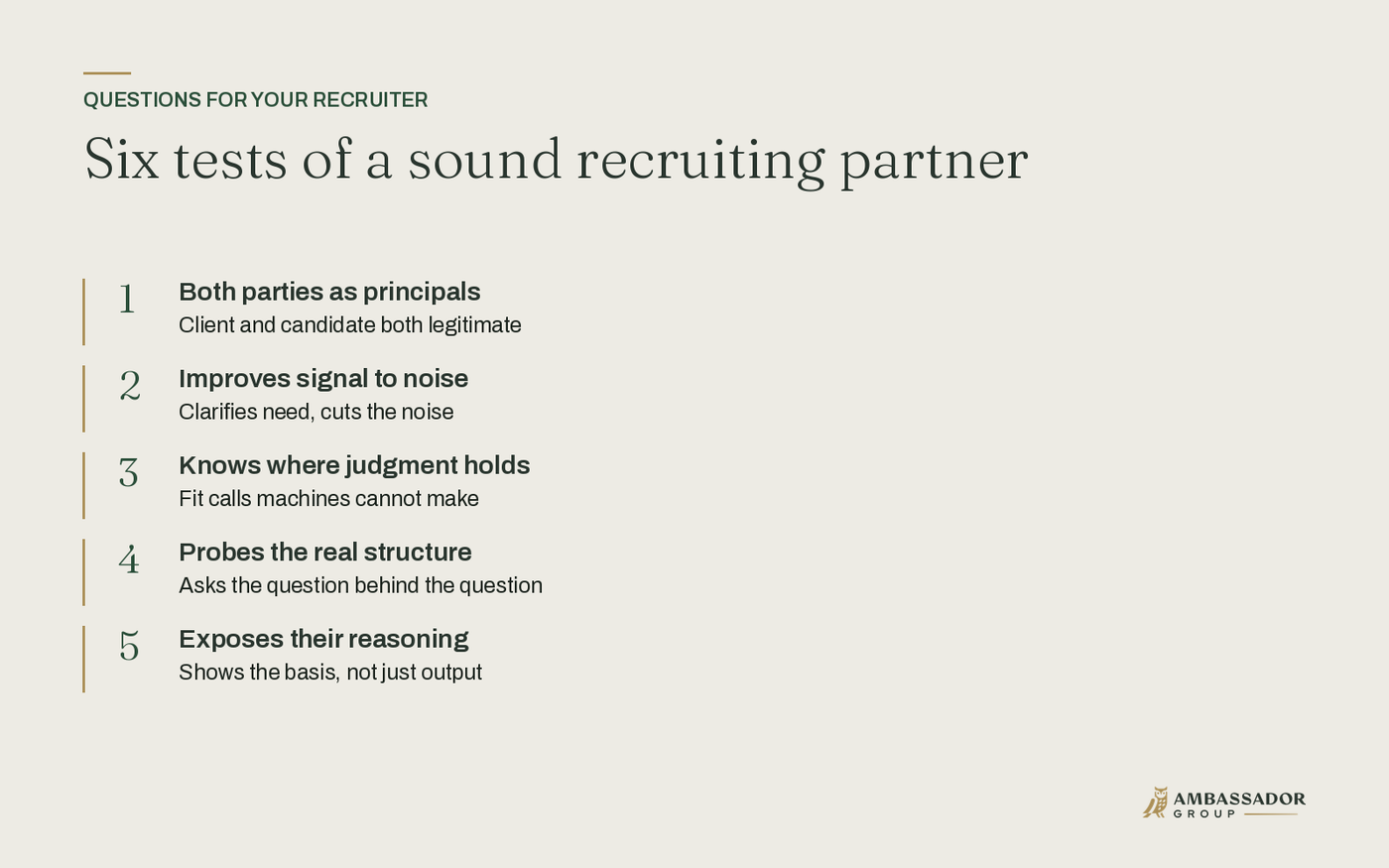
Do they treat both parties as legitimate principals?
A hire reconciles the interests of two parties. The company spends money. The candidate spends something equally real: risk, career trajectory, opportunity cost. Someone who only appreciates one side has misread the structure of the problem. A recruiter who treats the candidate as a resource to be moved, rather than a principal whose interests are genuine, will surface the wrong matches and miss the misalignments that sink a hire in month two.
Do they improve the signal-to-noise ratio?
Hiring decisions are probabilistic, made under uncertainty, not computable problems with a clean answer. The job is to raise the ratio of signal to noise: deliver insight, clarify your messaging, amplify your reach, strip out what does not matter. A recruiter blasting you with resumes is doing the opposite, adding noise and calling it effort. One who compresses your narrative or delivers false precision is corrupting the inputs to your decision.
Signal is whatever is genuinely relevant to a candidate's fit, and it differs from search to search. Ten companies hiring a superintendent will want ten different superintendents, judged by ten different heuristics. The work is figuring out what counts as signal for your specific company, your specific project, your specific definition of long-term success, and then optimizing the entire process around it. There is a scene in Moneyball where executives like a player because he has the looks and the girlfriend, and Brad Pitt's character keeps dragging them back to whether the man gets on base. The looks are noise. Getting on base is signal. A recruiter who cannot tell the difference for your business is a liability dressed as help.
A job description describes an imaginary person who does not exist, so the task is to understand the problem that imaginary person was invented to solve.
Do they understand where human judgment cannot be substituted?
A great deal can now be automated, and that is genuinely useful. Outreach scales. Content drafts itself. The printing press freed scribes from copying manuscripts by hand, and that was a gift. What does not automate, certainly not now and perhaps not ever, is judgment about fit, context, and counterfactuals. Somewhere between pure gut instinct and pure machine output sits the human work of weighing how well a specific person fits a specific role on a specific team. A recruiter who outsources that judgment to an applicant-tracking screen has handed away the one thing you were paying for.
Do they probe the underlying structure?
Behind every job description is a question the description does not ask: what is the pain that needs relief, the ambition that needs empowering, the problem this hire exists to solve? A leader says "I need a superintendent," and the real story underneath could be systemic turnover from a culture problem, a troubled project, a process breaking down, or an ordinary life event that took a good person out. Each of those changes what counts as the right hire. A recruiter worth trusting reasons backward from the actual need to the traits that satisfy it, and asks the questions behind the question until the real problem comes into view.
Do they expose their reasoning?
Trust is built through transparency. In a high-stakes working relationship you want access to the reasoning behind the output, not the output alone. A recruiter can say "interview this person, they are great, take my word for it," or he can say "here is exactly how I evaluated and filtered this candidate, and here is the basis for the conclusion." The same applies to market strategy. He can conceal his methods, or he can tell you plainly: here is how I am approaching the market, here is the messaging, you asked for three to five years of experience and here is why I am casting wider, here is how I will evaluate. When the reasoning stays visible, good candidates do not get filtered out prematurely and weak ones do not get inflated. Some of the most rewarding work in this field is introducing a candidate who looks wrong on paper, explaining exactly why the fit is real anyway, and watching the client come away glad they took the interview they would otherwise have skipped.
Do they hold a coherent theory of success?
An offer letter is not the finish line. A signed contract that ends in a failed hire still costs the company the thing it was buying, however the fee was earned. The honest definition of success is a durable match: a hire that holds. That standard reshapes the whole engagement, because it means the work continues through onboarding and into the year that follows, when the relationship has to be cultivated rather than assumed. Fit is not binary and rarely total; it is a percentage that can be built, maintained, or eroded by how a leader onboards, checks in, and leads after the hire. A recruiter who shares your definition of success will be aligned with you on what winning truly means. One who counts the offer as the victory will leave you alone with the part that was always going to be hardest.
Run these six questions across anyone performing the recruiting function for you, internal or external, before you let them shape a decision this consequential. The quality of your next hire is downstream of the quality of the judgment you allow into the structure, and that judgment is yours to vet.