When you apply for a construction role, you are not filling out paperwork. You are giving a hiring leader the first honest picture of what you have built and how you work, and the documents you bring decide how clearly they can see you. A good match runs in both directions: the company owes you a fair, transparent read, and you owe the company an accurate account of your career. The documents are where you start paying your half. Bring the right ones, prepared with care, and you make it possible for a leader to evaluate you on what you have done rather than on what they have to guess.
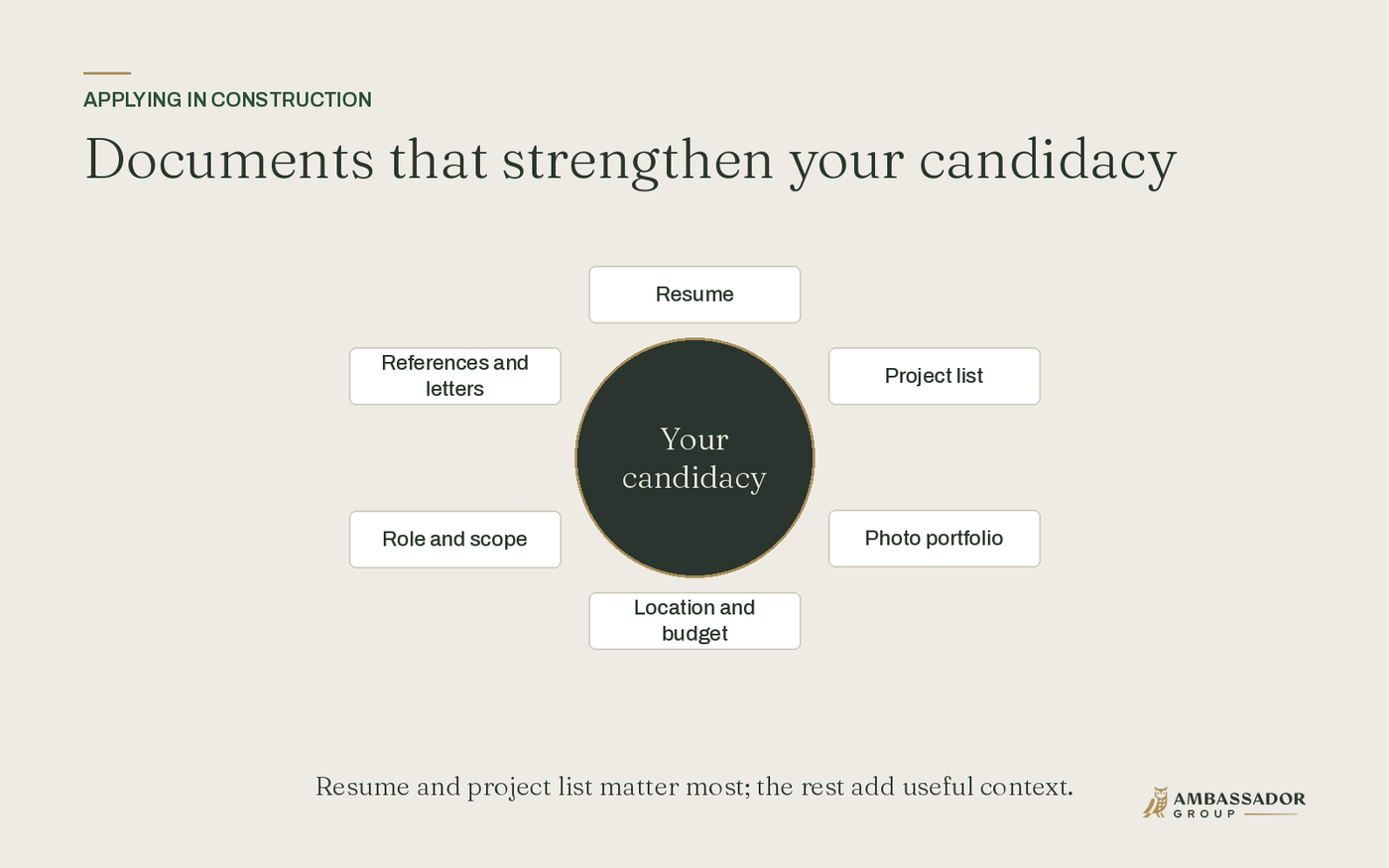
Most people lead with the resume and stop there. The resume earns its place, because its job is to communicate the chronology of your work history, the arc of where you have been and in what order. A leader scanning it wants to follow that arc without having to call you to fill in the gaps. But for a construction professional, the resume is rarely the document that tells the richest story, and treating it as the whole application leaves your strongest evidence on the table.
The project list does the heavy lifting
The document that often carries the most weight is a well-organized project list. The chronology on a resume tells a leader when you worked. The project list tells them what that work involved and whether it translates to the kind of building they do. It is the bridge between your history and their need, and most applicants either skip it or throw together something too thin to be useful.
Build it with the details a hiring leader is genuinely trying to learn. For each project, include the location, the budget, and your specific role and responsibilities on that job. Note the architectural style where it matters, because a leader running custom residential work reads a fine-detail remodel quite differently than a tilt-up warehouse. The goal is to let someone understand where your experience truly lies, not to list everything you have ever touched.
A project list with real numbers and real scope often tells a hiring leader more than your job titles ever could.
Be precise about scope and honest about your part in it. Were you on the project at groundbreaking or did you come in at closeout. Did you run the schedule or support someone who did. What was the budget you were trusted with. Those specifics are what let a leader picture you on their own jobs, and vagueness here reads as either inexperience or evasion, neither of which serves you.
Pictures make the work real
A portfolio, or a set of project photographs, turns description into evidence. You can fold the images into the project list or keep them separate, but either way they let a leader see the finish, the complexity, and the standard you held. In construction, the work speaks in a way bullet points cannot, and a clear photo of a difficult detail you delivered carries weight that a sentence about it does not.
This matters most when your experience sits in a specialty. If you have run intricate millwork, complex structural work, or a particular style of custom home, photographs let a leader confirm at a glance that your hands have been where your resume says they have. The image closes the distance between a claim and the proof of it.
References are a signal of the trend
Letters of recommendation and strong references round out the picture. Past employers and partners who had a good experience working with you are a meaningful indicator to a prospective one that the trend is likely to continue. A leader hiring you is making a bet on the future, and a credible voice vouching for your past is one of the few honest ways to lower the uncertainty of that bet.
Choose references who can speak to how you work day to day, not the most impressive title in your phone. A foreman who watched you hold a schedule under pressure tells a hiring leader more than an executive who barely knew your name. Line them up before you need them, give them a heads-up, and make sure they can speak to the specific role you are pursuing.
Prepared well, these documents do something larger than get you in the door. They let a leader form an informed, accurate judgment about whether this role fits the person you are, which protects you as much as it protects them. A match built on a clear picture holds. One built on a thin application and hopeful guesses tends to come apart a few months in, and you are the one who lives inside that mismatch. Assemble the full set, tell the truth in detail, and you give the right opportunity a fair chance to find you.