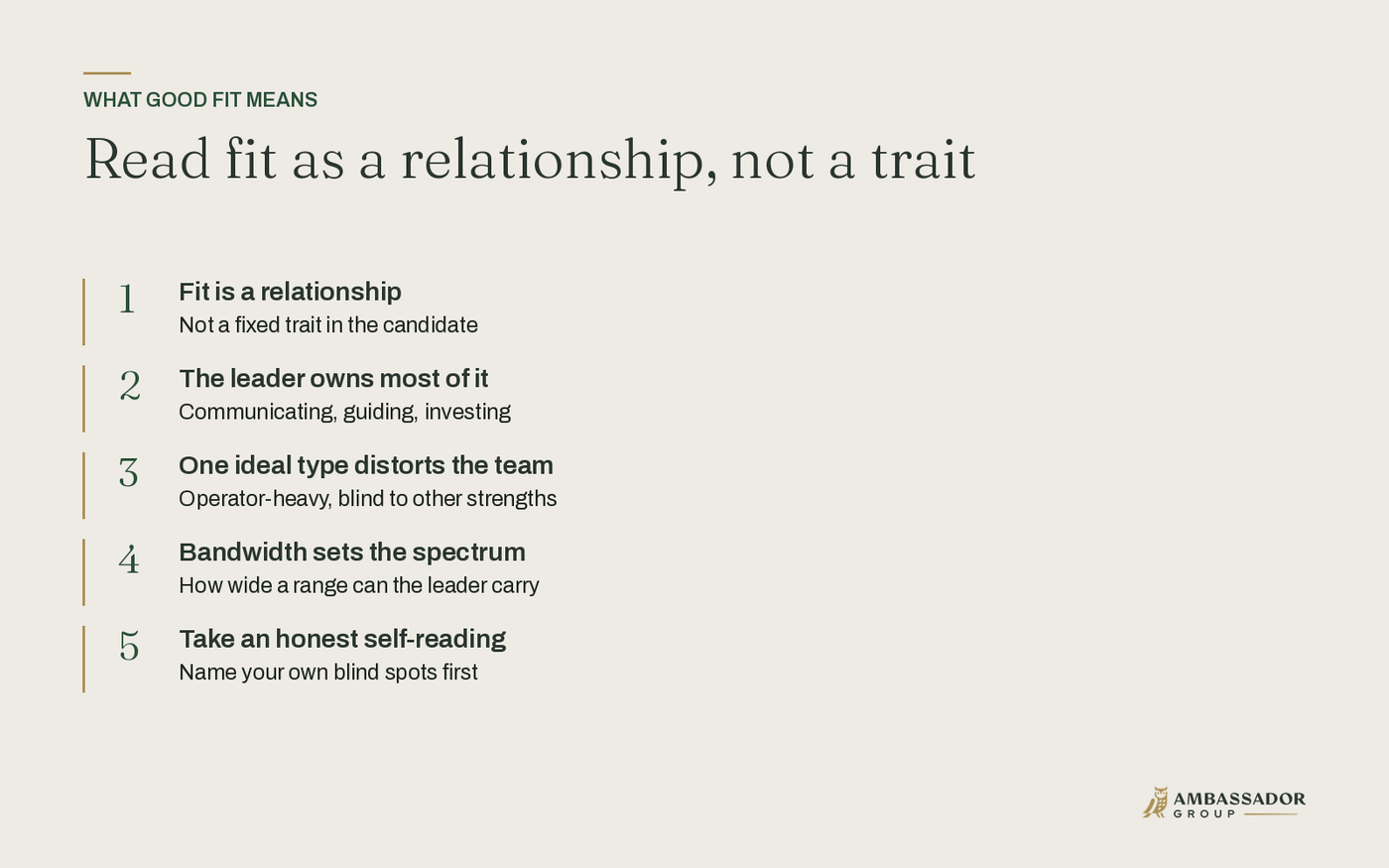
The phrase "good fit" gets used as if fit were a property of the candidate, a fixed trait you could test for and stamp. The longer I sit with it, the less the candidate looks like the whole story. I have watched people with the supposedly ideal personality fail in a role, and the reason was not the person. It was the dynamic between that person and the leader they reported to. Fit is a relationship, and a leader who cannot see his own half of that relationship cannot see the candidate's half clearly either. Hiring is where a leader's self-knowledge becomes visible, because the leader is a variable in the equation he keeps trying to solve for in the candidate alone.
Start with what the standard story gets wrong. The common belief is that a role calls for a specific personality, and if you hire that personality, success follows. But the candidate does not unilaterally control the outcome. The leader pours enormous input into it: how clearly they communicate, how they guide and correct, how much structure they provide, how well they read the person in front of them. A capable hire under a leader who manages poorly can look like a bad hire, when the real failure sits on the other side of the relationship.
The mirror image teaches the same lesson
I have also watched people who lacked the so-called perfect personality succeed anyway. They did it through self-awareness, an honest understanding of themselves and of the problem they were solving, which let them build an authentic approach that worked for them rather than copying a template. Sales is the clearest case. Plenty of assessments promise to tell you who will sell well based on personality, and I question the premise, because selling is largely the act of sharing something you are convicted about and confident in. I have seen people with wildly different personalities sell effectively. They sold differently.
That observation should change how you read fit. Over-prioritizing one ideal personality type does more than miss good people. It distorts the business. Hire nothing but operators and you become operator-heavy, the whole company head-down in the weeds, fluent in one way of solving every problem and blind to the rest. You lose the person who brings process discipline, the one who carries vision for a creative path through a hard problem, the one whose strength is the relationship that keeps a client through a rough phase. A role filled the same way every time builds a team that thinks the same way every time.
Fit lives in the relationship, and the leader owns most of it
Most leaders resist what comes next. The more carefully you examine "good fit," the more it stops being about the candidate and becomes about the relationship between the hire and the leader. How capable, willing, self-aware, and emotionally intelligent is that leader at communicating, guiding, persuading, and inspiring this particular employee to do their best work inside the shape of their personality? Fit behaves like a spectrum rather than a binary, black-and-white verdict on a person, and where a candidate lands on it depends heavily on the leader they land under.
The more you see that you are the biggest part of the fit equation, the more ownership of your hiring you get to take back.
That realization frees you rather than discourages you, because the part you control is the part you have been blaming on others. A leader with wide bandwidth, real emotional intelligence, and energy to invest can succeed with a broad range of personalities. A leader who is buried in the work, or thinner on the people side, will rely on the employee to carry weight the leader is not carrying, and that reliance is a risk. Neither leader is wrong to exist. But they are not interchangeable, and pretending otherwise is how a company hires the same problem twice.
You can watch this shape a business from the outside. Some companies stay small and cannot grow, and the ceiling is the leader's own leadership bandwidth. The leader lacks the bandwidth to open the doors wide enough, so the organization can only function with a narrow band of candidates, and growth stalls there. Then there are the dynamic leaders who recognize their dependence on strong people, who treat hiring and developing and leading as the most important work they do, and who invest in it accordingly. Those leaders become effective with a far wider array of personalities, and the range itself opens opportunity the narrow company never reaches.
The better question before your next hire
So change the question you carry into the interview. "Is this person a fit for the job" is real and worth asking; can they do the work matters. But the larger question is often "is this person a fit for the leader," and answering it honestly means taking stock of yourself first. How wide a spectrum of personalities can your leadership style, your competence, and your bandwidth accommodate right now? That number is not fixed forever, but it is what it is today, and hiring outside it without knowing it is how good people end up failing on your watch.
Durable matches come down to mutual commitment, built authentically and humanly through demonstrated competence and real investment in the relationship over time. The leader commits to the new hire, the new hire commits to the leader, and that bond gets cultivated rather than assumed. None of that is possible if the leader treats fit as a quality he inspects in others while exempting himself from the inspection.
Before your next hire, take an honest reading of your own bandwidth and your own blind spots, because the fit you are searching for is built as much by you as found in them.