Two fish in two tanks can argue all day about what water is, and each one will be right about the only water it has ever known. That is the trap waiting in most construction interviews. A founder who has run one company for fifteen years has swum in a single body of water so long that it has become invisible to him, and he interviews as if his water is the water. A leader who cannot see the assumptions baked into his own operation cannot see clearly where a candidate's assumptions will collide with them, and that blindness is where good hires quietly start to fail.
I have been recruiting in the construction space for thirteen years, and the fish problem is the most common mistake I watch interviewers make. The industry shares a spine. There is a pre-construction phase, a build, a closeout, a turnover of the keys. There is shared vocabulary that everyone uses with confidence. Underneath that shared spine, though, every firm has invented its own way of moving a project from a set of drawings to a finished building, and almost none of it is standardized.
The same words, different meanings
A submittal process at one company is a disciplined gate with named owners and hard deadlines. At another it is a loose habit that lives in one person's inbox. Both call it the submittal process. A change order at one firm triggers a formal conversation with the owner before a shovel moves; at another it gets handled in the field and reconciled later. Both call it a change order. The estimating approach, the handoff from pre-construction to operations, the way a superintendent is expected to talk to subs, the threshold at which a problem gets escalated: all of it is local, all of it is unwritten, and all of it hides behind language that sounds universal.
So when a candidate comes from a different aquarium and uses your exact words, the potential for misunderstanding is larger than the conversation feels. You both say schedule. You both say quality control. You both say the superintendent owns the building coming out of the ground. You walk away believing you aligned, when in fact you each pictured a different operation and never noticed the gap.
The candidate using your vocabulary fluently is the most dangerous illusion of fit, because it lets you skip the work of finding out what the words mean to them.
Pedigree is not portability
The version of this mistake that costs the most begins with a strong resume. A superintendent comes from a well-respected firm, has good tenure, builds the kind of work you build, and presents well. The interviewer reasons forward from the logo: respected company, long tenure, likable person, therefore a safe hire. That chain skips the only question that matters, which is whether the way this person learned to operate maps onto the way you operate.
It often does not. The candidate spent a decade absorbing another company's frame of mind, its escalation habits, its tolerance for ambiguity, its definition of what a superintendent is responsible for. When that person walks in, they import all of it. Now you have a capable professional running your projects with another firm's operating system, and the friction shows up everywhere: in how schedules get communicated, in what gets escalated and what gets absorbed, in how subs are managed, in the small daily judgments that no job description captures. The client feels it before you can name it. A talented hire becomes a source of stress, not because the person is weak, but because the fit was assumed instead of examined.
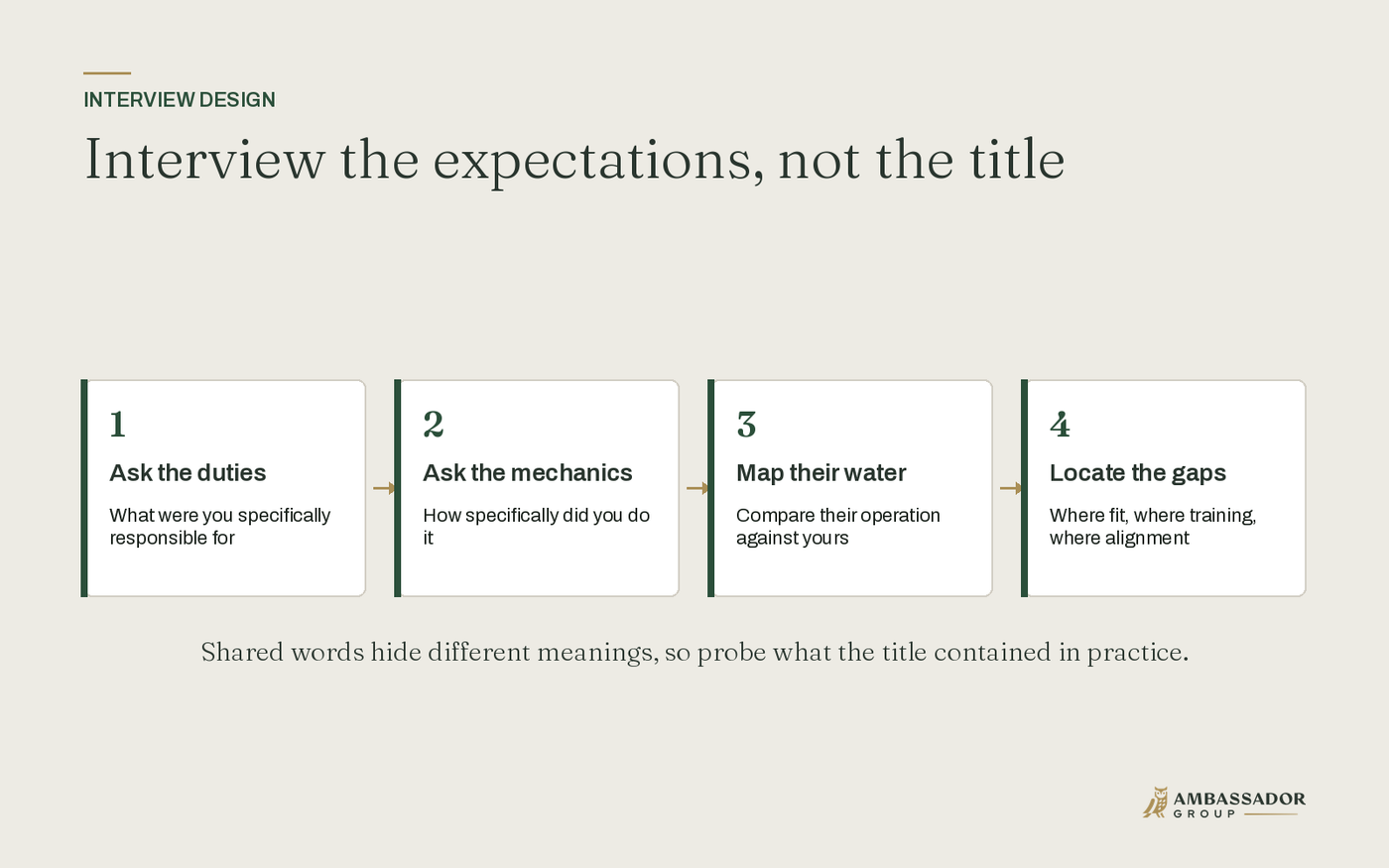
Interview the expectations, not the title
The repair is to stop treating the role as a fixed thing that travels intact across companies. A superintendent title means something at your shop and something else at theirs. Instead of confirming that someone has held the title, build an image of what the title contained for them in practice.
Ask what they were specifically responsible for, then ask how they specifically did it. Push past the summary into the mechanics. What did they own in the submittal process, and what did someone else own? When a change order surfaced in the field, what were they expected to do before acting? How did they run a look-ahead, and who did they answer to when the schedule slipped? You are not testing whether they are good. You are mapping their water against yours.
From that map, three things become visible. Where this person will naturally fit your process without friction. Where you will need to train them onto your way of doing things. And where you will need to align expectations out loud before day one, because their default and your default are about to disagree. That map is worth more than any reference, because it turns a vague sense of fit into a set of specific, addressable gaps.
The self-awareness underneath
None of this works without organizational self-awareness, and that is the harder half. To interview for fit against your water, you first have to be able to see your water. You have to know why your process works the way it does, which of its rules are written and which are absorbed by osmosis, how your priorities and personalities and history got baked into the way the building gets built. Most leaders have never articulated this, because the assumptions that run a company are exactly the ones nobody questions from the inside.
A leader who has examined his own operation can say plainly what is unique about it, and that clarity is what lets him test a candidate against something real. A leader who has not will keep mistaking shared vocabulary for shared meaning, keep reading pedigree as portability, and keep importing other companies' operating systems into his own, then wondering why strong people arrive and slowly come apart.
Your firm is more unique than it feels from the inside, which is the whole reason the water is invisible to you. Before your next interview, spend an hour naming the parts of your process you have never had to explain to anyone, and you will know exactly which questions the conversation has been letting you skip.