For a decade I knew what I was doing and could not explain it. I could perform the work and could not teach it, and I had no name for the gap between those two things. The name is expert blindness, and it afflicts everyone who has poured years into a hard-won skill. It also wrecks more onboarding than any resume ever did. A leader who cannot see his own knowledge clearly cannot transfer it to the person he has hired, and the hire that looked like a sure thing in the interview stalls in the first ninety days for reasons no one can articulate.
The mechanism is invisibility by familiarity. When a skill becomes automatic, the thousand small judgments underneath it disappear from conscious view. The expert no longer remembers learning that a particular pour sequence telegraphs a scheduling problem, or that a certain tone from an owner means the next change order is coming. The knowledge has gone wordless. That wordless knowing is the asset, and it is exactly what cannot be handed across a desk, because the expert has lost sight of the steps that built it.
High-skill shops are the most exposed
The companies that prize skill the most tend to onboard the worst. A shop full of remarkably capable people is a shop where almost everyone has forgotten what it felt like to not know. The current staff is so hardwired into the systems, the process, and the unwritten business logic that they cannot empathize with someone walking in from outside. They assume the new person sees what they see. The new person does not, and the gap is widest precisely where the team's competence is deepest.
I have watched accomplished people leave one respected firm for another and struggle in ways that surprised everyone. Their pedigree created an assumption: the fit is obvious, so they will hit the ground running and need little support. Sometimes that holds. Often it does not. A strong candidate dropped into an environment riddled with expert blindness is handed an unspoken expectation to divine how the place works, and even excellent people can drown trying to reconstruct a system no one will make explicit.
If a person has to climb the mountain to become an expert, they have to descend it to become a teacher, and most experts never make the trip back down.
The fix is descending the mountain on purpose
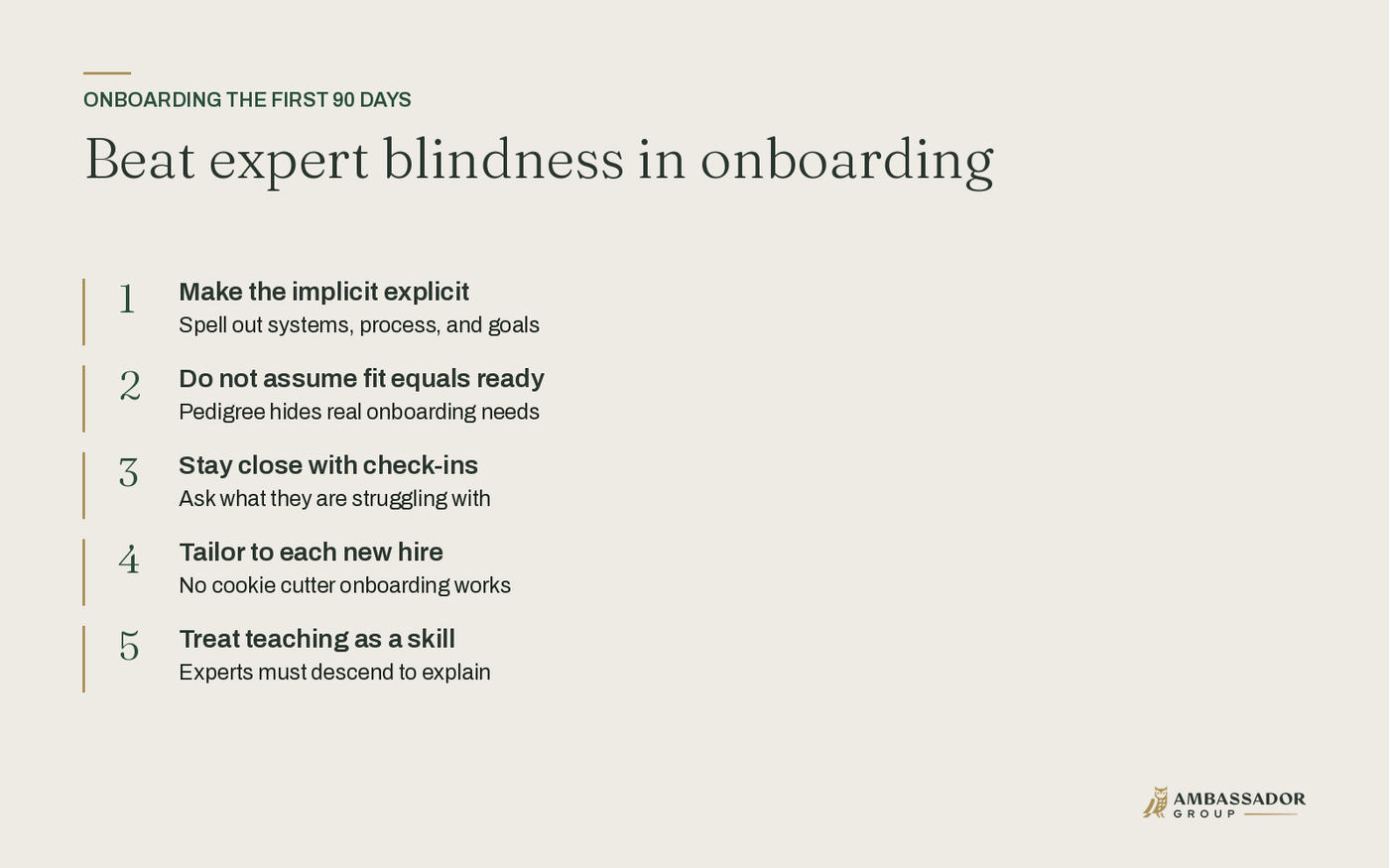
Onboarding well means treating explicitness as a discipline. Make the systems, the process, the expectations, and the goals as plain as you can stand to make them, including the things that feel too obvious to say. The instinct to skip the obvious is the blindness operating in real time. What is obvious to a ten-year veteran is invisible to a capable newcomer, and the cost of the unspoken assumption lands later as confusion, slow ramp, and turnover.
This is a skill in itself, and it is worth naming as one in your organization. Find the people who are genuinely good at teaching what they know and at managing onboarding as a real procedure, not an afterthought. Climbing the mountain and descending it are different abilities. The best superintendent on your roster may be a poor trainer, and that is not a character flaw, it is the predictable shape of deep expertise. Build the teaching capacity deliberately rather than assuming it comes bundled with skill.
Stay close, because no two ramps are identical
The other half of the work is proximity. Regular check-ins, and not the perfunctory kind. The questions that matter are direct: what are you struggling with, and what can I help you with. Those questions do something structural. They make it safe for a new hire to admit what is not yet clear, which is the only way the unspoken parts of the job ever get surfaced and explained.
Every person you hire will need a slightly different ramp. One needs the org chart and the decision rights spelled out. Another needs to watch how a hard conversation with a subcontractor gets handled before they can run one. Another needs the financial logic behind why the company bids the way it does. There is no single cookie-cutter onboarding that guarantees success, because the blind spots a new hire walks in with depend on where they came from and how their previous shop did things.
Consider a strong project manager arriving from a competitor. On paper the move looks frictionless, because the work is the same category and the resume reads clean. In practice the new shop closes out projects through an unwritten rhythm: which submittals get pushed first, how the superintendent and the PM split owner communication, when a change order gets logged versus negotiated. None of that lives in a manual. The veterans run it on instinct, and they assume a peer of equal experience will pick it up by osmosis. The new PM, capable and motivated, spends three months guessing at a system that could have been drawn on a whiteboard in an afternoon. The shortfall is in the assumption that experience makes the local rules visible.
The remedy is to interrogate your own instincts before the new person ever struggles against them. Sit with a trusted veteran and ask what they do that they have never written down, then write it down. The act of forcing tacit knowledge into plain words is uncomfortable for an expert, which is the surest sign it was needed.
You can recruit well, interview with rigor, and make a genuinely strong hire, and still watch all of it unravel because expert blindness was never accounted for in the weeks that followed. The cost of that unraveling is steep, in money and in the energy of everyone involved, and it is almost entirely preventable. Look hard at what your best people know but cannot say, name the teaching as a skill worth developing, and stay close enough to your new hires to hear what they cannot yet name. The expertise that built your company is only an asset to the next person if you are willing to make the climb down and hand it over.