A gelato counter and a moon mission do not warrant the same interview. One mistake costs you a wasted shift and a little wasted product. The other costs lives and a national program. Yet most construction leaders run a single interview format against every role they fill, from a part-time field hand to the operations director who will steer twenty million dollars of work. The resolution of your interview should rise with the stakes of the role, and a leader who cannot see what a role costs the business cannot see what level of scrutiny it deserves. Hiring is where a leader's judgment becomes visible, and judgment starts with knowing what you are underwriting.
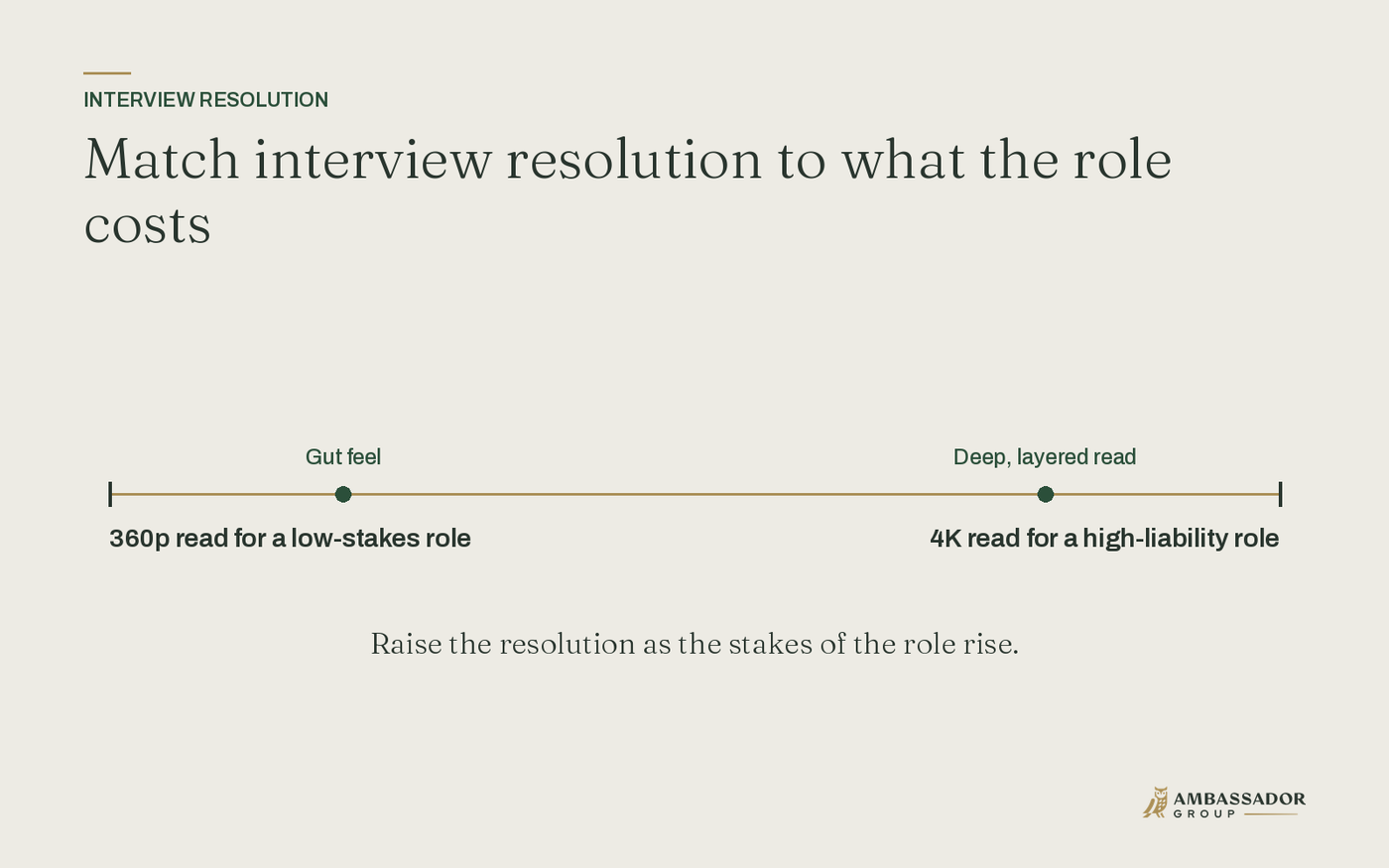
I have found one analogy more useful than any framework for this: think of interviewing in terms of resolution. Old internet video at 360p was blurry, washed out, good enough to recognize a face and nothing more. The same footage at 4K shows you the pores. Your interview process sits somewhere on that spectrum, and the question is whether the resolution matches what is at stake. For a role that touches millions in margin, schedule, and client trust, a blurry read is malpractice you will pay for later.
What you are underwriting
Before you design the interview, answer a plainer question: what do you need to know to be confident this hire is worth the investment? Most leaders have never written that answer down. They interview by habit, asking the same handful of questions they have always asked, then trust a gut feeling formed in the first ten minutes. That works at a gelato counter. It does not work when the person you are reading will own a project's profitability, set the tone for a field crew, and stand in front of your best client every week.
Fit is high-dimensional, and a low-resolution interview collapses it into one or two crude axes. Consider what you are testing for: fit to the leader, fit to the culture, fit to the client, fit to the problem this role solves, fit to the team they will run, and fit to the process they will live inside. A superintendent can be excellent on paper and still be wrong for a leader who manages loosely, a client who needs constant contact, or a team that has been burned by the last three hires. None of that surfaces in a 360p conversation built around "tell me about yourself."
A high-resolution interview is the difference between knowing someone can do the job and knowing they can do it here, for you, on this project, with this crew.
The flip side you keep forgetting
There is a second screen running the whole time, and most leaders never look at it. The person across the table is a full-grown adult, sovereign, free to choose. Your read on their fit to you means nothing if you are not a fit to them, because if they do not want what you are offering, they will leave regardless of how well they match the role. Bilateral assessment is the part of resolution that ego tends to blur. You are not the only one deciding. A strong candidate is interviewing your leadership, your pay, your project list, and your honesty as hard as you are interviewing their experience, and they will walk if the picture stays out of focus.
Raising resolution here means showing the role as it stands, including the parts that are hard. A candidate who chooses you with clear eyes about the difficult client or the messy process stays through the difficulty. A candidate sold a smooth version quits the first time reality contradicts the pitch.
How to raise the resolution
When you keep getting surprised by a hire after the fact, treat the surprise as data. The thing that broke six months in was a thing you did not know and did not test for, and it was probably knowable. Personality, real skill under pressure, how someone handles a schedule slipping out from under them: a lot of interviewing goes an inch deep and a mile wide, touching everything and confirming nothing. Find the few dimensions where you need to go a mile deep instead.
Going deep looks concrete. Bring in a job walk and watch how the candidate reads an active site. Build a test project or a takeoff scenario and see how they think when the answer is not obvious. Introduce them to the team they would lead and watch the chemistry, or the lack of it. Ask follow-up questions that do not stop at the first clean answer, the second and third "and then what happened" that move past the rehearsed story into the real one. Layer in assessments where personality and behavior carry real weight. Each of these adds resolution the single conversation cannot.
There is a fashionable argument that long interview processes are abusive, a waste of a candidate's time, a sign of a company that does not know what it wants. When a company truly does not know what it wants, that criticism is fair, and a vague, sprawling process punishes everyone. But for high-liability hiring, where the role will move millions and shape your culture, a serious process is what you owe your team, your clients, your family, and the candidate. Strong friendships are forged over time, not in one sitting, and you cannot fully know a person from a single conversation. Some of what you are reading is true about them in ways they have not yet seen themselves.
A serious process also filters for you. Candidates who want your mission lean in when they see how carefully you select, because the rigor signals that the work matters. The ones who only want a paycheck get repelled, and a few will complain online about how long it all took. Those people were never going to carry your mission, and their exit is the process doing its job. Set the expectation of a thorough process up front, then run a thorough one, and let the people who want what you are building reveal themselves by staying engaged.
Look at your last bad hire and ask what resolution would have caught it, then build that into the next interview before you need it.