You will pour weeks of energy into landing the offer and almost none into how you leave, and that imbalance costs people relationships they spend years rebuilding. I have witnessed somewhere around five hundred resignations, some sweet and some spicy, and roughly half are hard in some way. The resignation is where you prove that the match you made was an honest one, owned by both sides. You committed to a new company in good faith. Leaving the old one with respect is how you honor the people who invested in you, and how you keep your name worth something in an industry smaller than it looks.
Lead with respect and specific gratitude
When you resign, lean hard into respect and specific gratitude toward your teammates, your boss, and the company, even when you are leaving for a reason you are not happy about. Two things make this worth the discipline. First, the industry is small, and the people you are leaving may have a chance to work with you again. Their impression of you is an asset you carry forward, so make it a good one. Second, gratitude that is specific is the kind that lands. Name the real reasons people helped you and how it benefited you. Vague thanks evaporates. A precise account of what someone taught you or covered for you is something they remember.
Hold your criticism. You may have a genuine reason for leaving, and you may be right about it. But your boss did not come to work expecting a resignation, and when you hand one over, the first response is usually a quiet panic: there is work underway that needs you, and two weeks may not be enough to transition it. That is their problem to solve, but it means the moment is loaded with fear. Pile your grievances on top of that and human nature does not hear it. There may be a time down the road to share the feedback, or there may not. Either way, the resignation is not it.
Be clear in your own mind before you walk in
Get honest with yourself about why you are leaving and what you are building toward in your life. You do not owe anyone that justification, but you need it clear in your own head, because of what happens next.
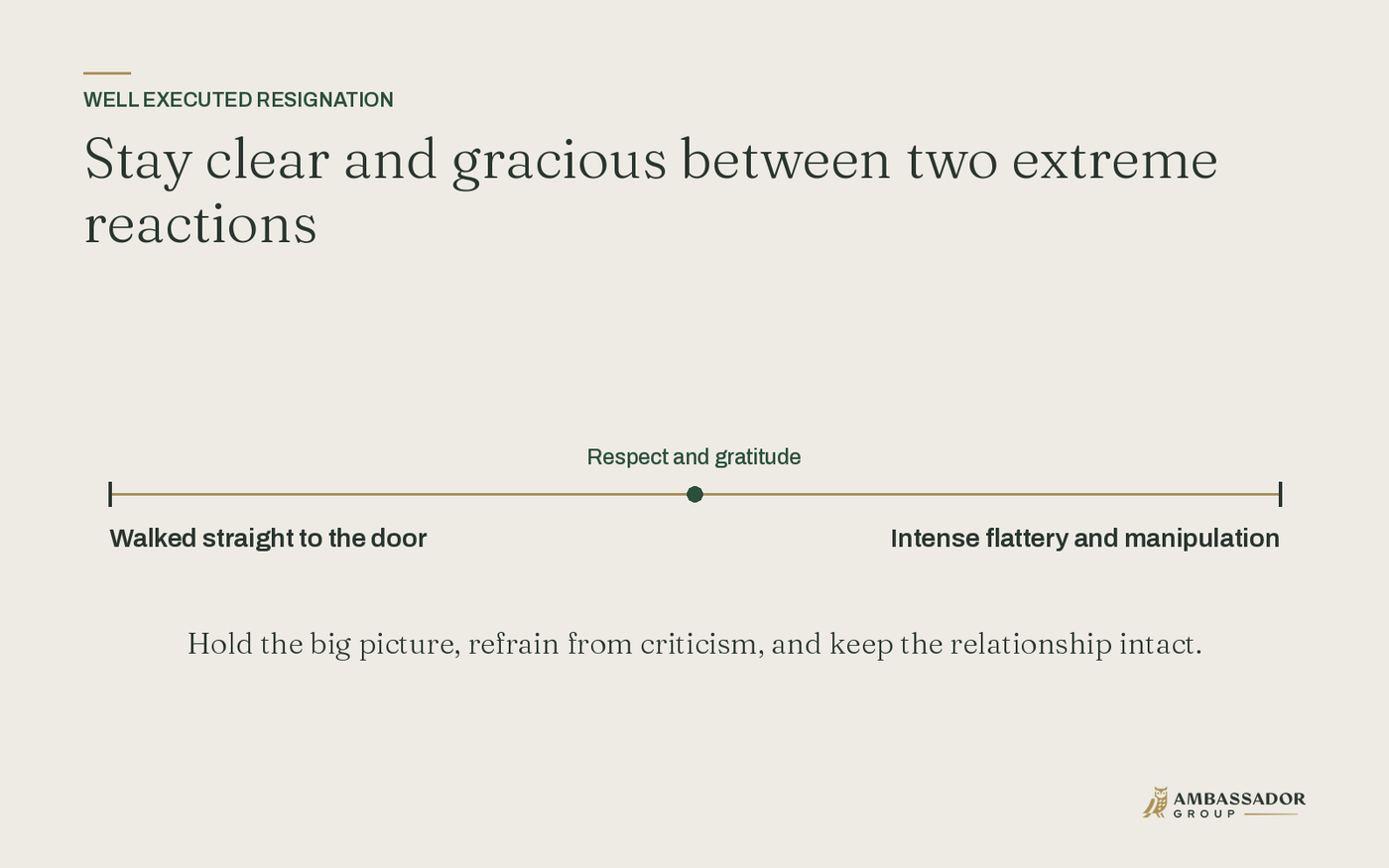
When you resign, the reaction tends to land somewhere on a spectrum. On one end, you get walked to the door. That is policy at a lot of companies, it is not personal, and it is still jarring after years of strong relationships. On the other end, you get flattery, and sometimes manipulation, because keeping you is worth a great deal to them right now. If your reasons for leaving are not clear and steady in your mind, that pressure can shake your resolve or be used against you.
A resignation is the last work you do for a company, and it is the work people remember longest.
This is why you write a letter of resignation that models the same gratitude, respect, and professionalism you would show in conversation. Say that your reasons are personal and about improving your life. You do not need to define them or say where you are going. Personal reasons are nearly impossible to argue with, and that is the point. No one can credibly tell you that you should not try to improve your life.
Handle the counteroffer with conviction
Then there is the counteroffer. I will not tell you that every counteroffer is bad or that you should categorically refuse one. I will tell you what I have seen: I have rarely watched a counteroffer turn into a lasting, good relationship. Most often they function as a bandage, sometimes a placebo, meant to resolve the situation in the company's favor and to move your departure to a timing that suits them. There may be situations where accepting one is right. The odds, in my experience, are poor enough to generally advise against it.
A counteroffer also costs you on the other side. The company that interviewed and negotiated with you in good faith was hoping you were their person. Use their time and goodwill as a bargaining chip and then back out, and they may resent it, fairly or not, even if pressuring them was never your intention. They invested real team hours believing in you. Disappointing them that way is a mark you do not want on a relationship you worked to build.
The way to avoid the whole bind is to be clear before you ever resign. Do your due diligence in the interview process. Get the questions answered, the offer understood, the fit tested, so that when you give notice you are operating from conviction, not from a number you can be talked out of. People waffle at this stage, because delivering bad news to people they like is genuinely uncomfortable. The reason you started interviewing, and the reason you accepted, should be fixed in your mind as you prepare to resign.
Protect your landing first
One practical safeguard: do not resign until you have a signed offer letter, a start date, and a team that is ready for you. It is rare and inadvisable for a company to do this, but I have seen a hire fall apart after someone already gave notice. Make sure your landing pad is firm and ready before you initiate anything. You are protecting the move you worked so hard to make.
Done well, a resignation does not damage relationships. It strengthens them. Your boss is disappointed but genuinely happy for you, handles it with class, and walks away respecting how you carried yourself. You keep the relationships, you keep your reputation, and you hold your head high. The same care a good company owes you, you owe it back, and the resignation is where you prove you meant it. How you leave is yours to author, so write it like the professional you are asking your next company to believe you are.