A short note after an interview is one of the cheapest, most overlooked moves a candidate can make, and it works precisely because so few people bother. I have watched over a thousand interviews at client companies, and a sincere thank you afterward remains surprisingly rare. When one arrives, it lands. A hiring leader reads it and revises their read of you upward, often without quite knowing why. That is worth understanding, because a good match is built on both sides carrying their half of the relationship honestly, and the note is one small place where you start carrying yours.
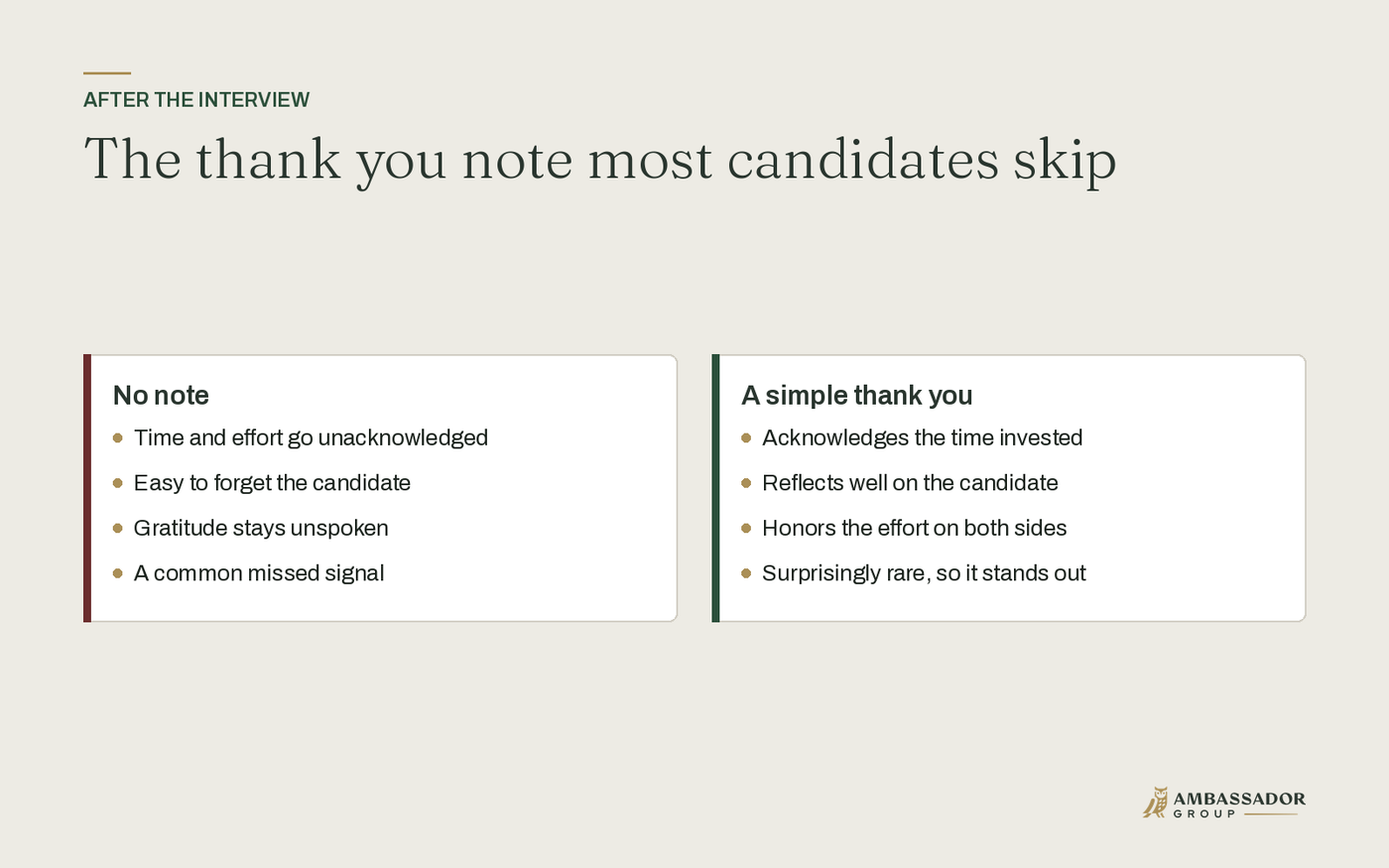
What the note signals
The interview is an exchange of investments. The company gave you time it could have spent building, and several people rearranged a day to sit with you and weigh whether their team and yours could work well together. You gave your time too. The thank you acknowledges that the exchange happened and that you noticed the cost on the other side. That awareness is the thing a hiring leader is quietly trying to measure the whole way through: does this person see past their own ambitions to the people they would be working with.
In construction that read matters more than in most fields, because the job is relational at its core. A superintendent who cannot acknowledge a subcontractor's time, a project manager who never thanks the field for a hard push, an estimator who treats the design team as an obstacle: those gaps show up as friction on every job. A leader interviewing you is looking for evidence of how you treat people when nothing is being demanded of you. A note sent after the decision is partly out of your hands is a clean piece of that evidence. No one made you write it.
The note is a small, honest act of regard, which is exactly why it reads as real.
Gratitude is information, not flattery
There is a way to write one of these that backfires, and it is the version that reads as a closing technique. Effusive praise, a hard pitch restated, a paragraph engineered to seem eager: a seasoned interviewer has seen all of it and discounts it on sight. The note that works is plain. Thank them for their time. Name the thing you genuinely found interesting, the part of the project, the challenge the team is wrestling with, the question that made you think. Keep it short enough that it reads as sincere rather than labored. If you have a real concern after the conversation, you can name that too, because honesty about fit serves both sides better than a performance of enthusiasm you do not feel.
This is where the bilateral nature of a good match becomes concrete. The company owes you candor about what the role demands and what it is like to work there. You owe the company an honest representation of yourself, and a thank you that names what genuinely drew you in is part of that honesty. If nothing drew you in, the absence of a note tells its own truth, and that is fine. A match that does not form cleanly is information both parties can use rather than a failure to paper over.
How to send one
Send it within a day, while the interview is fresh for both of you. Email is the right channel for most construction roles, because it reaches the person without intruding and gives them something to forward to the others who interviewed you. If you met with several people, a brief note to each, mentioning the specific thing each one covered, lands far better than one generic message copied around. The superintendent talked you through the schedule risk on the current project; the estimator pressed you on how you handle scope gaps. Reference what was said. That specificity is what separates a real note from a template, and a hiring leader can tell the difference instantly.
A few things to keep in mind as you write it:
- Thank them for the time, not for "the opportunity." The first is true; the second sounds like a form letter.
- Name one concrete thing from the conversation so they know you were present for it.
- Keep it to a few sentences. Length reads as effort to impress, not gratitude.
- If a question came up that you wanted to answer better, this is a fair place to add the thought you wished you had given.
- Send it whether or not you think you got the job. The point is the regard, never the advantage.
Why this is yours to own
The reason this small habit carries weight is that it is entirely within your control. You cannot control the budget the company is working with, the other candidates in the process, or whether the role turns out to be the right one. You can control whether the people who gave you their afternoon walk away knowing you valued it. That is the same instinct that will make you a person worth working with once you are inside a team, and it is the instinct a good hiring leader is hunting for the whole time.
A thank you note will not rescue a poor interview, and it should not be treated as a trick to tilt a decision. It is the first small installment on the respect a good working relationship runs on, paid before you know whether the relationship will form at all. Write the honest one, send it the next morning, and let it say something true about how you treat the people whose time you have spent.