The most dangerous part of looking for your next role is the looking itself. When you are already employed, every application is a small disclosure, and the open job board you scroll at night can quietly become a profile that tells the wrong people you have one foot out the door. Applying on Indeed creates a record that can be traced back to you. That is the trap that keeps strong construction professionals stuck: the people most worth recruiting are the ones with the most to lose by being seen searching. A good move depends on you representing yourself honestly to the right companies while staying invisible to the ones who should not know yet.
That tension is worth taking seriously, because a career move is a two-sided commitment. You own your half, and the company owns theirs. A durable match comes from both sides seeing each other clearly and choosing on purpose. You cannot make that kind of informed choice if the cost of being seen looking forces you to either stay put or expose yourself before you are ready.
Confidentiality is the precondition
For a superintendent, a project executive, or an estimator with a reputation in a regional market, exposure is not a minor risk. Word travels fast in construction. A current employer who learns you are interviewing can shift you off the good project, freeze your trajectory, or start treating you as a short-timer months before you would ever leave. The market is small enough that one careless application can reach a competitor, a former colleague, or your own boss.
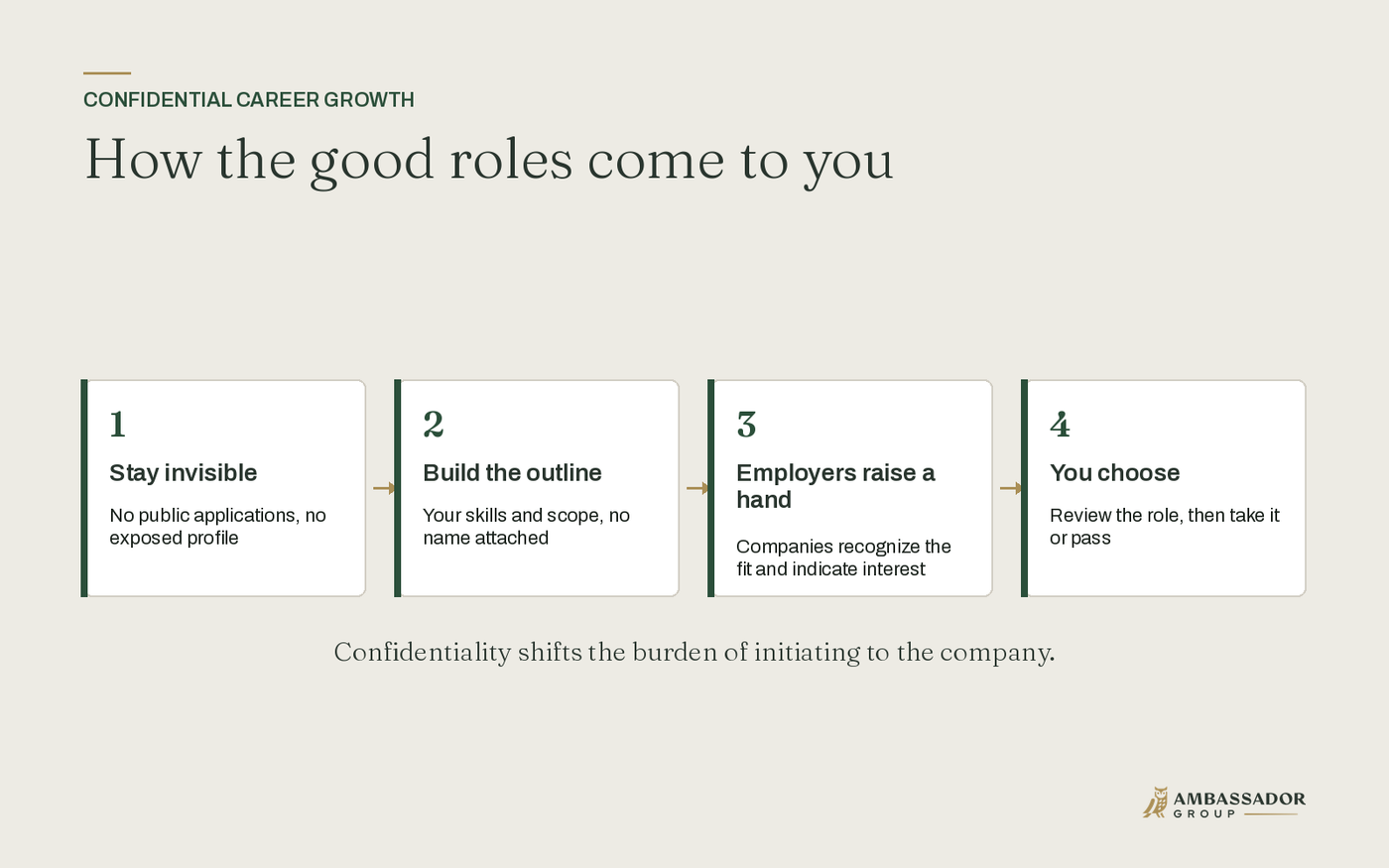
So the search has to protect you first. The way that works is straightforward. A confidential outline of your abilities, the kinds of problems you have solved, and the scope of projects you have run gets put in front of hiring authorities with nothing personally identifiable attached. It is a description of your skill, not your name. A company reads it, recognizes the shape of someone they need, and indicates interest. Only then do you decide whether to take the conversation or pass.
When confidentiality holds, the good roles come to you, and you keep the power of choosing instead of chasing.
That reversal matters more than it first appears. In an open search, you apply broadly and hope, and every application spends a little of your privacy. In a confidential one, the burden of initiating shifts to the company. You are not flooding the market with your resume. You are letting qualified employers raise their hand toward a candidate they already want to meet, and you are reviewing them with the same scrutiny they would bring to you.
Your half of the honest match
Confidentiality protects you, but it does not do your work for you. The outline only earns the right interest if it represents you accurately. This is where your obligation begins. Describe what you have genuinely owned on a job, not an inflated version that collapses in the first hard interview. Name the project sizes, the delivery methods, and the scope you genuinely carried. The companies worth joining are the ones that read that honest picture and want exactly the person it describes, and the only way to reach them is to be that person on paper.
The same honesty applies to what you want. A move that lasts is built on more than a bigger number. Think about the kind of work that holds your attention, the leadership you do your best work under, the commute and the travel you can sustain, and the trajectory you are reaching for. A company that knows those things about you can tell you early whether the role fits, which spares you the slow disappointment of a job that looked right and was not. When you are vague about your own goals, you invite a mismatch and call it bad luck.
A confidential channel exists so that good employers and serious professionals can find each other without either side gambling their standing to do it. You decide whether you belong in that channel by the standard you hold yourself to: a polite professional pursuing excellence in your work, experienced in some real facet of construction, and clear about the life you are trying to build. Meet that standard and the search stops being a risk you manage and becomes a set of choices you make on your own terms. The next move is yours to define, so define it before someone else defines it for you.