Starting a new role is a lot like jumping onto a fast-moving train. The train is the company already in motion, the projects mid-stream, the crews who already know each other's shorthand, the systems that were built before you arrived. Jumping on while it runs at full speed is difficult and sometimes dangerous, and it does not always go well. The fix is for the train to slow down long enough for you to get on, and part of making that happen is yours to own. A durable match depends on both sides, and your first ninety days are where you hold up your half.
One trap catches good hires more than any other. A company puts real effort into interviewing, decides you are strong, and concludes you will hit the ground running. The assumption feels like a compliment. The cost of it is that the train never slows down. Onboarding gets skipped because everyone is confident it will not be needed, and you are left sprinting alongside a company moving a hundred miles an hour, trying to leap aboard without anyone easing off the throttle. The better the interview went, the more likely this is to happen to you.
Onboarding is built for one person at a time
There is no single onboarding process that fits everyone, because you are not arriving the way the last hire arrived. You bring a particular history, a specific set of strengths, gaps the company has not seen yet, and your own expectations about how the work should go. A role is a puzzle piece, and the fit only holds when the edges are read accurately on both sides. What you needed in your last position to get up to speed may be nothing like what you need here, and the company cannot tailor the climb if you stay quiet about where the footing is loose.
This is why your voice in the first months matters more than you might assume. The company is not a mind reader. It knows the projects and the systems cold, and it knows almost nothing yet about how you learn, where you feel behind, or which tool or relationship would unlock the next gear for you. When that information stays in your head, the company keeps onboarding a stranger it has imagined instead of the person who showed up.
The company knows its train. Only you know what you need to climb aboard it, and that knowledge is worthless until you say it out loud.
What the check-ins are for
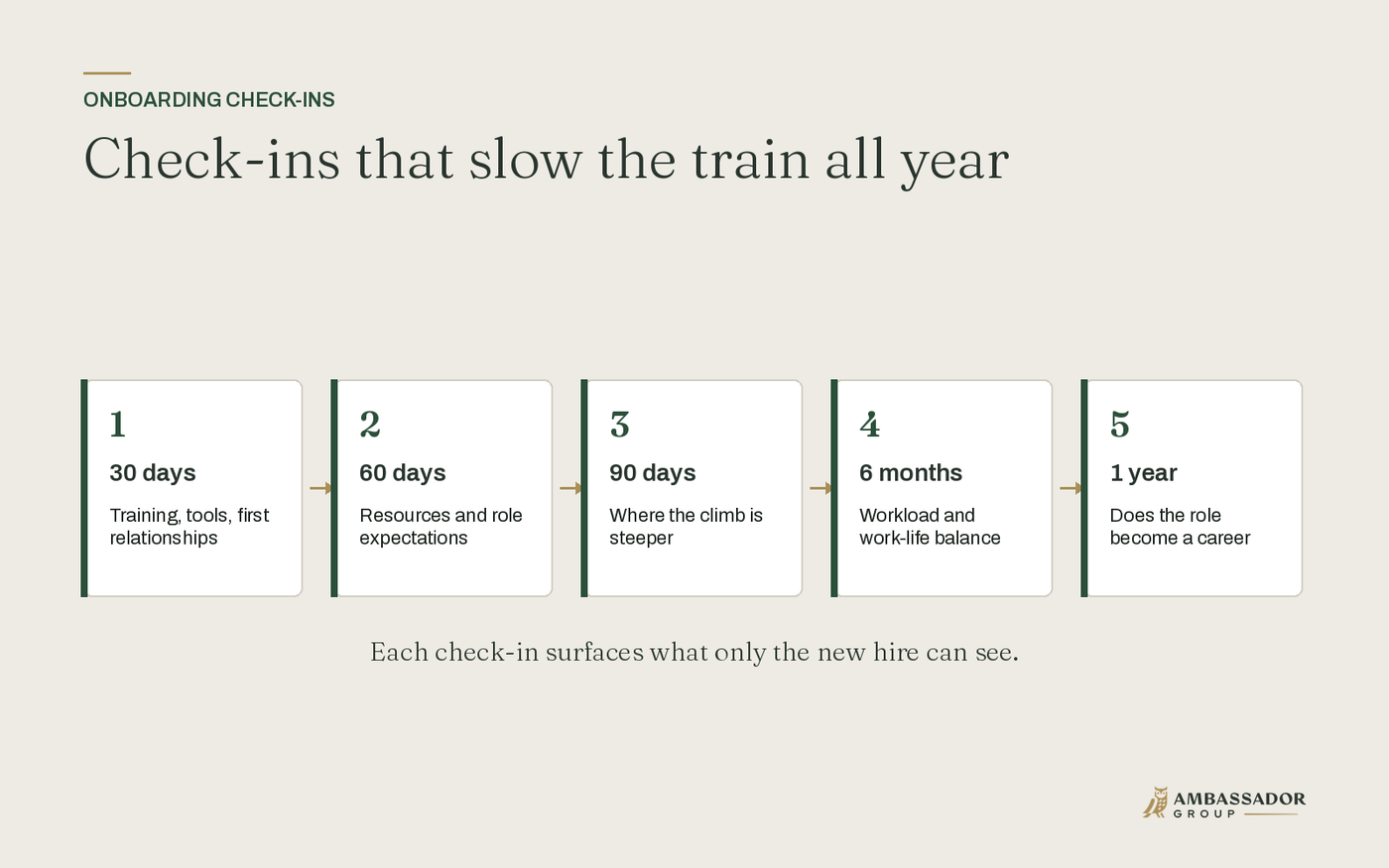
To keep the train at a manageable speed, structured check-ins run across your first year: around the thirty, sixty, and ninety-day marks, then again at six months and a year. They cover the things that quietly decide whether a start succeeds: your training, the tools and software you have been handed, the resources you still need, the relationships you are building, the expectations attached to your role, and the balance between the work and the rest of your life. None of those is a small detail. Each one is a place where a strong hire stalls when nobody asks.
These conversations work as a feedback mechanism aimed at the onboarding process. The point is to surface what is working so the company can keep doing it, and to name what could be smoother so the company can adjust while the adjustment still helps you. They are not a performance review, and they are not a back channel for grievances. Onboarding rarely gets the credit it deserves, because when it goes well it feels like nothing happened. Naming what is going right is part of the work, since a company that cannot see its own good onboarding tends to stop investing in it.
One ground rule protects you. Keep anything confidential out of these check-ins. If you have a real issue with the company that has to be handled by the company, take it to your boss directly, the way any professional dispute should be handled. The check-ins exist to improve the onboarding process itself, and they work best when they stay in that lane.
Your half of an honest match
You also get to see the feedback before the company does. Whatever gets reflected back to the firm about your start, you review first, so you can confirm it represents you accurately and there are no surprises or misunderstandings. Nothing about your experience gets characterized for the company that you have not already said yourself. That design exists to protect the honesty the whole match is built on, and it only works if you engage with it plainly rather than offering the polite version of how things are going.
So treat the first ninety days as active work to engage with rather than a probationary stretch to survive quietly. When the operations contact reaches out to schedule a check-in, come with specifics: the part of the training that left a gap, the software nobody walked you through, the relationship you have not had time to build, the expectation that turned out to be fuzzier than it sounded in the interview. Naming those things is professional candor, and it supplies the only information that lets the company slow the train at the exact spot where you need it slowed.
The interview earned you the role. The onboarding decides whether the role becomes a career, and that outcome rests as much on your candor as on the company's effort. You committed to this company with open eyes, and the company committed to you the same way; the first ninety days are where both sides prove the commitment was real. Say what you need while saying it still changes the climb, and you turn a hard jump onto a moving train into a start you can stand on.