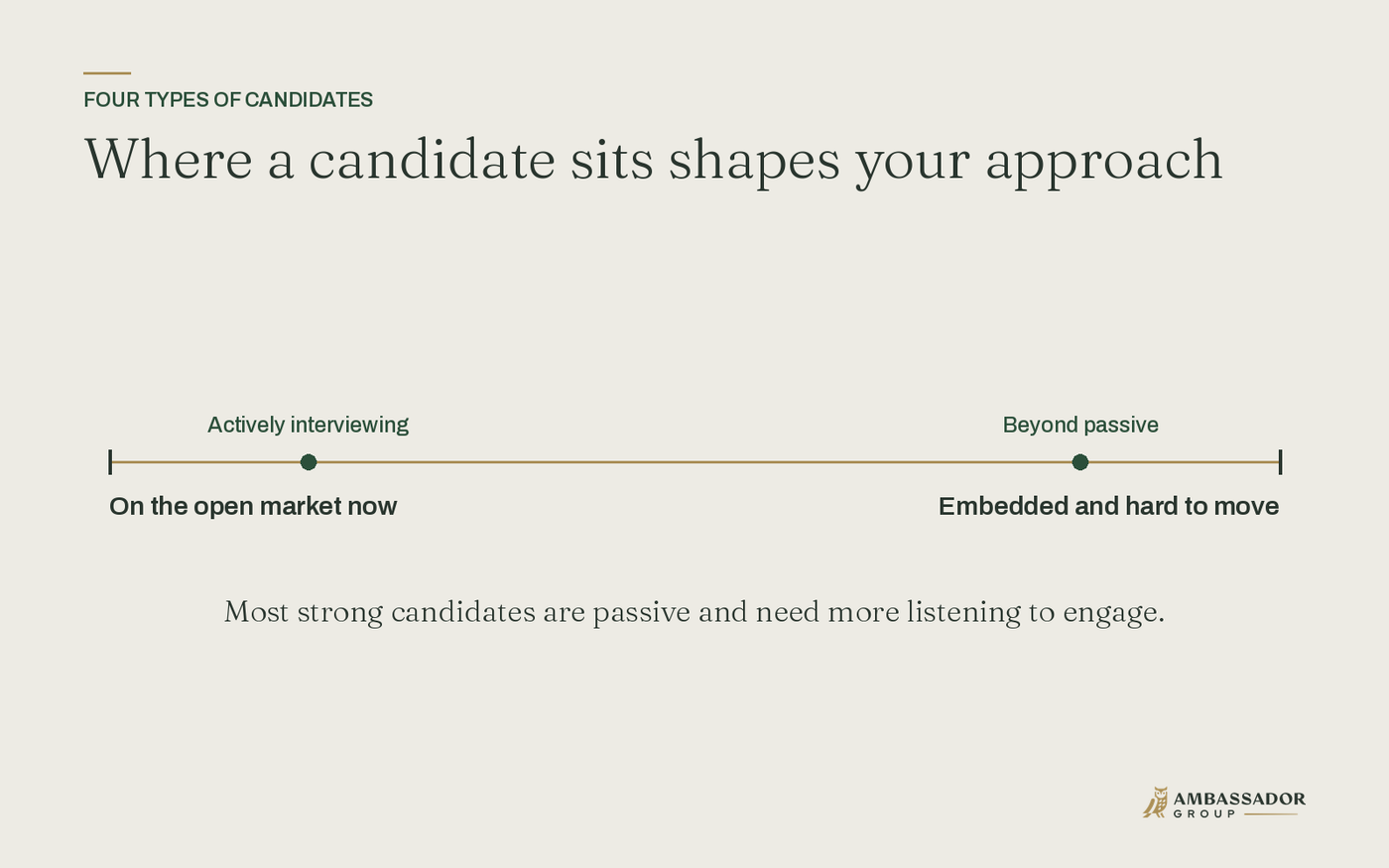
The best person for your next leadership role is probably not reading job postings. They are running a project right now, doing it well, and have given no thought to leaving. That single fact reshapes how a hire has to work, because the strongest candidates rarely arrive through the front door of an open search. A leader who understands this stops measuring talent by who happens to be available and starts measuring by who is genuinely the right fit, which is the same discipline that separates a thoughtful hire from a desperate one. The four categories below describe where a candidate sits on the spectrum from open to embedded, and each one demands a different posture from the person doing the hiring.
Actively interviewing
The first category is the person already on the open market. They carry a career wound or a specific pain, and they are interviewing elsewhere right now. The temptation is to discount them, since availability can read as a signal that something is off. That read is lazy. A capable person can be on the market for reasons that have nothing to do with their ability: a company that sold, a project that wound down, a leader who left and took the culture with him. What you offer may be precisely what they are looking for, and meeting them is often a sound use of an hour. The work here is to understand the pain that put them in motion and to test whether your role resolves it or repeats it.
Open but not active yet
The second category has the same career pain but has not started interviewing. The emphasis belongs on yet, because nothing stops them from applying somewhere tomorrow. For now you have the jump. That advantage is real and it is perishable. The posture it calls for is to be timely, relational, and confidential, because you are talking to someone who has not yet decided to look and may not want their current situation disturbed. Move too slowly and the window closes when they start fielding other conversations. Move without discretion and you put their standing at risk. The leader who treats this candidate with care, and with speed, converts a head start into a hire before the field gets crowded.
Passive
The third category is the largest, and it is where most durable matches come from. A passive candidate carries no obvious wound and feels no pressure to leave. They are open to something better if it presents itself. A great deal of high-quality talent lives here, doing good work and not advertising any intention to move. That changes the relationship entirely.
A passive candidate will not come to you asking for a job, and they will not move for a vague reason. They require more listening, more patience, and a genuine effort to understand what would improve their life. This is a bilateral relationship that has to be built, not a transaction to be closed. The candidate owns their half of the decision and is under no obligation to perform interest they do not feel. They will make a move only when they are convinced your role is clearly superior to what they already have.
A passive candidate is deciding whether your opportunity is better than a job they are content to keep, and that decision belongs to them.
For a leader, the shift is one of expectation. The investment a passive candidate brings early is lighter than what an active interviewer brings, and reading that as disinterest is a mistake. They are protecting time and standing they have no urgent reason to spend. The way you earn their attention is by understanding their motivations and showing, concretely, how the role serves them. Make it good for the person, and the rest follows: they want to come, they want to stay, and they are easier to retain because the move was theirs as much as yours.
Beyond passive
The fourth category is small and stands apart. These people are embedded. They have been at their company for decades, they hold senior roles, they have equity and compensation plans built to keep them, and they are tied to the organization tightly enough that most observers would call them inextricable. Under normal circumstances they are. The reason they are worth a conversation is that something about your specific role has caught their attention. They are listening, even if they have not articulated to themselves why a change might appeal.
A beyond-passive candidate may never have framed their own openness in words, but they will take a networking conversation, and they will tell you what is out there and what is missing. Meeting them is worth the time even if it goes no further, because the relationship and the understanding outlast any single search. The same question governs this category as governs all of them: what are this person's motivations, and how would your role improve their life. The deeper they are embedded, the more your answer has to be both specific and true.
The common thread
Across all four categories, the question that matters never changes. What moves this person, and how does your role make their life better. The categories describe how much momentum a candidate already has toward a change, and that momentum dictates your pace and your approach, but it never replaces the underlying work of understanding the human being in front of you.
A leader who learns to read where a candidate sits on this spectrum stops being held hostage by who is available and starts pursuing who is right. The active interviewer needs you to resolve a real pain. The open-but-not-active candidate needs you to be fast and discreet. The passive candidate needs you to build something genuine and to prove the role is better. The beyond-passive candidate needs a reason worth disturbing a comfortable life. Each posture is a form of respect for where the person genuinely stands, and respect is what makes the match hold once the offer is signed. You decide how well you read the table, and that read shapes every hire you make.