Hiring rarely improves by accident. Most owners run dozens of searches over a career and end up no better at it than when they started, because nothing in the process is set up to teach them. The work stays a gamble: stressful, expensive, and random enough that plenty of capable owners decide to cap the company's size rather than face more of it. That ceiling is rarely a market problem. It is a leadership problem wearing a market costume, because a leader who cannot see why his hires fail cannot see the candidates in front of him clearly enough to choose well. Two changes break the pattern, and both put the accountability where it belongs.
The first is to collect data on the process. The second is to hold leaders accountable for the people they hire, and to keep holding them accountable when those people leave. Neither is glamorous. Together they convert hiring from a roll of the dice into a craft you can get better at.
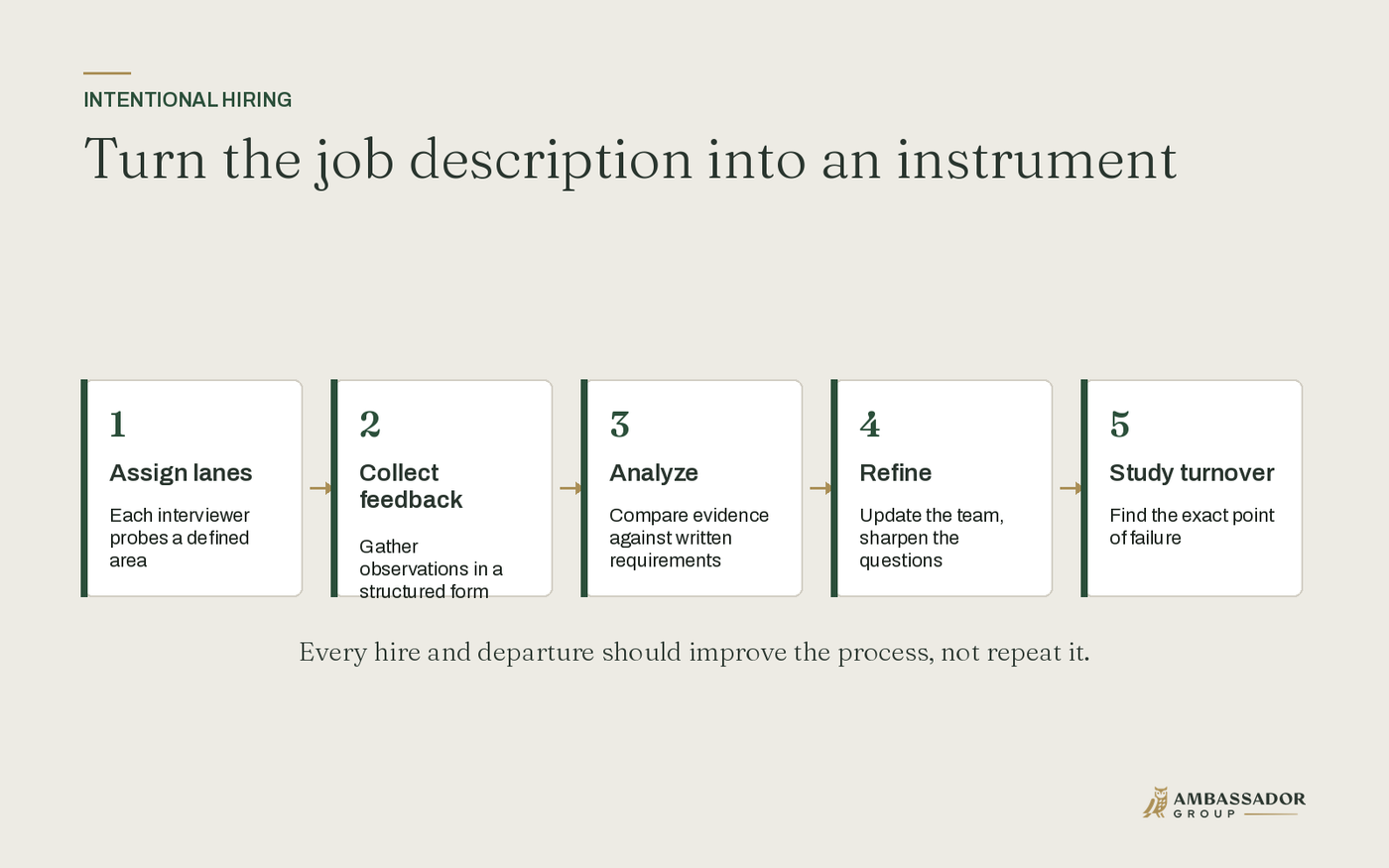
Turn the job description into an instrument
Hiring stays random when the interview is improvised. The fix is to make the job description do real work. Assign interview lanes so each person probes a defined area. Collect their feedback in a structured form. Analyze it against the requirements you wrote down. Update the team, then refine the questions for the next candidate. The job description stops being a posting and becomes an instrument you interview against, which means you finish each search holding evidence instead of an impression.
That data keeps paying out after the offer. In onboarding, you already know where the gaps were, so you can aim leadership energy precisely at closing them and stay close to the new person while the bond is forming. Retention is a plan you built from what the interview taught you, tracked across the first year while the relationship sets.
When someone leaves, tear the engine apart
Turnover is the most expensive teacher you will ever ignore. The reflex is to label it and move on: it was not a fit, so you try again. A doctor who told you only that you were sick, with no symptom and no cause, would lose your trust in a sentence. Treat a departure the same way you would treat a failed pour. Pull the engine apart and find the exact point of failure: the expectation that was never set, the skill that was never validated, the value that never got pressure-tested.
Every hire and every instance of turnover should massively improve your hiring process, or you are paying full price for a lesson you refuse to learn.
This is where leader accountability earns its place. It is common to see a shop with troubled leadership churn through people and then blame the people for churning. Sometimes there is truth in the complaint. Often the truth sits in the middle, and the only way to find it is to study the data rather than defend the narrative. A leader responsible for the success of his people will look at his own contribution to a departure before he looks for the exit interview that lets him off the hook.
Experience is not the same as interviewing skill
One trap deserves its own warning. A leader can be a seasoned expert in construction, in a particular kind of construction, and still be a weak interviewer. That is not a criticism of his character. Deep, multi-layered, investigative interviewing is a separate discipline, and being a great builder does not confer it. The most common failure that follows is believing the candidate instead of validating the skill.
Watch how this plays out. A candidate says he is a strong project manager. He means it; for his definition of the role, he is telling the truth. His concept of the job and the hiring authority's concept differ by a wide margin, and because nobody validated the difference, both walk away satisfied and surprised six months later. They talked right past each other and never knew it. Validating a skill means watching the person do a version of the work, or walking through real scenarios until the definitions line up, not nodding along to a confident answer.
The reason all of this matters is respect. A candidate changing roles is trying to improve his life, and he is doing it with far less information than you hold about your own organization. He does not deserve the chaos of a mishire that better diligence would have caught. You will never make the process flawless, because it is a human process and humans do not reduce to a formula. But you can keep closing the gap, search after search, until the gamble starts to feel like a craft. Hold your leaders accountable, keep the data honestly, and the next hire becomes a decision you can stand behind rather than one you hope works out.