A superintendent who ran twenty-million-dollar custom homes for a respected builder can join another respected builder doing the same dollar value and fail inside a year. Both firms were healthy. The man was good at his job. The resume matched the opening on every visible axis. What killed the hire was the gap between two unstandardized companies that both assumed their way of building was the way of building. A leader who cannot see how idiosyncratic his own operation is will keep mistaking a title for a skill set, and a leader who cannot see himself clearly cannot read the person across the table.
The trap is the word "standardization," and how much of it an industry truly has. Highway construction is close to a solved problem. The engineering is mature, the process has been refined for a century, and success in the field is largely a matter of executing a well-established method correctly. When one highway builder hires from another, the standardization of the industry absorbs a great deal of the risk. The two firms do the work in recognizably similar ways, so prior experience transfers with reasonable confidence. Finance behaves the same way, hemmed in by regulation and narrow operating norms.
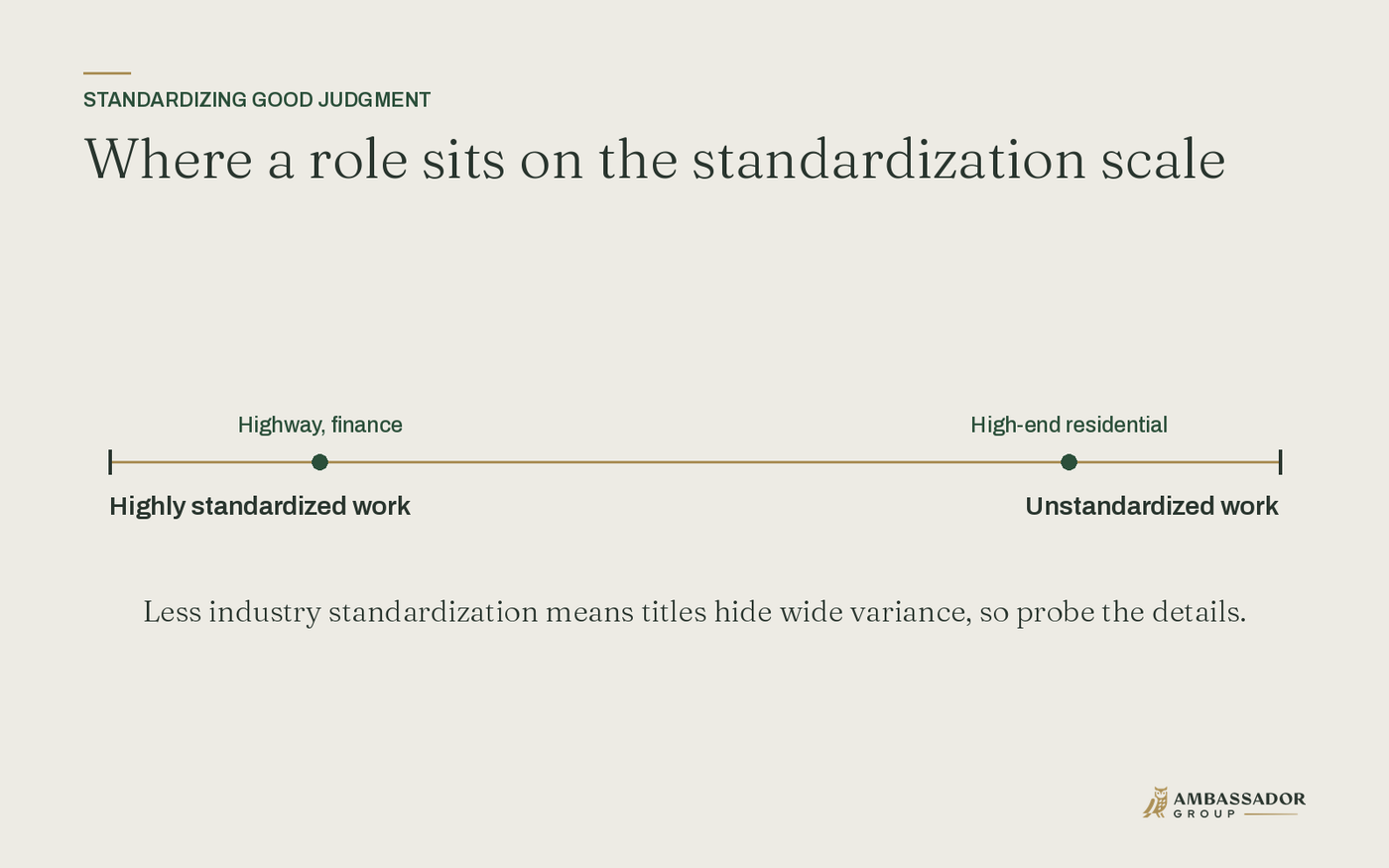
Large custom residential is barely standardized at all
Now look at large custom residential, the ten-million-to-one-hundred-million range where the homes start to rival commercial projects in scale and complexity. The end product might look similar from firm to firm, but the path to it diverges almost completely. How a company estimates, how it structures contracts, how its superintendents run a site, how it manages change orders and RFIs and the owner-architect-contractor relationship: all of it varies widely, because none of it is constrained by a state spec or a federal standard. The work is, by its nature, an exercise in pushing past what is normal. Each firm builds its own normal.
This is why titles deceive. A foreman at one company carries the authority of a superintendent at another. A project manager here owns scope that an APM owns there. When that title lands on a resume, the unwary leader reads years of experience and a list of impressive projects and fills in the rest with assumption. The candidate did build the same kind of home. He did carry the same job title. The fit, though, lives in the details nobody examined: what he believes about how to work with subs, how he handles a schedule under pressure, where he draws the line between protecting the relationship and protecting the margin.
When the industry will not standardize the work for you, the burden of standardization falls on the interview, and most interviews are not built to carry it.
Standardize what you can see, then test against it
The fix begins inside your own company, with the slow work of self-awareness. You cannot interview against a standard you have never articulated. So define your own operation before you try to assess anyone else's fit to it. Name what your project management process truly is. Name how your superintendents run a site, how you schedule, how you price change orders, how you handle an RFI. Then go a layer deeper and name why, because the process always traces back to a conviction. What do you believe is good risk management in construction? How much do you compromise, and on what? What is the place of value, of service, of conviction from which all those choices extend?
This is harder than it sounds, and it is genuinely a problem of perspective. Most leaders study their own operation up close for years and rarely get a clear view of how anyone else runs the same job. That myopia is dangerous in an interview, because the leader who has only ever seen one way of building treats his way as the obvious way and expects a seasoned candidate to share defaults the candidate has never held. Having seen inside hundreds of construction companies, I can report plainly that there is no single way to estimate, to schedule, or to lead a field team. There are many functional ways, and capable people are shaped by whichever one raised them.
So once you can describe your own operation, interview against it on purpose. The resume gets a candidate to the conversation; it does not finish it. Get into the details. Ask what the person was responsible for in concrete terms, over what period, on which projects. Ask about the hard decisions and the failed jobs, never the highlight reel. Ask why five times in a row until you reach the belief underneath the behavior. Ask what he thinks about OAC meetings, about client communication, about working with architects, about how he handles a change order when the owner is upset and the schedule is slipping. You are not checking whether he has done the work. You are checking whether the mindset behind his work will translate into yours.
Get past the veneer or you learn nothing
None of this works while both people are still performing. Early in an interview everyone is managing an impression. The candidate wants the role, fears the judgment, and carries the ordinary insecurity of being evaluated by a stranger he is not yet sure he can trust. As long as that veneer holds, the answers stay polished and useless. The interviewer's job is to dismantle it fast, to make the conversation safe enough that the candidate stops auditioning and starts comparing notes honestly. That requires a posture most interviewers resist: curiosity over authority, collaboration over interrogation. A hiring leader who runs the conversation as a hierarchy will get performance. One who runs it as a genuine exchange will get the truth, and the truth is the only thing worth assessing.
A senior field or office hire in this space is a million-dollar decision. It moves project financials, company morale, and your reputation with the clients you most want to keep. The way to take risk out of a decision that large is to know as much as possible about the person, and to make sure the person knows as much as possible about what he is walking into. That is informed commitment, and it only forms when both sides have dropped the act.
So before your next interview, do the unglamorous work first: write down how your company operates in practice and why, in enough detail that a stranger could test against it. The clarity you build in yourself becomes the standard you can finally hold a candidate to.