The most dangerous interviewer in a construction company is the one who has done the job for twenty years and has never been taught to interview for it. Tenure gets mistaken for qualification, and the company hands a million-dollar judgment to someone running on a gut feeling they have never had to defend. A leader who cannot see his own blind spots cannot train them out of the people he sends into the conversation, and an interviewer who cannot see a candidate clearly will hire the wrong one with total confidence. Interviewing is a skill, and like every skill in the field, it is built through reps and feedback, not absorbed by watching from the trailer.
When leaders ask how to bring new interviewers along, the instinct is reasonable: put them in interviews and let them learn. As a baseline that is not a terrible call. But left there, the new interviewer learns the wrong lesson. They learn that interviewing is a vibe check, a read on whether they liked the person, because no one ever gave them a sharper job to do.
Give them a narrow job to do
The decision an interviewer is making lives below the level of the hire-or-pass call. That question is too large to think about well, and an interviewer aimed at it will default to instinct every time. The real job is narrower and harder: hold the requirements of the role in high resolution, then look for the specific skills, character, judgment, emotional intelligence, intellectual capacity, and experience that would let this person solve the company's problem the way the company needs it solved.
That distinction is where most poor hiring decisions are born. An interviewer thinking at the macro level gets a feeling and calls it confidence. Some people are better at this than others, but I have never seen instinct alone hold up as a reliable way to make decisions this expensive. The details are where the truth lives, and a new interviewer has to be pointed at them deliberately.
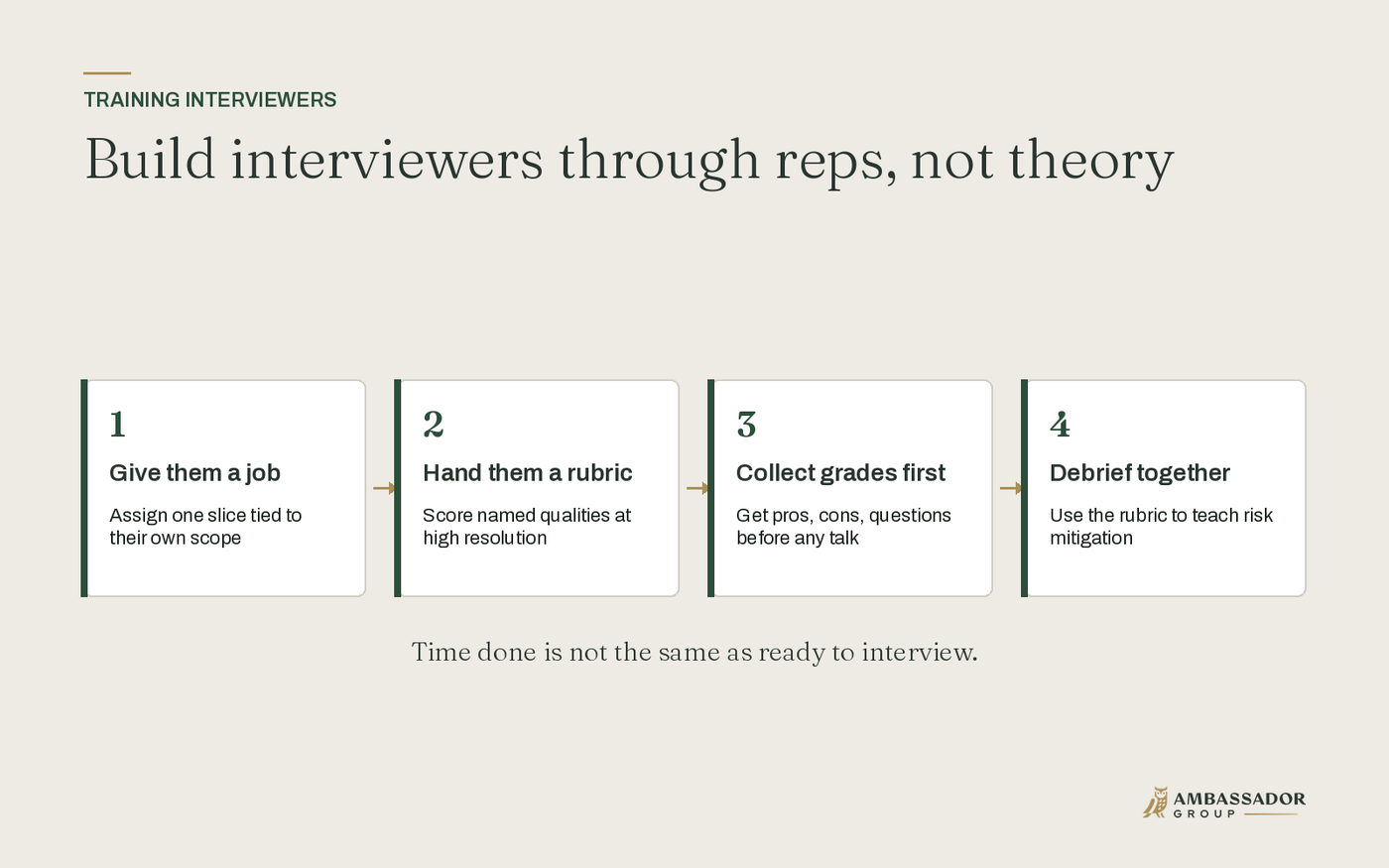
So give the new interviewer a piece of the problem, and make it a piece they already know cold. If you are training a project manager or a superintendent, hand them a slice of the evaluation that sits inside their own scope. Someone who lives in schedules should be assessing how the candidate thinks about schedules, how they sequence a build, how they protect float, how they set expectations when a date is slipping. Someone who owns change orders should be probing how the candidate handles a change order under pressure. One variable, evaluated with real depth, teaches more than a whole interview evaluated with none.
An interviewer aimed at the whole hiring decision falls back on instinct; an interviewer handed one piece of the job in high resolution learns to see.
Make the standard visible before the conversation starts
Before the new interviewer walks in, give them a debrief template and a rubric. The rubric is the thing that tells them what qualities to watch for and the level of precision to watch for them at. It turns a vague impression into a set of observations they can defend in detail, and it teaches the habit of thinking in detail rather than in feeling.
Then ask for that rubric back before you debrief together. This sequence matters. Get their read on the candidate's qualification level, the pros and cons, what they liked, what they did not, the questions that surfaced, all of it written down before the conversation pulls toward your opinion. An interviewer who commits to a judgment in writing, then hears the group discussion, learns where their read was sharp and where it drifted. An interviewer who only ever talks after the senior voice in the conversation has spoken learns to nod.
Run that loop enough times and you are building something specific: an interviewer who understands what risk mitigation looks like inside this role, at this company, under this leadership. That is the actual product of training, and it does not arrive by osmosis.
Tenure is not a license
One of the most expensive assumptions in hiring is that long experience in a role makes someone qualified to interview for it. It does not, and treating it as if it does is dangerous. It is the same faulty logic as "I have been driving for thirty years, so I must be a great driver." There are young drivers who are precise and careful, and there are veterans who are frightening behind the wheel. Time at the task is not the same as skill at the task, and interviewing is no exception.
A superintendent who is excellent in the field may carry blind spots straight into the interview: a bias toward people who remind him of himself, an ear that warms to confidence and misses competence, a tendency to sell the role instead of testing the fit. Those blind spots do not announce themselves. They get exposed only when the interviewer is given a structured job, a rubric, and a feedback loop that forces the read into the open where it can be examined.
This is why the leader's own self-awareness sets the ceiling. You cannot train an interviewer to see what you have never learned to see yourself. If you have never named what good judgment looks like in your shop, you cannot hand that definition to the people interviewing on your behalf, and every one of them will quietly substitute their own. The work of becoming a clear interviewer and the work of becoming a clear leader are the same work, run on two people at once.
Before you send your next interviewer into a conversation, decide what one piece of the role you are asking them to evaluate, write down what strong and weak answers look like, and ask for their read before you give yours. The quality of every hire downstream depends on whether you trained an evaluator or only added another witness.