The most expensive assumption in hiring is that someone who is excellent at the job is therefore qualified to evaluate others doing it. The two skills are unrelated. A leader who cannot see the difference between performing well and assessing well will staff his interview team with his best people and still hire badly, because evaluating a candidate is a discipline of its own, and it has to be taught. Hiring is where a company's judgment becomes visible, and a team that has never learned to interview puts that judgment in the hands of people who are guessing with confidence.
I have watched seasoned professionals walk into an interview and come out having learned almost nothing useful. They liked the person. They indexed on warmth, on a shared rapport, on the comfortable sense that someone could do the job because they spoke the language. Likability is real, and it matters, but mistaken for competence it becomes a trap. The fix is building a process that makes ordinary, busy people accountable for the quality of what they learn.
A good interview is the start of a working relationship
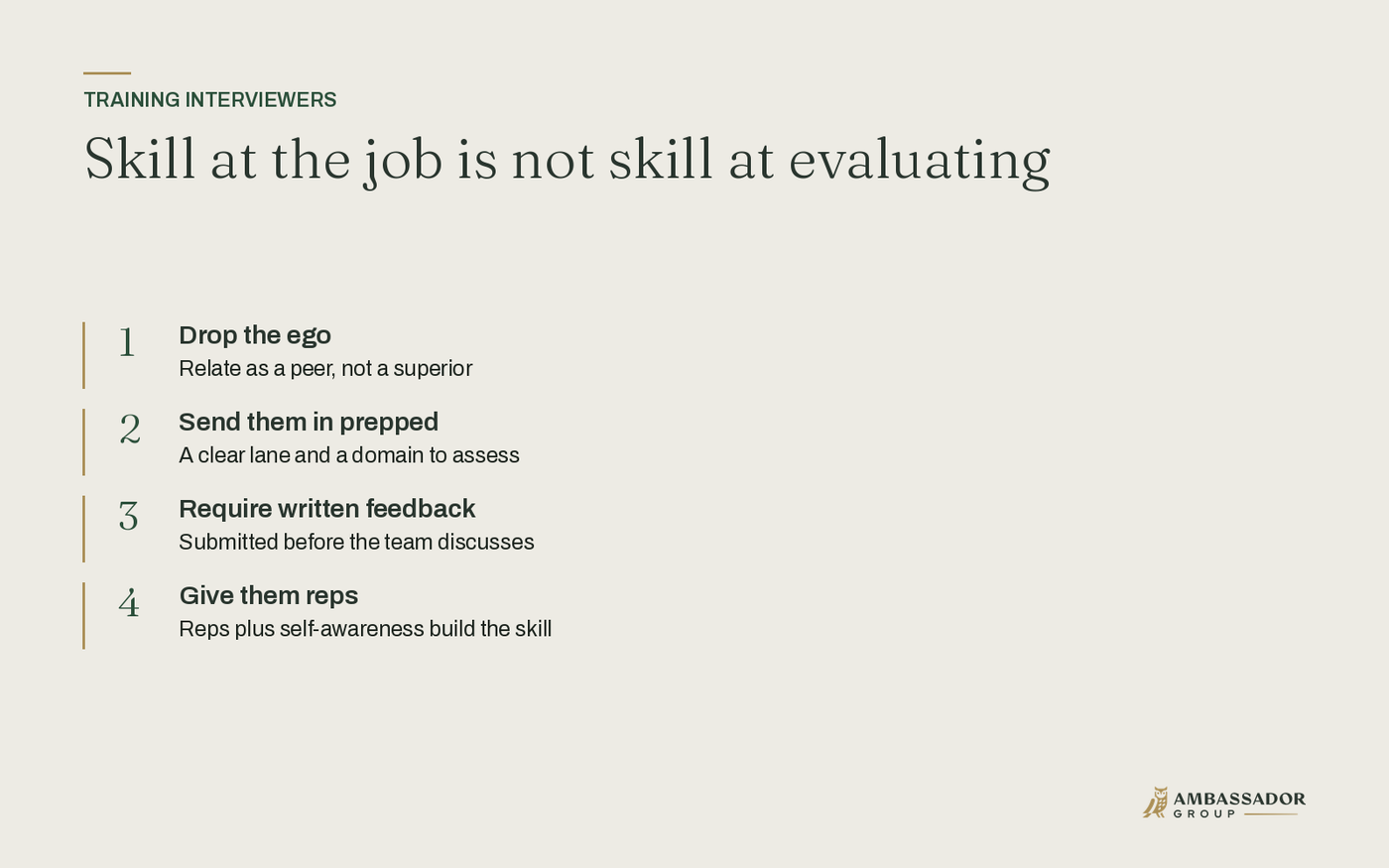
New interviewers often see the role as hierarchical: they are the judge, the candidate is on trial. That posture produces a stilted conversation and thin information. High-quality employment, the kind marked by long tenure, real performance, and people who want to keep working together, depends on the same things friendship depends on. Trust. Respect. The wish to be around each other. An interviewer is closer to a curious, slightly skeptical peer than a superior, and the candidate opens up accordingly.
That reframe takes the ego out of the interview, which is the precondition for everything else. There is no single correct way to run one. Some people frame the conversation and move straight into hard questions; others warm up first. Neither is wrong, and the worst outcome is forcing an interviewer into a style that is not theirs, because candidates can feel the performance. Helping someone find their own approach starts with their self-awareness: who they are, what they notice, what they care about. An interviewer who knows their own defaults can correct for them. One who does not will read every candidate through their own preferences and call it instinct.
Make people accountable for the insight they bring back
The second failure is information quality. Untrained interviewers ask closed questions that earn a yes or a no, skip the follow-up where the real answer lives, and leave with impressions instead of evidence. The repair is structural. Send each interviewer in with a brief: here is the candidate, here is what the process has already covered, here is what still needs to be discovered, and here is your specific job in this conversation. Guard rails matter. A shared passion for snowboarding is not the assignment. Whether this person can do the work, will do it, will enjoy it, and will fit the team is the assignment.
Give each interviewer a domain they own. Put a project engineer in a superintendent interview and have them probe the area they live in: RFIs, submittals, change orders, plan updates, the way the candidate handles the field tools in practice. They become the expert on that slice of fit, responsible for it, rather than wandering toward a vague verdict on the whole person. The instruction you never want to give is "tell me what you thought of them." That question has no edges, and it produces nothing you can act on.
An interview team that does not make itself accountable for real insight is underwriting a hire on faith and calling it judgment.
Then require written evaluation before the group talks, against a rubric everyone saw going in. This is not a pop quiz; people should know what they are being asked to assess. Writing it down first does two things. It forces each interviewer to commit to a position before the group can pull them toward consensus, and it makes them accountable for the quality of their own observation. The difference is the same as a class with a test versus one without. When people know their notes will be read, they pay attention on an entirely different level.
Lanes, records, and the long memory of a good process
A strong interview strategy has roles and assignments, exactly like a well-run project. Picture a four-person team as four lanes on a highway. Without markers for who covers what, you get people swerving across each other, repeating questions, confusing the candidate, and leaving whole stretches of the road unexamined. Those gaps are the blind spots you discover months later when the hire is struggling in an area no one thought to probe, and the cost of that discovery runs into real money.
The written record pays off again after the hire. Months in, the team can compare how the candidate showed up in the interview against how they perform once the work is real. That continuity is where blind spots become visible: I never followed up on that answer, I assumed alignment I never checked, I missed the thing that is now causing friction. Teams that keep no record have blind spots too. They cannot locate them, so the accountability for every mistake slides onto the candidate, who is declared to be "not who they said they were," and the cycle runs again unbroken.
What this builds, and where it leads
Run the process honestly, in your own firm and not only for the candidates you assess, and it trains itself forward. A new interviewer with a lane, a brief, and a written evaluation gets reps. They watch more experienced colleagues catch things they missed and absorb the heuristic. Most companies do not hire every week, so reps are scarce, which makes structure matter more, not less. Give your interviewers the same personality assessments you give candidates and put them on the same path of self-awareness. People who understand their own wiring evaluate other people's wiring far better.
When seasoned staff push back on writing feedback, and some will, explain why it exists, then hold the line. If someone refuses, keep them out of the interview. An unaccountable interviewer brings little signal and a great deal of risk to a decision where, in a few hours, you may hand a person hundreds of thousands of dollars of liability. The interviewers who take the discipline seriously become the ones who, when a hire does not work out, look first at their own notes rather than at the candidate. That habit, the willingness to read a failed hire as partly a failure of your own process, is the thing that compounds.
Many companies stay small because they cannot grow their interviewing skill, which means the owner can never trust the team to assess fit without him in the conversation. Building that skill is how delegation becomes safe and how growth stops depending on one person's gut. Look at how your team interviews today, ask who owns which lane and who writes anything down, and you will know exactly how much of your hiring is judgment and how much is hope.