Most leaders who bring in outside help to hire have a single picture in their head of what they are paying for: someone goes out, finds a strong candidate, and hands that person over. Find the person, and the job is done. That picture is the reason a lot of expensive hires still fail. The candidate is the easy part to point at, but the success or failure of a hire is decided far more by leadership than by the person being led, and a leader who cannot see that is the same leader who cannot see why his good hires keep underperforming. The instrument that reads a candidate accurately is the leader's own clarity, and finding the candidate is only the first inch of the work.
I have been matching people into construction roles for fifteen years, and the one claim I will stand on is this: the relationship around a hire matters as much as the candidate inside it. Set expectations badly, run a sloppy interview, onboard with no thought, manage with no perceptiveness, and a genuinely good candidate will fail in front of you. Set those things well and a candidate who looked unremarkable on paper will succeed past what anyone predicted. The level of leadership is the variable that moves the outcome most, and it is almost always the variable nobody examines.
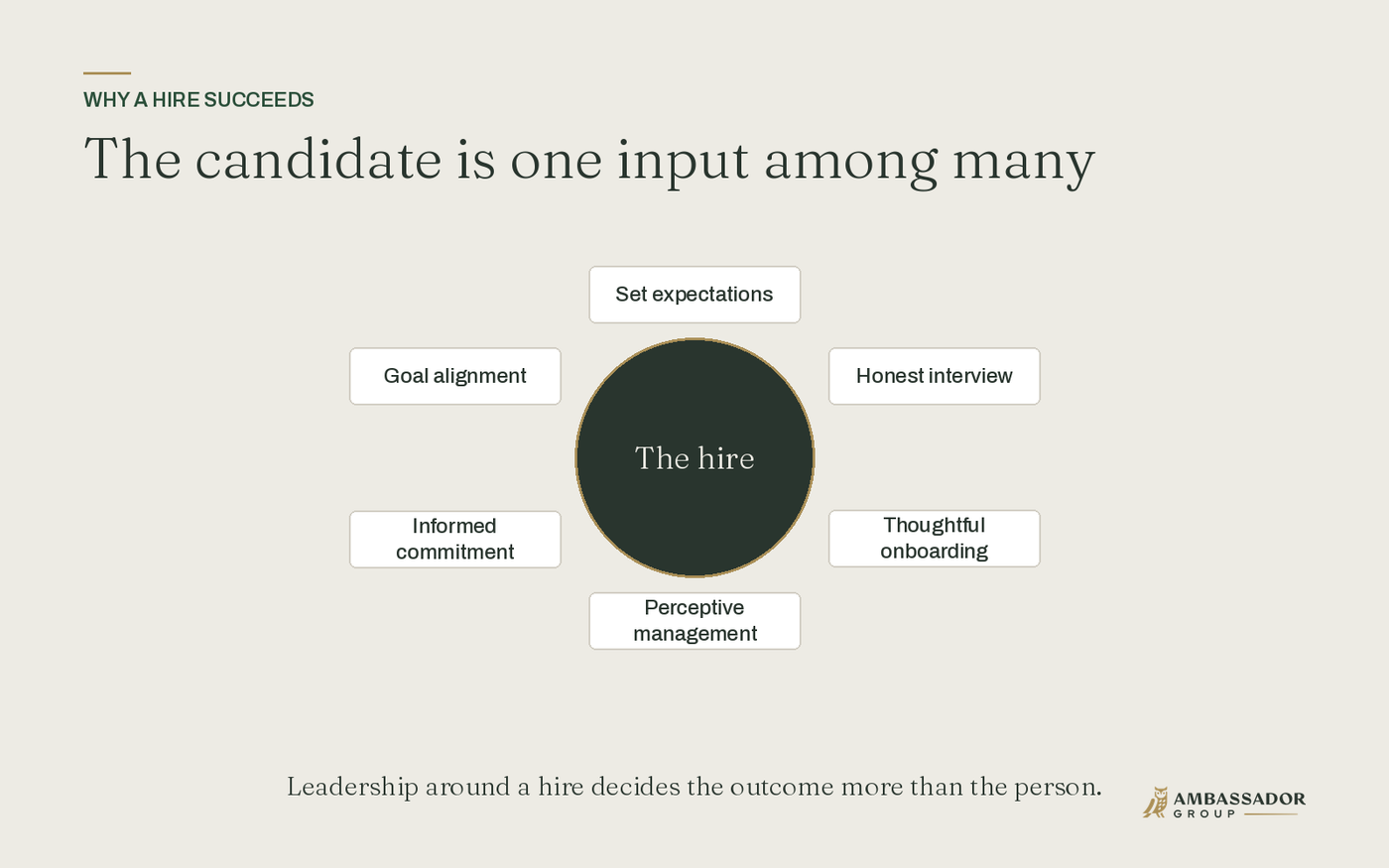
Quality of candidate is the wrong place to look first
When a hire goes sideways, the reflexive diagnosis is that the candidate was not good enough. Sometimes that is true. Far more often it is a quality-of-leadership problem wearing a quality-of-candidate mask. The person was capable. The system around them, the expectations, the support, the accountability, the encouragement, was tuned to someone else, or tuned to no one in particular.
Building a team is the work of seeing people in high resolution. Different people need different things. One field leader works best left alone and trusts the long leash; another needs a closer hand and clearer guardrails. Read both through the same default and you will manage one of them wrong without ever knowing it. A leader who has never examined his own defaults applies them to everyone and calls the result judgment. The candidate pays for the blur.
A good candidate run through a bad process will fail, and the process is the part you control.
Where the recruiter's value truly lives
Consider the common pattern, the one that wastes most of what a search has to offer. A leader works with a recruiter, the recruiter delivers a candidate, and the leader reasons that because this person was recruited, they must be excellent. The recruiter, having worked hard to find them, agrees. Then the company's internal process takes over. The interviews go in-house, information stops flowing back to the recruiter and back to the candidate, and the recruiter ends up on the outside of the one stage where their experience matters most.
That is the moment the value leaks away. The recruiter has navigated relationship development between candidates and companies many times over. They have repped the problem of how expectations get set, how informed commitment gets built, how two parties learn to read each other before the offer rather than after. A leader who sidelines that experience right when the interview and the fit conversation begin is paying for a map and then folding it up before the hard part of the trip.
If you think of every dollar you spend on a search as money spent on finding a candidate, you are missing what you bought. Finding the person is necessary, and on some level it is not the hardest thing. Building a highly functional, committed relationship that can survive the chaos ahead is the harder thing, and it is the thing worth paying for.
You are hiring for the chaos, not the calm
No one hires a senior leader because the seas are smooth. You hire because you have a problem: complexity, pressure, a project that needs solving, a part of the business that has outgrown its current leadership. The person you bring in is joining you in the middle of that, not after it clears.
Which is exactly why inherent candidate loyalty is a thin thing to rely on. Loyalty varies by personality, and it frays under exactly the conditions you are hiring to handle. What holds instead is alignment: a real match between the candidate's goals and motives and the company's, checked honestly before anyone commits. Fit is a complex thing, far more than a skills checklist. It is the alignment of what the candidate wants with what the company is truly like, including the parts that only show up under stress.
Get more by asking for more
So the way to get more from a search is to refuse the narrow version of it. Do not work with someone whose job ends at delivery. Work with someone whose job is to help you see the candidate in high resolution, to build informed commitment on both sides, and to stay in the process through the interview and the fit conversation where relationships are made or broken.
That means keeping information flowing both ways during the internal stages instead of going dark. It means treating the recruiter's read on the human landscape as an asset to use, not a step to skip. It means measuring the success of a hire by the durability of the relationship it creates, not by how impressive the candidate looked the day they walked in.
The candidate is one input. Your leadership, your expectations, and the relationship you are willing to build around them are the rest. Look honestly at how much of your last failed hire was about the person and how much was about the system that received them, because that answer is the one only you can change.