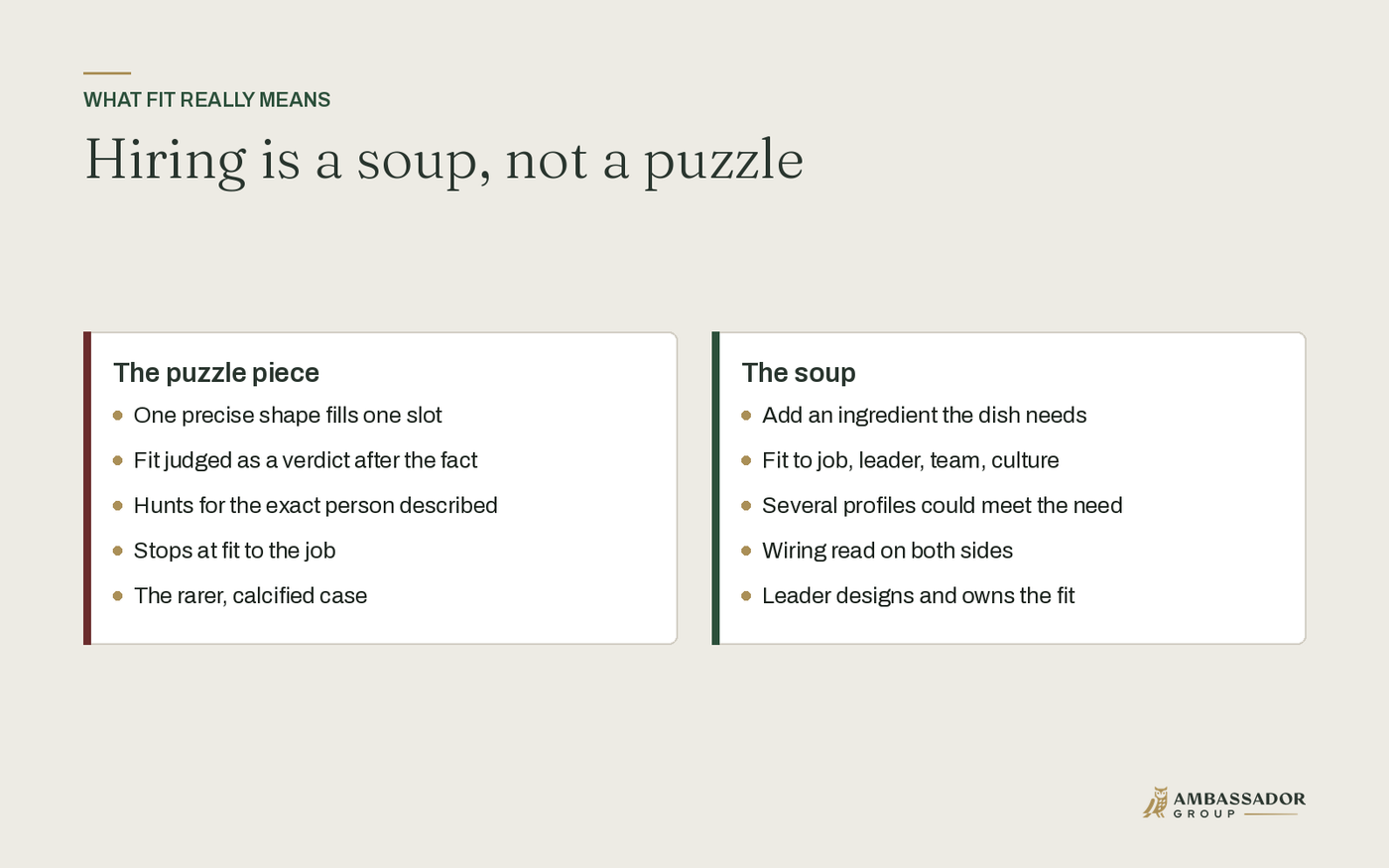
When a leader says "bring me good people," the word fit is already doing more work than anyone admits. Fit gets used as if a role were a puzzle with one precisely shaped opening, and the task were finding the candidate cut to match its lines. People are closer to ingredients than puzzle pieces, and a team is closer to a soup than a finished puzzle. A leader who cannot see that, who cannot name what his own organization tastes like and where it needs a new flavor, cannot see a candidate clearly either. Fit is something a leader is responsible for understanding, designing, and maintaining, not a verdict handed down after the fact.
Notice how often "good fit" turns out to be a label applied in hindsight. A person succeeds, and everyone calls it a great fit. A person struggles, and the same people decide they were never a fit at all. That retrospective habit hides the real question, which is what fit means before the hire, while there is still time to assess it. And the honest answer is that fit is not one thing. It has layers, and a leader who collapses them into a single gut feeling is flying with the headlights off.
Fit has at least three layers
Start with fit to the job. A project manager carries managerial responsibility for schedule, budget, client relationships, and coordination, and they have to perform that well. That layer is real, but it is the shallowest one, and it is where most interviews stop.
Next is fit to the leader. It has been said that people do not quit jobs, they quit leaders, and the chemistry between a new hire and their direct manager often decides whether the rest holds. A candidate can be a clear fit for the organization and the role and still grind against the particular person they report to. That same candidate might thrive reporting to a different department head inside the same company. They have to believe in the mission and trust that senior leadership has integrity, but the daily chemistry that matters most is with whoever they answer to.
Then comes fit to the team and the culture. A new person has to synchronize with the people already in the building, and that synchronization depends on their motivations, their nature, the way they move. None of these layers reads off a resume, and all of them take time to ascertain, because each one runs through the full breadth of human complexity.
The soup, not the puzzle
Here is where the metaphor earns its keep. A leader with a need often describes more than one kind of person who could meet it, because they do not have a puzzle with one etched opening. They have a team, a whole soup of complementary flavors, and several different additions could make the functional whole capable of reaching its goals. One role might be served by a savory, experienced hire who commands a higher base salary; the same gap might be filled by someone earlier in their career with a different strength to offer. The leader is trying to add an ingredient that advances the goals of the business, not hunting for one exact person.
A team is a soup of complementary strengths, and the leader's job is to know what the dish already tastes like before deciding what to add.
The puzzle-piece situation does exist. A mature organization with fully baked processes sometimes needs a person to slot into a tightly defined role, and misalignment there causes real problems. That is the rarer case. More often, businesses solve problems with some freedom in how the work gets done, and the leader is adding to a soup, not filling a slot. Knowing which situation you are in, the calcified role or the open one, is itself a piece of self-knowledge most leaders skip.
This is also why the person eventually hired is never the imaginary person described at the start. The real candidate rhymes with the sketch, carries some of its features, and differs in others. A leader who insists on the imagined profile will reject the actual human who could have done the work.
Wiring you cannot interview your way to
Underneath all of this, people are radically unique, and a great deal of what shapes a hire is wiring a candidate cannot fully articulate and an interview cannot fully surface. How fast someone likes to work, how much agreeableness or friction they carry, how social they are under stress: these durable traits show up on the job whether or not they showed up in the conversation. A leader who hires on impression alone keeps getting surprised, sometimes pleasantly, often not, by qualities that were always there and went unseen.
This is the case for a structured job fit assessment, used on the hiring leader as much as on the candidate. A tool that measures behavioral wiring on both sides lets a leader see around the corner: where friction is likely, where strengths will land, where a candidate's proclivities will help or strain the role. It is not a test someone passes or fails. You want a pillow soft and a hammer hard; a strength in one role is a liability in another. The same assessment can widen the talent pool, surfacing strengths a quick read of a resume would miss and candidates a leader might otherwise have passed over.
The example that taught this lesson hardest involved two genuinely strong people who could not work together. A capable operations manager joined a high-visionary owner whose operational chaos the new hire was supposed to quell, and the conflict was immediate. Both people were excellent. The mismatch was in how their personalities met, and the responsibility for that fit sat with the leader, because the leader owns the culture, the interview process, and the roles. Leaders who use their authority to force everyone to accommodate them build worse teams than leaders who know their own strengths, own their weaknesses, and hire people to cover the gaps.
So before the next hire, look at your own wiring and your team's before you judge a candidate's, and treat fit as something you are accountable to design rather than a label you assign when it is already too late to change.