Retention gets treated as a corporate metric, and that framing hides where the problem lives. A company that bleeds its people cannot grow, because every departure drains money, momentum, and the seasoning that turns a competent hire into a senior asset. Underneath the buzzword sits a harder truth that runs straight to the leader: turnover is rarely a verdict on the people who left. It is a reading on the person who hired them, managed them, and either earned their commitment or assumed it. A leader who cannot see his own part in that cycle cannot see why good people keep walking out the door.
I have been matching people into construction roles for over a decade, and I have watched the same trap close on small and mid-sized companies again and again. The owner wants to build something larger than himself, but the people he brings in churn before they mature into the roles that would let him climb out of the daily grind. He burns his hand on the stove enough times that he stops reaching for it. He resigns himself to working in the business instead of on it, and a business that never escapes that loop stays smaller, more stressful, and less profitable than it should be.
Turnover is the friction you cannot see on the P&L
The expense of losing people is real and badly underestimated, partly because it never shows up as a line item. There is no row for the lost interviews, the onboarding hours, the customer relationships that wobble when a familiar face disappears, the morale that sags when the team watches another colleague go. It behaves like drag on a hull: unseen, constant, slowing everything down while the captain wonders why the boat will not pick up speed.
Hold a leader accountable for that drag and the first place to look is the hire itself. Retention is built on a foundation of good decisions, and the earliest decision is whether to bring someone in at all. A thin job description that never names the real pain in the business, a shallow interview process, a candidate who is never told what they are walking into: those failures guarantee turnover before the person finishes their first month. When the leader later says the person who showed up was not the person who interviewed, that explanation does not travel far. Hiring someone is a commitment, on both sides, to a relationship you both believe can work and a promise to help that person succeed inside it.
Loyalty is cultivated, not recruited
A lot of hiring authorities treat loyalty as a trait they can screen for, as though it were a fixed property of a candidate they might find with enough looking. It is closer to trust. It has to be developed, respected, and curated over time, and the only person positioned to do that is the leader the new hire reports to. You earn it by being honest in the interview about what the role demands, what the team is struggling with, and why someone might reasonably decline the job. That candor pulls both parties past the veneer of the early conversation, where everyone is nervous and managing impressions, and into something real enough to build on.
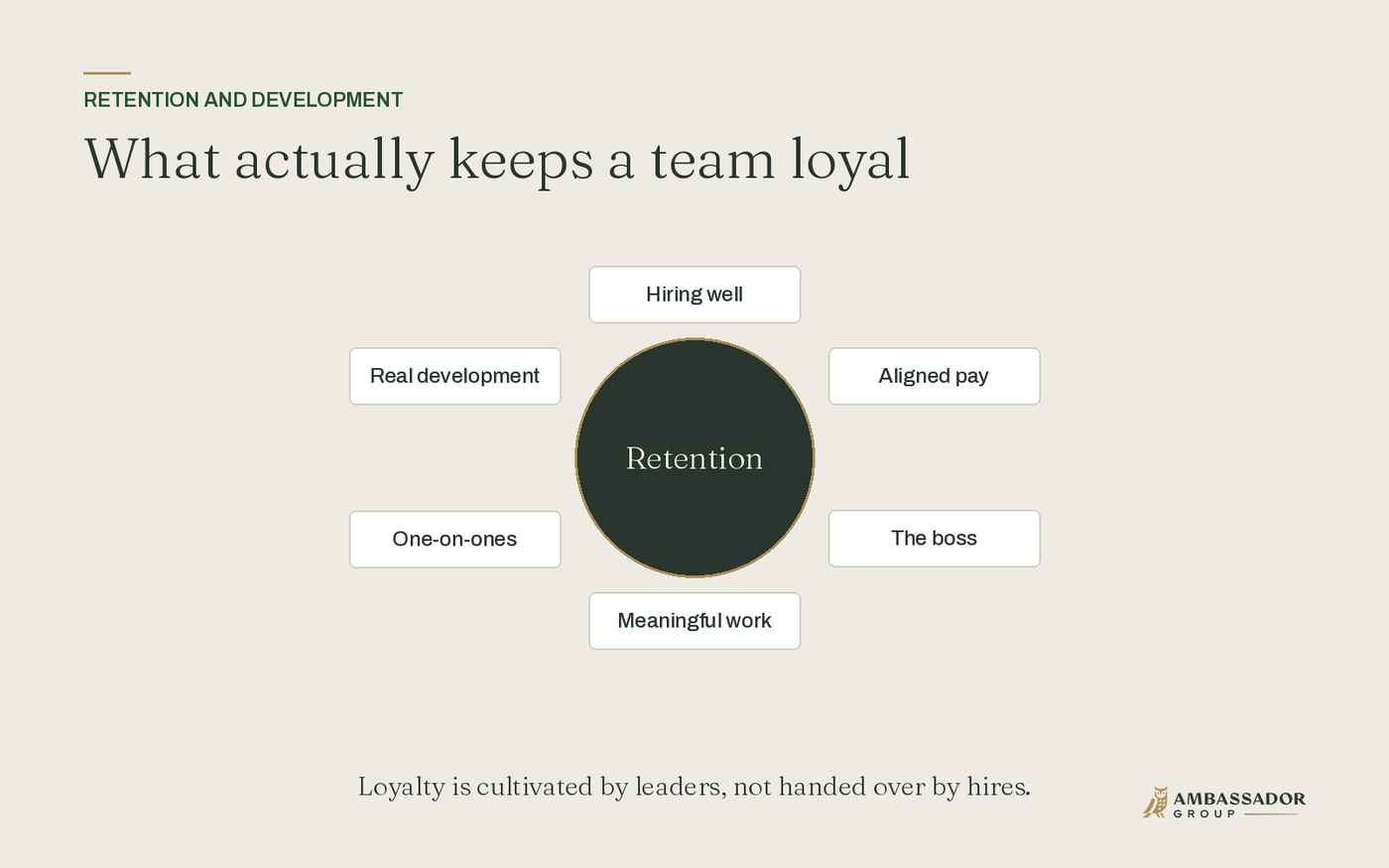
Loyalty is not endowed. It has to be developed, respected, and curated, and the only person who can do that is the leader the work runs through.
Go first. A leader who names his own challenges before asking the candidate to name theirs gives the conversation permission to be true. That is the same posture that retains people once they are inside, because the relationship between an employee and their direct supervisor is one of the largest forces in whether they stay. People quit their boss. A middle manager promoted for technical skill, with no aptitude for the human side of the role, becomes a quiet exit ramp for everyone beneath them. Meet with your people one-on-one, in private, often. You cannot support a person whose life and frustrations you know nothing about, and the commute that has become unbearable or the client who has worn them down is invisible to a leader who never asks.
Pay, meaning, and the freedom to leave
Compensation belongs in the same honest conversation. Salary surveys promise a tidy benchmark, but the data underneath them is thin, and the title "project manager" hides a dozen different jobs with different scopes, structures, and cultures. The more useful question is what a specific person is genuinely worth to your specific business, then paying them as close to that as the company can sustain and giving them real authority over their own earnings. There is always another firm that can justify paying your best person twenty percent more to win a project. The defense against that is a clear path to growing here, under a leader the person already respects.
Money is the floor, not the ceiling. People also want to know their work matters, which is why feedback from a boss, a peer, or a customer carries so much weight. A company builds buildings, but what it does underneath that is improve the lives of the people who use them and the people who do the work. A leader who can name that connection, and reflect it back to the team, gives people a reason to invest a piece of their one finite life with him. The newer reality is that people now have mobility they never had before. Someone can apply to a hundred jobs in an hour, which means leaders who neglect pay, development, meaning, and respect no longer get away with it. That shift is good. It forces the hard work of earning people instead of trapping them.
Some turnover is healthy
Not every departure is a failure. People leave for good reasons, to relocate or chase an opportunity you could not offer, and how you send them off teaches your whole team something about how loyalty is repaid here. Treat strong people who leave as alumni: with gratitude, an open door, and a standing invitation back. The other healthy turnover is removing those who will not perform, because high performers will not stay where low performance is tolerated, and protecting standards is part of protecting the people who meet them. Both kinds, handled with respect, strengthen the culture rather than fraying it.
So before the next search, take an honest read of the whole system you have built, including yourself. Look at where alignment quietly broke with the last few people who left, what your exit interviews told you even when the message was angry, and where a one-on-one would have surfaced a problem while it was still small. Retention is the accumulated result of decisions only you can make, and you already know which of yours have been overdue.