The candidates who stand out in interviews almost never stand out because of raw talent. They stand out because they prepared, and most of the people across the table from them did not. After more than a decade of watching interviews in construction, the pattern is steady enough to call a rule: preparation is the most accessible advantage a person can bring into an interview, and almost nobody uses it fully. That gap matters because an interview is the moment a hire either earns honest self-representation or buries it under nerves. A leader who wants to see a candidate clearly needs that candidate prepared enough to show their real self, and a candidate who wants to be seen accurately owes the same effort. Preparation is where both halves of a good match start paying in.
Preparation does more than impress
The easy way to read interview prep is as a performance edge, a way to look sharper than the next person. It is that, but the more interesting effects run inward. A prepared candidate is less nervous, because the questions that would have caught them flat-footed are already turned over in their mind. They come across as genuinely interested, because they have done the work to understand the company rather than the work to fake enthusiasm. And they leave with something the unprepared candidate never gets: a clear read on whether the company aligns with their own values.
That last point is the one most people skip, and it is the one that protects them. An interview is a two-way evaluation. The company is deciding about the candidate, and the candidate should be deciding about the company with equal seriousness. Preparation is what makes that second evaluation possible. Walk in without it and the conversation happens to you. Walk in with it and you can ask the questions that tell you whether this role is worth taking, not merely whether you can get it.
Preparation wins you the offer and, in the same motion, shows you whether the offer is one you should want.
Five areas worth the work
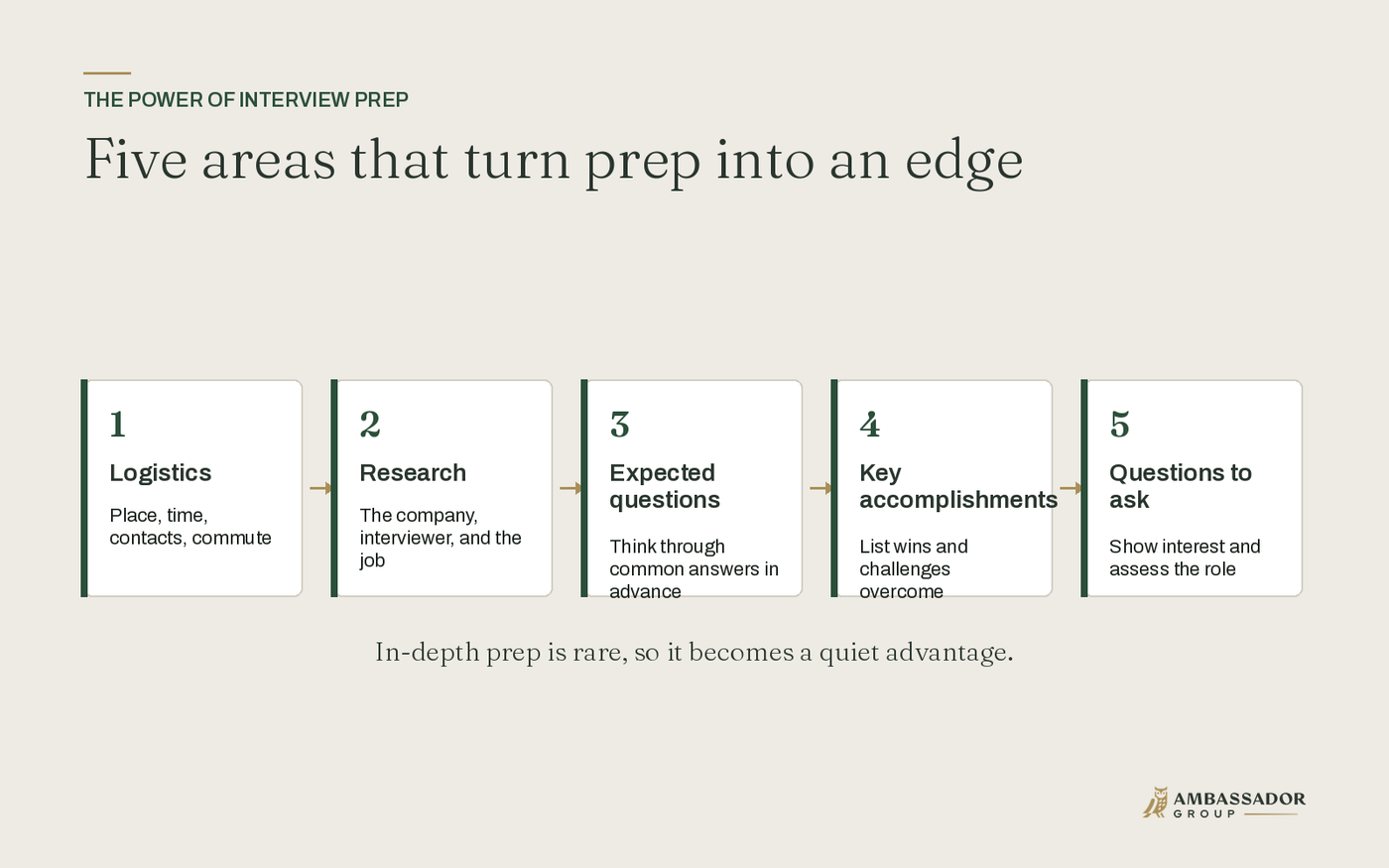
The preparation that pays off is not mysterious. It breaks into five areas, and each one closes a gap that trips up unprepared candidates.
- Logistics. Know where to be and when. Confirm the time, the address, the contact information, the commute, and any detail that could go wrong on the morning of. None of this is impressive on its own, but arriving frazzled or late spends goodwill you have not yet earned, and it is the easiest thing in the entire process to control.
- The company, the interviewer, and the job. Understand the mission of the organization you might join. Learn who you will be meeting. Read the job description closely enough to speak to it. In construction this means knowing the kind of work the company builds, the markets it serves, and where this role sits in delivering a project. A candidate who has done this homework can connect their own experience to the company's actual needs instead of reciting a generic pitch.
- Answers to the questions you can see coming. Most interviews ask a predictable core of questions. Think through your answers in advance so you can speak with clarity rather than improvising under pressure. This is about having considered the obvious ground so your attention is free for the parts of the conversation you cannot predict, without scripting yourself into something stiff.
- A list of your accomplishments. Highlight what you have built and the challenges you have worked through. Specific projects, real scope, the problems you solved. These are the details that are hardest to summon in the moment, and the moment is exactly when you need them. A superintendent who can describe a difficult schedule recovery, or an estimator who can walk through a bid that won on margin and held, gives an interviewer something concrete to evaluate. Vague strengths persuade no one.
- Questions to ask the interviewer. Thoughtful questions do two things at once. They show real interest, and they let you assess the role on your own terms. Ask about how the company handles conflict, what gets someone promoted, what the first ninety days look like in this position. The questions you bring reveal how seriously you are weighing the decision, and the answers tell you whether to keep weighing it.
Why so few do it
If preparation is this accessible, the obvious question is why it stays rare. Part of the answer is that it takes effort, and an interview can feel like a hoop to clear rather than a decision to make. Part of it is overconfidence, a sense that experience will carry the conversation. It will not. Experience gives you something to say, but preparation is what lets you say it well, in the right order, connected to what this particular company is trying to accomplish. The candidate who relies on talent alone tends to ramble, miss the company's real concerns, and forget the accomplishments that would have made the case.
The rarity is the opportunity. In a field where most people walk in cold, the candidate who has done the work stands out by contrast, not by margin. That advantage is available to anyone willing to spend a few focused hours, regardless of pedigree or polish.
What preparation buys you
The deeper payoff is honesty. A prepared candidate represents themselves accurately, asks the questions that surface whether the fit is real, and walks out with a clearer sense of whether this is a place they would thrive. An unprepared one gambles on a good impression and learns the truth after they have already accepted. The first path leads to a match that holds. The second leads to a move regretted within a year.
Treat the interview as a decision you are making as much as a test you are passing, and preparation becomes the tool that lets you make it well. The hours you put in before you walk through the door are the most controllable advantage you have, and using them is entirely your choice.