Most employment lawsuits do not begin with a statute. They begin with a person who felt mishandled by someone who never stopped to consider how the handling landed. That is the pattern Kevin Cleveland, an employment attorney at O'Hagan Meyer, keeps seeing from the litigation side, and it lines up with a harder truth about hiring and leading: a leader who cannot see the effect of his own actions cannot see the people around him clearly either. The legal exposure is downstream of that blindness. The contracts and the policies matter, but the recurring failure is a leader who stopped treating employees as people partway through a busy week.
The golden rule is a risk-management tool
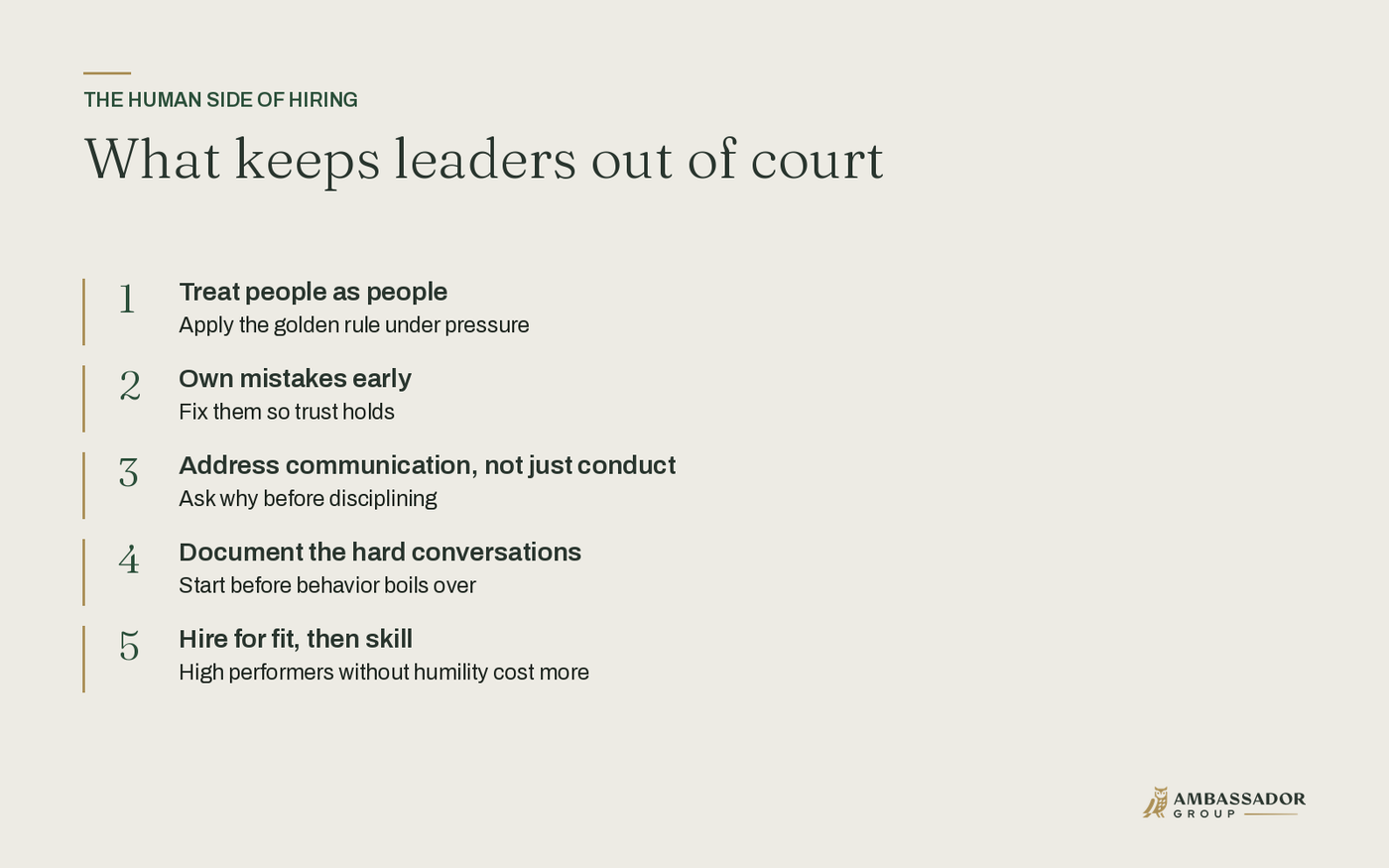
Cleveland's observation is almost embarrassing in its simplicity. The lesson that prevents the most litigation is the one most people learned as children: treat others the way you would want to be treated. The reason it gets abandoned at work is pressure. Deadlines compress patience. The job needs to ship, the crew needs direction, and somewhere in that grind a supervisor stops accounting for the fact that the person across from him is carrying his own load, his own family, his own bad week.
Cleveland traces most of the wrongful-termination and harassment files he handles back to a communication breakdown that nobody addressed. A supervisor and an employee stop being able to talk. Rather than asking why the two of them cannot get on the same page, the supervisor labels it an employee problem and starts documenting deficiency without ever diagnosing cause. The discipline escalates. The resentment compounds. By the time it reaches a lawyer, the original misunderstanding has hardened into a grievance.
Most of the lawsuits trace back to an employee who did not feel treated fairly, and that almost always started with a leader who stopped asking whether he was treating people the way he would want to be treated.
The construction version of this is familiar. A field leader who runs hot, who corrects in front of the crew, who never closes the loop on why a worker keeps missing the mark, builds the exact conditions Cleveland sees turn into claims. The behavior was visible for months. Nobody intervened because the person was producing, and producers get a long leash. The leash is the liability.
Self-awareness shows up on both sides of the table
What Cleveland calls a character flaw, when there is one, is usually a lack of self-awareness about consequence. A leader who cannot read the effect of his own conduct will keep generating the same friction and keep blaming the people caught in it. The same gap appears in employees who never consider that a late timesheet stalls payroll for everyone, or that the workplace is not a place to vent however they please. Awareness is the variable on both ends, and the leader sets the tone for whether it gets practiced.
Cleveland points to the malpractice research Malcolm Gladwell describes in Outliers, where the doctors who got sued tended to be the ones patients did not like, regardless of how often they erred. The corollary in employment is direct. A leader who owns a mistake when it happens, who fixes it and explains the reasoning even when the answer is no, earns enough trust that people bring problems to him instead of to an attorney. That trust is cheaper than any defense.
Hire for fit, then verify what the risk demands
The same self-knowledge that lowers legal exposure also sharpens hiring. Cleveland hires for fit over resume, because experience is teachable and drive is not. He reads a candidate for the qualities a job description never captures: whether the person wants to get better, whether he would be glad to see them in the office. He keeps notes on why he liked or did not like someone, partly as a hiring discipline and partly as protection, since a year later no one remembers the answer that ended an interview.
That instinct has a ceiling, and the discipline is knowing where it sits. In construction the risk is physical and immediate. A superintendent jacking up a house to build a new story underneath cannot be chosen on personality alone, because an inexperienced read on that job carries liability in every direction. Cleveland's framing holds: license and certification clear part of the bar, county records and completed projects verify the rest, and the depth of diligence rises in proportion to the consequence of being wrong. Fit is the default. Verification is what the stakes require.
There is a quieter danger in the opposite hire. The candidate chosen purely for a resume is often a high achiever who has never been told he was wrong, and when his people skills finally force a separation, the blame has to land somewhere other than himself. Those exits become lawsuits. The way through is to surface the friction early, document the conversations without theatrics, and treat the goal as helping the person succeed rather than building a case. A leader who waits for a boiling point has chosen the litigation he later complains about.
The work that prevents the lawsuit
The thread running through Cleveland's whole account is that the legal protections come second to the human read. An interview feedback form is useful in court, but its real value is forcing a hiring team to agree on what they are looking for before they walk in, so they do not each chase a different version of the right person and settle on a weaker hire. Good HR works the same way, by finding the human factor blocking someone's performance rather than logging another policy violation. The documentation matters because the thinking behind it matters.
A leader who builds a team where the pieces complement each other, who reads his own blind spots, who treats people as people under pressure, is running the same discipline that keeps him out of court. The law rewards the leadership, not the paperwork. Look at the friction in your shop before the next hire or the next hard conversation, and ask how much of it is waiting on you to handle a person the way you would want to be handled.