A company cannot examine fit in an interview if it does not know who it is. That sentence sounds obvious until you watch how many leaders walk into a hire without a clear answer to it, then wonder why the candidate who looked right turned out wrong. The honest version of the master idea is plain: a leader who cannot see himself clearly cannot see a candidate clearly, and an organization that cannot name its own identity has nothing to measure fit against. Getting a candidate to open up and tell the truth starts on the leader's side of the table, not the candidate's, because you cannot draw out an honest answer to a question you have never honestly answered yourself.
Start with the leader. I am 37 and still getting to know myself, and I expect to be at it for the rest of my life. Self-awareness is a journey, nobody arrives, and the people most certain they have arrived tend to carry the largest blind spots. That is tolerable in most of life. It is expensive in hiring. People are hardwired with durable behavioral patterns that shape how they handle stress, what problems they enjoy, and how they show up at work. A leader who has never examined his own sensitivities, strengths, and weaknesses is blind to the traits in a candidate that will help or hurt that person in the role, and blind to the kind of leadership that person will need to succeed. Hire a salmon to climb a tree or a monkey to swim the ocean, and the failure was designed before the first day.
The organization has a self too, and it is usually vague
Widen the lens from the leader to the company and the same gap appears. Plenty of organizations carry a mission statement and a set of core values the marketing department wrote because they sounded like what the market wanted to hear. Under that polish there is often no honest answer to a simpler question: why does this company get up in the morning? Money is not the answer. A company organized around money is a shallow company, a mercenary one, and people feel it inside a quarter. If you are serious about a culture worth having, a product worth being proud of, and customers who stay, the words on the wall have to match the people in the building, because the mission does not happen on its own. It happens through people aligned to it.
A company also has a personality, not only a mission. It is the compendium of every personality at every level, from the field to the front office. When a high-pace owner has never examined his own tempo, he drives everything at that tempo because slowing down does not occur to him. That pace permeates the whole company and surfaces later as turnover, burnout, and performance problems, and he may never trace the symptom back to himself. The same blindness that hides his wiring from him hides its effect on everyone downstream.
Read your problems as a mirror
The humility worth practicing is to look at the recurring problems in your shop and consider that some of them reflect you. A rough edge in your own skill set. A strength of yours playing too large a role and crowding out the detail-oriented person who should be covering that gap. Senior leadership is frequently the most experienced voice at the table, not the wisest and not the most helpful, and knowing the difference is what lets you build a team instead of an echo. The willingness to read your weak spots as partly your own is rare, and it is the thing that separates a leader who keeps growing from one who keeps hiring the same problem.
If you do not know who your organization is, you cannot sell it honestly, and you cannot earn the kind of informed commitment that makes a person stay.
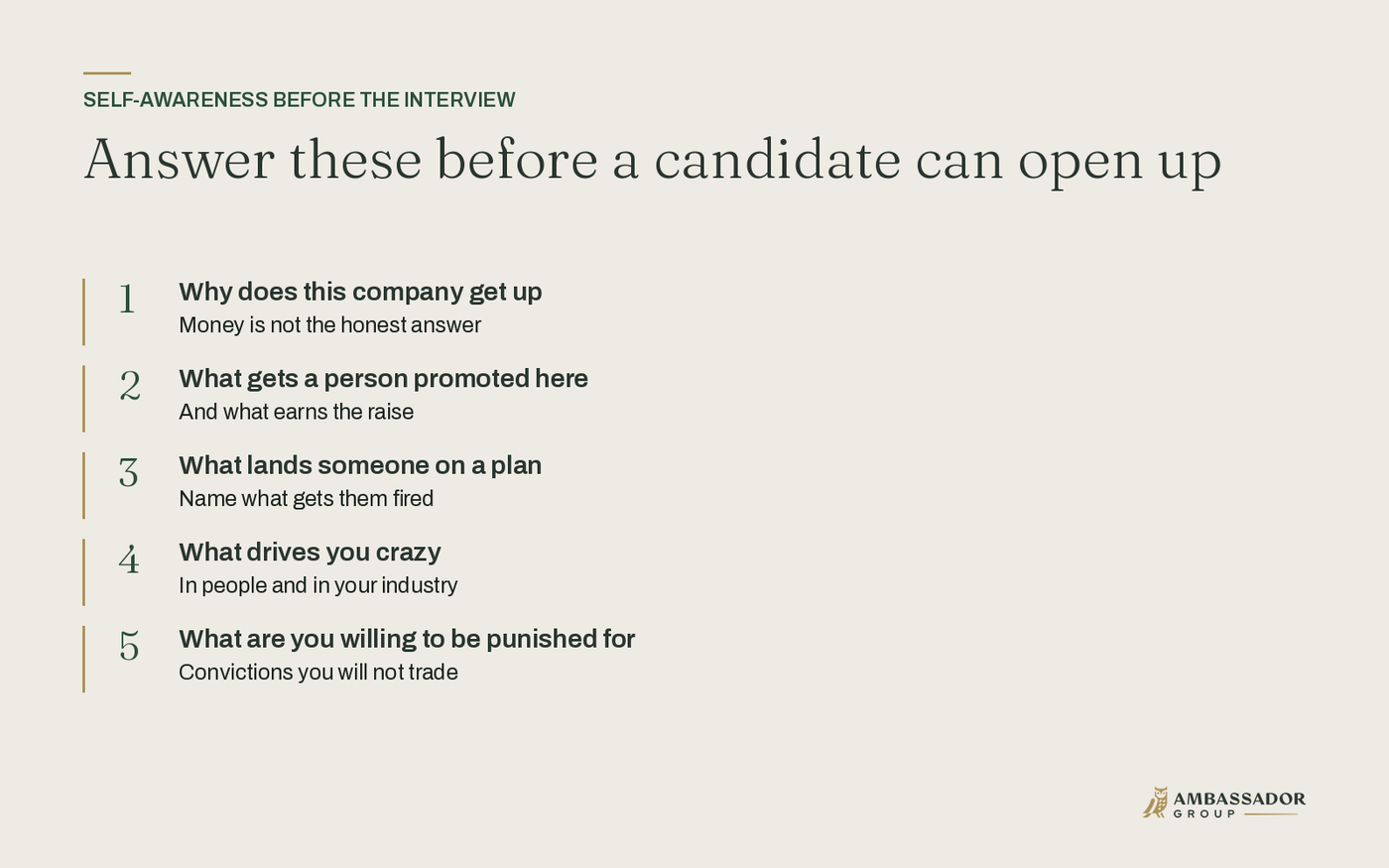
This is the link back to the candidate. People tell me all the time that they want their next move to be their last one. That outcome depends on an interviewer who can set real expectations, because clarity on the company's side is what gives the candidate permission to be clear on his. When you can say plainly what gets a person promoted here, what earns a raise, what lands someone on a performance plan, and what gets them fired, you hand both parties a language to test against. Leadership operates with more room inside a clear mission, employees know the rules, and fit stops being a gut feeling and becomes a conversation both sides can check.
Clarity is the tool that draws out the truth
So the work before the interview is to get clear about your convictions. What do you believe. What drives you crazy about your own industry. What are you willing to be punished for. Delving into those questions and answering them honestly produces a real benefit in the interview, because now you are speaking a language and an evaluation heuristic that lets you recognize the people who share your wiring and part ways early with the ones who do not. A candidate cannot open up to a company that is hiding from itself. He can open up to a leader who tells him the truth first.
That parting is not a verdict on anyone's worth. There are many good people and many good companies, and most pairs are wrong for each other. A candidate telling you he is not a fit is a gift, because the alternative is spending six months and half a million dollars forcing a match that was never going to hold. Telling a strong candidate the honest truth about where he would struggle here is the same kind of gift, even when it costs you the hire, because it lets him commit with his eyes open or walk before the cost compounds.
Before your next interview, look hard at the problems already in your shop and sort them: how many are genuinely about the person you are about to meet, and how many are reflections of a leader or a company that has not done its own work yet. You already know which questions you have been avoiding, and the candidate will keep handing you surprises until you answer them yourself.