Most hiring goes wrong before anyone meets the candidate, in the quiet moment a leader decides the interview is something to get through rather than something to design. Speed feels like progress when a role sits open and the field is short-handed, so the interview becomes a hurried gut-check and the offer follows a good feeling. But a leader who cannot see his own process clearly cannot see the candidate clearly either, and the structure of the interview is where that clarity either exists or does not. A deliberate process is how a leader slows down enough to do the painstaking assessment that earns real confidence in a hire.
The instinct to move fast is human, and in construction the pressure is constant. A super walks off mid-project, a backlog grows past what the current team can staff, and the search starts under the gun. Under that pressure, the interview gets compressed into a single conversation with whoever happens to be free, and the decision rests on whether the candidate seemed sharp for forty-five minutes. That is an impression dressed up as a judgment, and impressions are exactly where expensive mismatches are born.
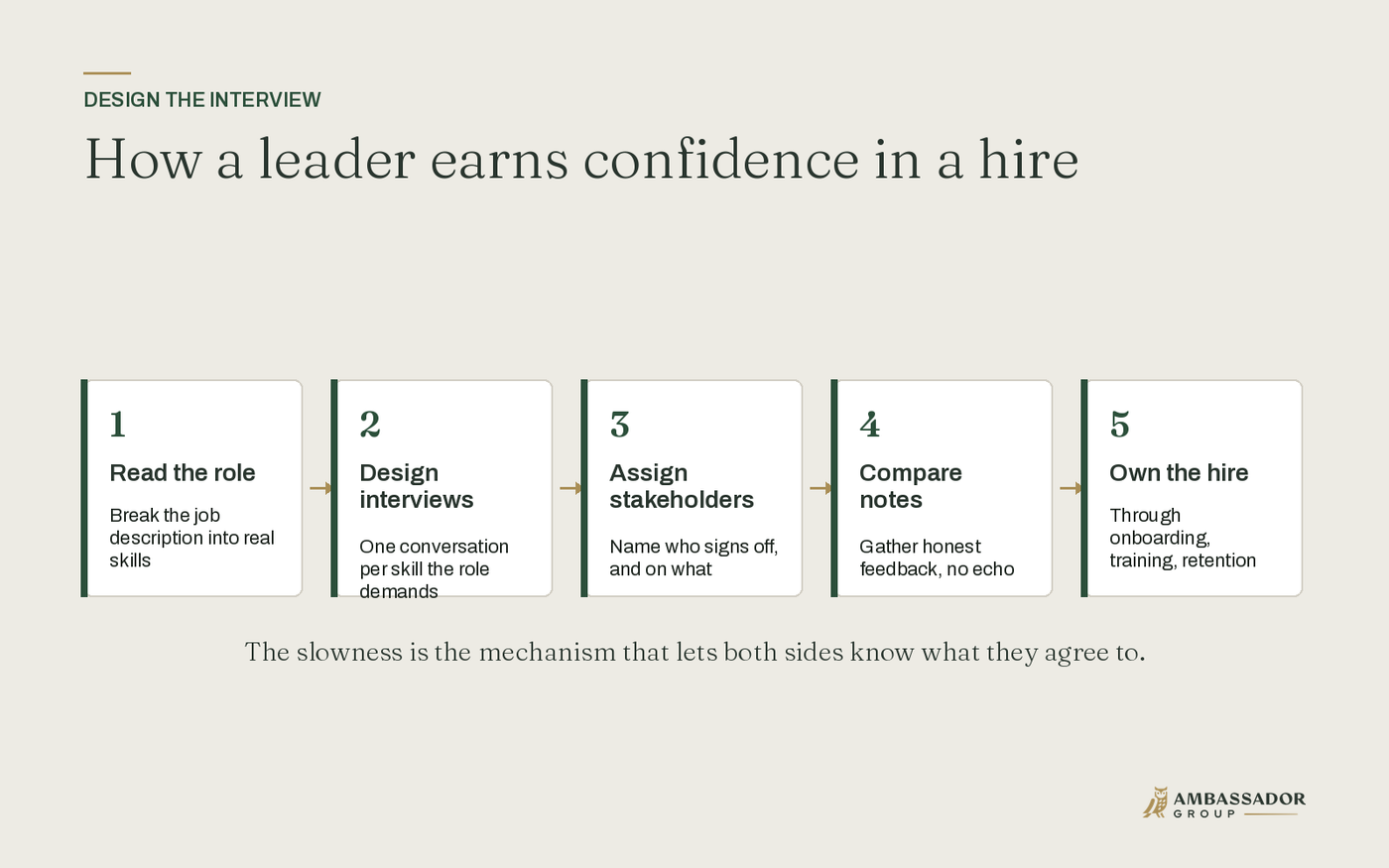
Start with the job description, then build the process around it
A sound interview process begins with the job description, read closely. What does this role truly require? A project manager who runs buyout and owns client relationships needs to be assessed differently than one who lives in submittals and RFIs all day. Break the requirements into the distinct skills the role demands, then design the kinds of interviews that can each test one of them. A technical conversation about scheduling and budget control is a different instrument than a conversation about how someone handles a subcontractor who is three weeks behind. One interview cannot carry all of that weight, and asking it to is how leaders end up surprised by a person they thought they understood.
Naming the components first turns a vague "let me see if this person feels right" into a set of specific questions a leader can answer. Each part of the role gets a deliberate look. The candidate gets assessed against what the work requires rather than against whether they reminded the interviewer of someone who once did well.
Decide who signs off, and on what
A real process names its stakeholders. Who needs to evaluate which part of the candidate's skill set, and on what basis will they make that call? The field leader who will manage the new hire has to weigh in on how they run a job site. A senior leader may need to assess judgment under pressure. Someone has to read the candidate's ability to coordinate with the office. When each interviewer knows exactly what they are responsible for assessing and how they will judge it, the evaluations stop overlapping into the same shallow impression and start covering the whole person.
That coverage requires coordination. The team needs a feedback mechanism, a way to compare notes without one strong voice steamrolling the rest. A leader who hears only confirmation of his own first impression has not run a process; he has run an echo. The point of multiple interviewers is multiple genuine readings, and that only works when the feedback is gathered honestly and weighed against what each person was asked to evaluate.
A deliberate interview process is how a leader slows down enough to see the whole candidate, instead of betting a year of work on a single good feeling.
Someone owns the hire, all the way through onboarding
The last piece is the one most often left unassigned: who is responsible for making sure this is the right hire, and that the company is set up to make the new person succeed? A hire is not finished at the offer. It runs through onboarding, training, and retention, and the same person who owned the decision should own whether the company holds up its end. Setting a candidate up for success is the company's job, and a process that ends the moment the contract is signed leaves the most fragile stretch of the relationship to chance.
This is where the discipline pays for itself. A leader who has broken down the role, assigned the assessments, coordinated the feedback, and named an owner has built something a hasty hire never gets: confidence that is earned rather than hoped for. The painstaking part is the point. The slowness is the mechanism that lets a leader and a candidate both know what they are agreeing to before they agree to it.
The cost of getting this wrong is measured in months and salaries. A vacancy held open one more week is cheap next to the wrong person a leader spends a year unwinding, and the wrong person is what a rushed process reliably produces. The diligence you skip to save time at the front is repaid, with interest, at the back.
So before the next search, look at the process itself and ask whether it is built to assess the job in front of you or only to fill the role fast. Design the interview the way a good builder sequences a job, and the hire you make will hold the weight you put on it.