Crestwood came to the table a skeptic. The leader who reached out had spent a career fielding the kind of recruiter contact that trains a person to keep recruiters at a distance: the cold calls that wear thin, the email blasts that treat a hire like a transaction. He expected more of the same. One meeting changed his mind, and the reason it changed is the whole lesson. A structured, transparent process gave him a language to judge fit against, and that is exactly where hiring stops being a gamble. A leader who can see his own requirements clearly can finally see candidates clearly, and the process Crestwood walked through was built to make both kinds of sight possible.
What flipped the skepticism was not a sales pitch. It was structure. Crestwood's leader describes himself as a structured person, and when he saw a five-stage process laid out in front of him, discovery, find, filter, fit, and finish, he recognized something he respected: a discipline that matched his own. Construction runs on sequence. You do not pour before you form, and you do not close out before you commission. A hiring process that honors sequence speaks the language a builder already trusts.
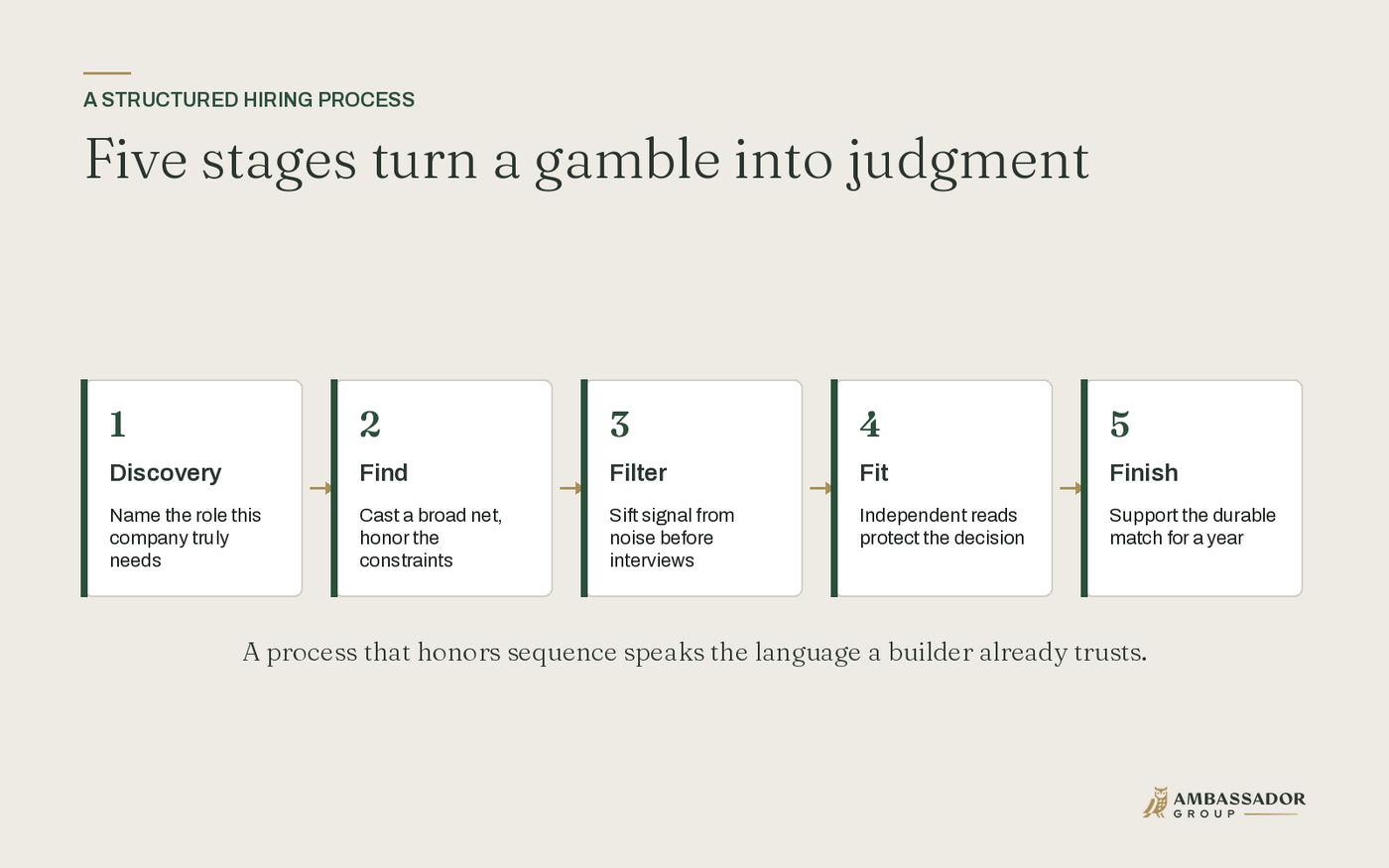
Discovery is where the real work hides
The stage Crestwood valued most was the one most leaders skip. Before any names surfaced, the search began by pulling the company's own requirements into the open. Teammates sat with Crestwood and dug into what it truly means to be a Crestwood superintendent, the specific person their projects and their culture demand rather than the generic title. That is the discovery stage doing its job: forcing a company to name its own identity before it tries to measure anyone against it.
This matters because no two searches are the same. The work was explicit that it does not run the same hire twice. A superintendent for one builder is not interchangeable with a superintendent for another, because the surrounding system, the pace, the standards, the way conflict gets handled, is different in every shop. A company that has never said those things out loud cannot test for them. Crestwood let the process pull that definition out, and everything downstream got sharper for it.
Discovery is the stage where a company stops describing the role it wishes it had and starts naming the one it truly needs filled.
Constraints were honored, not argued away
Crestwood set hard boundaries on how the search could run. They did not want anyone fishing in their own backyard or calling their competitors, and they said so plainly. The search took those constraints seriously and worked within them, casting a broad net while respecting the brand, the messaging, and the way Crestwood wanted to appear to the market.
That restraint is harder than it sounds. The easy path in recruiting is to chase the most reachable names, the ones already loud online. Many of the deepest professionals in construction carry almost no online profile, which means finding them takes patient relationship-building rather than a database query. Honoring a client's boundaries while still reaching those people is skilled work, and it pays off in candidates who fit the brand instead of merely the job description.
The filter that protected the hire
When the field narrowed, Crestwood started with roughly eighty to a hundred candidates and cut down on the plain criteria: location, skills, tenure, experience. Then came the part that protected the decision. After each interview, the two Crestwood partners were asked not to talk to each other until they had each completed a separate debrief. The leader found this odd at first. Why would he not compare notes with his own partner?
The reason is the same reason a structural inspection happens before the drywall goes up. Talk too early and one strong opinion paints over the other. His read would push onto his partner's, and his partner's onto his, and the honest signal each of them held would get muddied before anyone could examine it. By capturing both reads independently, then comparing where they aligned and where they diverged, the process turned a gut feeling into a conversation the two of them could inspect directly. The divergences sparked the most useful discussions, the why-do-you-think-that exchanges that surfaced what each man truly valued in a candidate.
Two customers, one durable match
Throughout, the process treated the search as service to two parties at once: the company doing the hiring and the candidate considering the move. Crestwood saw their own side of that care directly. What they did not see, by design, was the parallel support given to the candidate, the reflection, the encouragement, the honest preparation that helped a strong professional decide with eyes open.
That two-sided care is the quiet engine of a durable match. A hire that holds for years is not the product of selling a candidate hard and hoping. It comes from both sides arriving at an informed commitment, each one able to see the other in high resolution. Crestwood hired Rob through this process, and the leader describes a small fleck of pride every time he hears Rob praised, the satisfaction of having played a real part in a match that took. Nothing was hidden, no surprises waited at the finish line, and the expectations were set in the open from the start.
The skeptic became a repeat client for an ordinary reason: the process saved him time on the back end, educated him along the way, and made his decisions easier to trust. The lesson for any leader carrying the same skepticism is plain. Demand a process that pulls your own requirements into the open, honors your constraints, and protects your judgment from contaminating itself, and you will be the one who can finally tell a real fit from a hopeful guess.