A hiring leader meets your paper before they meet you, and the documents you hand over are the first honest account of your work they get to hold. In a good match, both sides own the outcome, and your half of that ownership starts with how clearly you represent yourself. A resume that communicates your chronology, a project list that shows what you have built, and references that vouch for how you work: these are the materials that let a leader decide, with real information, whether you and their company belong together. Vague paper forces a leader to guess, and a guess is where a mismatch begins.
Most construction professionals treat the resume as the whole story. It is one document with one job. The resume carries the chronology of your work history, the arc of where you have been and in what order. That arc matters, because a leader reading it is trying to understand the shape of your career, not score a trivia quiz on your titles. But the resume alone rarely answers the question a hiring leader cares about most: what have you built, and does that experience translate to the kind of work this company does?
The project list is where your experience becomes legible
That answer lives in the project list. A separate, well-organized list of the work you have run gives a potential employer the context the resume cannot. It shows what you have been doing inside the chronology, and whether your background lines up with their portfolio. A leader at a custom residential builder reads a project list differently than one at a commercial general contractor, and a strong list lets each of them see, quickly, whether your experience fits their world.
For the list to do that work, it has to carry detail. For each project, give the location, the budget, and your specific role and responsibilities. Note the architectural style where it is relevant. Add anything that helps a stranger understand where your experience particularly lies. A line that says "Project Manager, mixed-use, $14M, Oakland, ground-up, ran buyout and closeout" tells a hiring leader more in one breath than a paragraph of adjectives ever could. Numbers and scope are the evidence a leader needs to picture you on their job site.
A leader cannot match you to the right role from a blur; give them the budgets, the scope, and the part you owned, and you let them see you clearly.
Be precise about your role, because roles in construction do not mean the same thing from one company to the next. A superintendent at one shop wears the bags and runs a single building; at another, the same title leads a group of supers and never touches a tool. A project manager might run precon at one company and live entirely in the field at the next. When you describe your responsibilities plainly, you spare a hiring leader the trouble of guessing which version of the title you held, and you protect yourself from being measured against a role you never performed.
A portfolio and references finish the picture
If you have photographs of completed work, gather them. A portfolio of project images can stand alone or ride along with the project list, and for the right role it shows a leader something words struggle to convey: the finish, the complexity, the quality you are accountable for. A builder of high-craft custom homes will read a clear set of project photos as fast as any resume bullet.
Then there are letters of recommendation and strong references. These do quiet, durable work. When a past leader or client is willing to put their name behind your work, it signals that the people who watched you up close had a good experience, and that experience tends to repeat. A reference is a heuristic, a shortcut a hiring leader uses to predict the trend of your work from the people who already lived it. Line up references who can speak to specific projects and specific behavior, and tell them what role you are pursuing so they can speak to the right things.
Build the packet the way you build a job
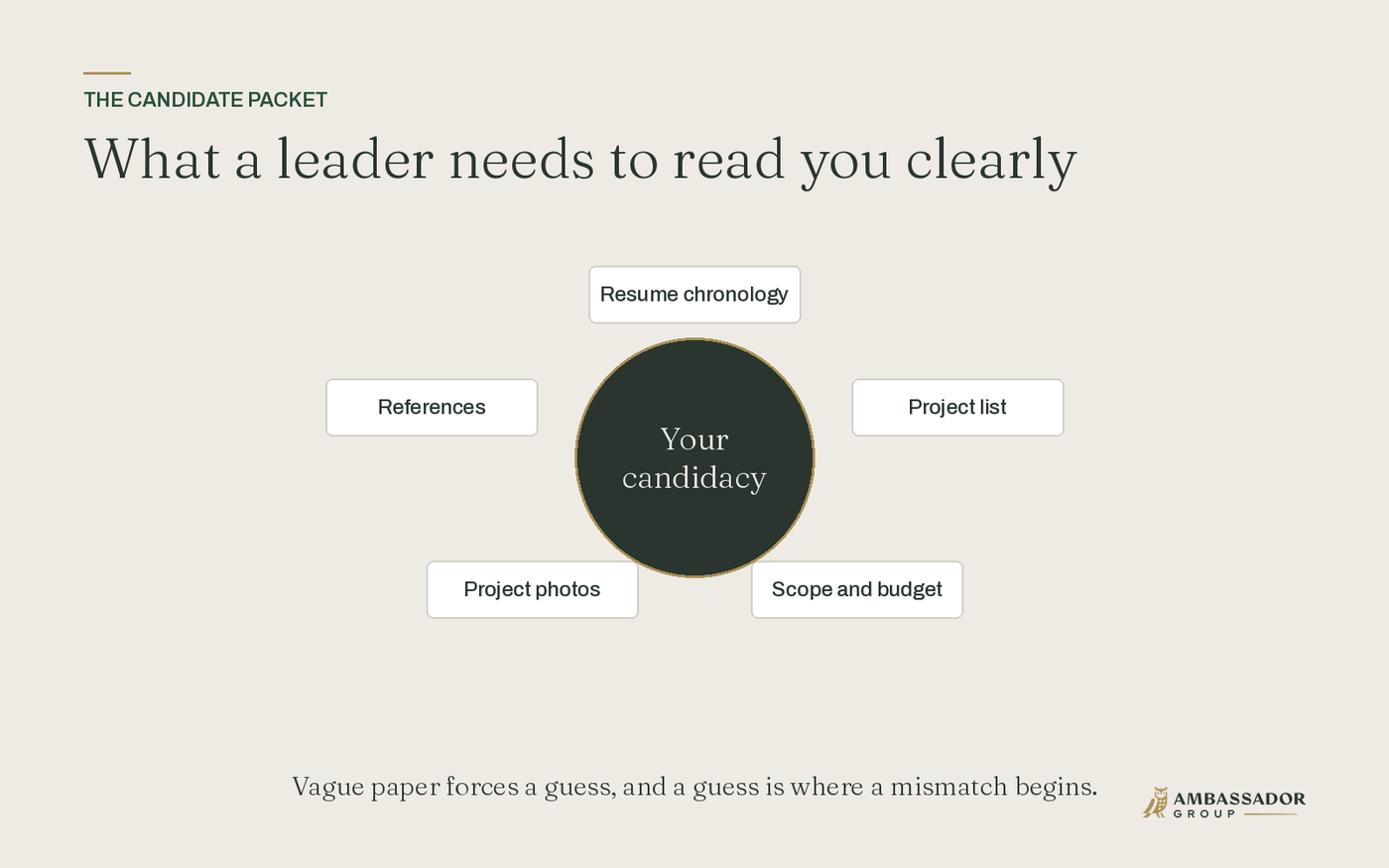
Assemble these documents the way you would run a project: complete, accurate, and organized so a tired reader can follow them at a glance. The resume sets the chronology. The project list supplies the scope and the budgets. The portfolio shows the craft. The references confirm the pattern. Together they form a packet that lets a hiring leader assess you on real information rather than impressions, which is exactly what you want, because a decision made on real information is the kind that holds.
Honesty runs through all of it. Claim the role you held, the scope you owned, the results you delivered, and resist both inflation and false modesty. A leader who hires you on an honest packet hires the actual you, and the actual you is the one who has to show up Monday and run the work. The match that lasts is the one where neither side had to discover a surprise after the offer.
You control every one of these documents, so build the packet that shows a leader the real shape of your work and lets the right match find you.