A filled role and a solved problem are not the same thing, and treating them as identical is the quiet mistake behind most regretted hires. A leader brings in outside help wanting an outcome: a division that runs without him, a project that ships on time, a team that stops leaking its best people. The hire is one input into that outcome. When the work that finds the hire is purely transactional, the leader is handed a name and left alone with the harder questions, which is precisely where a leader who cannot see his own organization clearly will misread the candidate sitting in front of him.
I have been matching people into construction roles for years, and the part of this industry I find hardest to watch is the stretch that treats a search as a fee to close rather than a relationship to get right. That stretch is rarely malicious. It is more often a kind of naivety about the forces in play: the person on the other side of the table is staking their time, their family's stability, and the years they will not get back, and a search run for the fee alone cannot hold the weight of any of that.
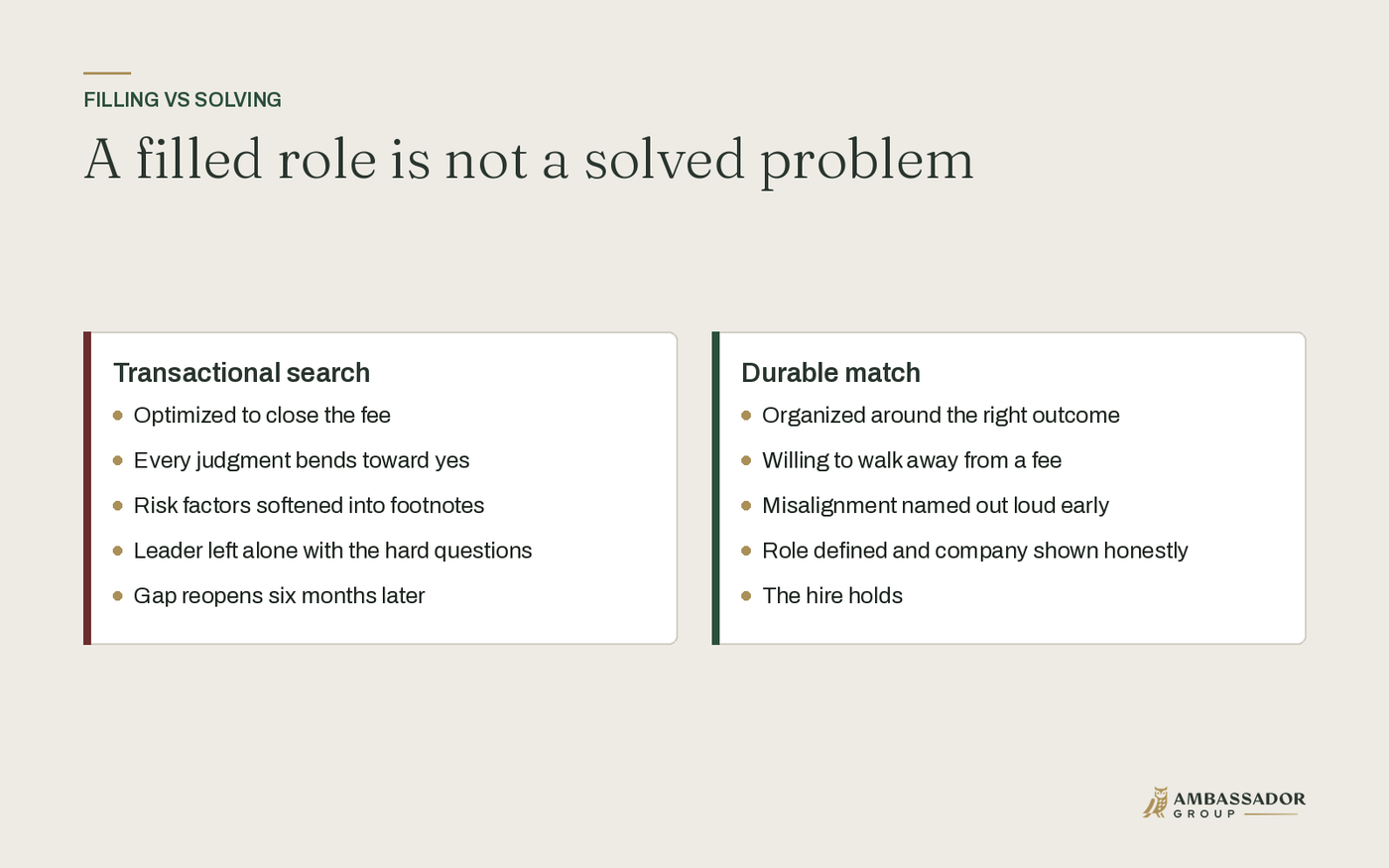
The fee is the wrong thing to optimize
Watch what happens when a search is organized around closing. The incentive bends every judgment toward yes. A candidate who interviews well enough gets framed as aligned. A risk factor that should stop the process gets softened into a footnote. Nobody will name the misalignment out loud, because naming it costs the fee, and so the one person with the clearest view of the gap stays quiet about it.
That silence is expensive in construction specifically, where the cost of a wrong hire is not abstract. A project executive who looked sharp in conversation and turns out to manage upward beautifully while letting field problems rot will cost a general contractor far more than the search ever did. The schedule slips. The owner loses confidence. The good superintendents under him start updating their resumes. None of that shows up in the interview when the interview is a formality on the way to a signature.
The math is worth sitting with. A wrong hire at the leadership level rarely costs only a salary. It costs the months before anyone admits the mistake, the projects that drifted while the wrong person held the wheel, the relationships with owners and subcontractors that frayed under poor judgment, and the strong people who left rather than work under it. By the time a general contractor unwinds a bad project executive, the bill can run past a year of compensation and into the kind of reputational damage that costs the next pursuit. A search that pushed the hire through to collect a fee captured a small fraction of that downside and left the entire rest of it on the leader's books. That is the trade a transactional search quietly makes on a leader's behalf.
A search organized around the fee will always find a reason to say yes, and the reasons it finds are the ones that fail you six months later.
The deeper failure here connects straight to the leader. A leader who cannot see himself clearly cannot see a candidate clearly, and a transactional search lets him skip the self-examination entirely. He never has to ask whether the role is defined, whether his own leadership generates the problems he is hiring to solve, or whether the company he is selling matches the company a new person will truly join. He outsources the search and assumes he has outsourced the thinking. He has not.
Hiring is custody of someone's life
The frame that changes the work is simple to state and hard to hold: hiring is custody of a person's time, which is the one asset they cannot earn back. A candidate leaving a stable role to join you is handing you a stretch of their life on the bet that you told them the truth. A company opening its doors to a new leader is handing that person influence over its culture and its margins. Both sides are exposed. Both sides own the outcome.
Run the search with that in view and the behavior changes on every side of the table. As the person doing the matching, the willingness to walk away from a fee becomes the proof that the relationship is being served rather than the invoice. As the hiring leader, the obligation shifts from filling the role fast to representing your company honestly, including the parts that are still rough. As the candidate, the obligation is the same in reverse: describe your work accurately, name what you cannot do, and decline a role you can already feel is wrong.
A candidate who tells you early that they are not a fit has done you a favor most searches are structured to prevent. The transactional version treats that honesty as a problem to manage. The version worth practicing treats it as the cheapest information you will ever get, because the alternative is discovering the same truth a year and several hundred thousand dollars later, after the wrong person has already reshaped a team around themselves.
Put in what you expect to get out
The old line about getting out what you put in works here as a plain description of how searches behave. A leader who invests an afternoon defining what the role truly owns, who answers honest questions about his own gaps, and who lets the match be tested instead of assumed will get a durable hire. A leader who treats the search as a vending machine and the candidate as the product that drops out will keep being disappointed by capable people, and will keep blaming the people.
So before the next search, look hard at what you are asking for. If the answer is a name to fill a gap, you will get a name, and the gap will reopen. If the answer is a person who can carry a clearly defined role inside a company you have represented honestly, the work in front of you is mostly yours, and it starts before any candidate is ever contacted. You decide which kind of search you are running, and that decision is the one that determines whether the hire holds.