You signed the offer, the team celebrated, and the hard part is only beginning. About eighty percent of turnover happens in the first six months after a job change, which means the most delicate stretch of a move arrives in the weeks right after you start, well past the interview and the negotiation. A durable match is something both you and the company build together, and onboarding is where that shared work either takes hold or quietly comes apart. Knowing that going in changes how you carry yourself through it.
Why the first months are the fragile ones
Two forces collide during onboarding. On one side is a team moving fast, solving problems, carrying a full workload, that now has to slow down enough to bring you up to speed. On the other side is you, experienced and eager to contribute, trying to connect dots you cannot yet see. The friction between those two is where new hires stall. The company that onboards well is the one willing to ease its pace long enough to train you properly, and the new hire who integrates well is the one who stays patient while that happens instead of forcing speed before the ground is solid.
Your experience helps you here, but it can also mislead you. Every company runs its own process, and the differences are often dramatic even when the job title is identical. The way one builder handles submittals, runs its meetings, structures its reporting, or uses its software may have almost nothing in common with the last place you worked. Coming in assuming your old methods transfer cleanly is one of the surest ways to create early friction. Coming in curious about how this specific company operates is one of the surest ways to avoid it.
Treat the check-ins as a real instrument
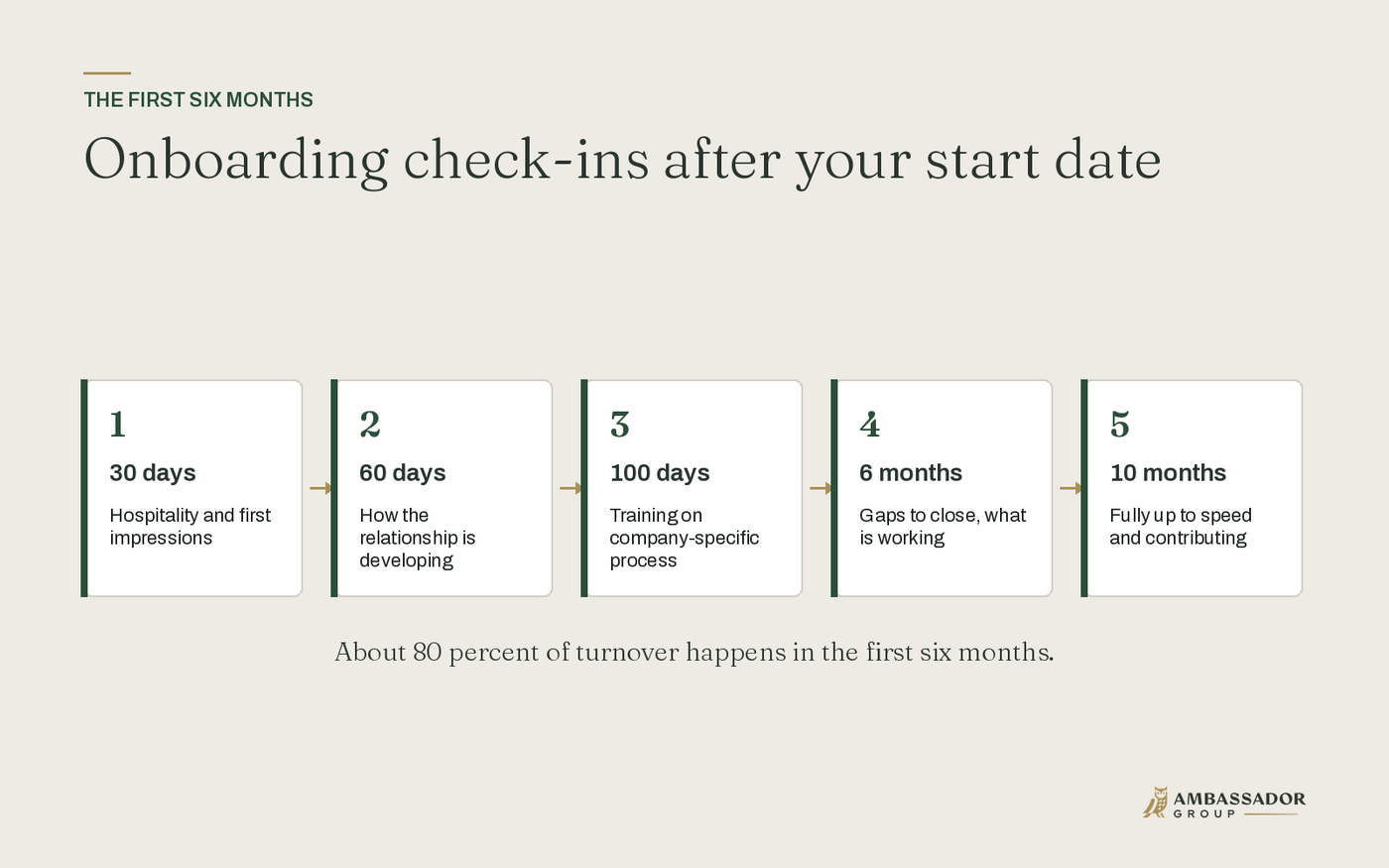
A good hiring process does not end on your start date. Expect to hear from me at roughly thirty, sixty, and a hundred days, then at six and ten months, to ask how the onboarding and training are going. The purpose is to give the company honest insight into what it does well and where it can improve, so the next person who walks in has an easier path than you did. These conversations do not require anything personal or confidential. They stay clear of informing on anyone and clear of mediating interpersonal problems. They are a structured read on the process itself.
Honest feedback about your onboarding is the most useful gift a new hire can hand a company that wants to get better.
A few categories come up each time, and it helps to think about them as you go:
- Hospitality. Was your arrival warm, predictable, and helpful, or were you left to figure out the basics alone.
- The developing relationship. Is the team making time to connect with you, the coffee, the informal context, the small conversations that turn coworkers into colleagues.
- The process itself. Have you been trained on how this company truly works, and where are the gaps, even granting your industry experience.
Your observations get written down and shared with the team in a respectful, constructive way. This is never set up to invite backlash, and if you ever worry about backlash, that is itself something worth saying. You are always free to give your feedback to the team directly as well. The check-ins exist mostly because the teams doing the hiring are often so busy performing that slowing down to examine their own onboarding is genuinely hard for them to accomplish.
Honesty and encouragement both move the work
The same candor that makes a match durable in the interview makes onboarding work after it. If something is unclear, if a step was skipped, if you are three weeks in and still do not understand a core part of the workflow, naming it plainly serves everyone. Most of what surfaces in these conversations is a small, fixable gap in training or communication, the kind of thing that festers if no one mentions it and resolves quickly once someone does. Staying quiet to seem low-maintenance helps no one, least of all you.
Encouragement matters as much as critique, and it is the part new hires forget. Onboarding is hard for every company, and good onboarding rarely gets noticed, because when it is done well you barely feel it happening. That paradox means the teams putting real effort into bringing you in often hear nothing back. Telling them what worked, what made your first weeks easier, what helped you find your footing, lands more than you would expect and motivates them to keep doing it. You are not only receiving a process here; you are helping shape the one the next hire inherits.
What you own in this
Much of onboarding is in the company's hands, but a meaningful share is in yours. You control whether you stay curious about how this specific operation runs, whether you ask when something is unclear, whether you give the team the honest read that lets them help you, and whether you offer the encouragement that keeps a stretched team invested in your success. None of that requires you to be anyone other than yourself. It requires you to treat the first six months as the real work of the move, which is exactly what it is. Show up ready to learn this place on its own terms, say what is true as you go, and you will give this match the best chance to hold.