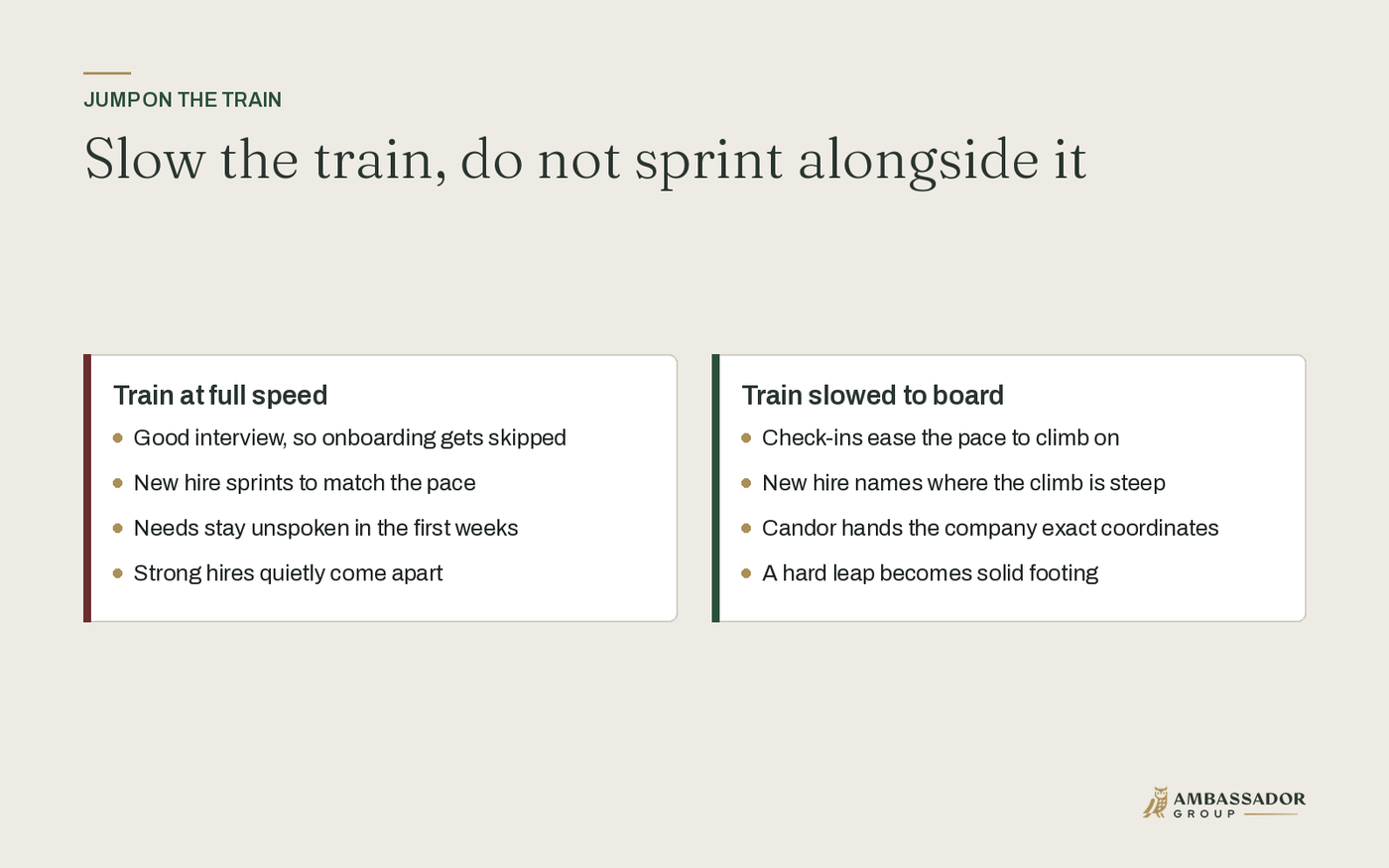
The most dangerous moment in a new role arrives after the interview is won: the first month, when the company is moving at full speed and assumes you can match the pace from day one. Picture a train at a hundred miles an hour and yourself trying to leap aboard. That is what onboarding feels like when nobody slows the train, and it is where strong hires quietly come apart. A lasting match is owned by both the company and the person it hired, and the early weeks are where you carry your share of keeping the match from breaking before it sets.
The irony is that a good interview makes this worse, not better. When a company invests heavily in selecting you and walks away impressed, it concludes you will hit the ground running. That belief feels good to receive and costs you later, because it quietly cancels the onboarding you need. The train stays at full speed precisely because everyone decided you would not need it slowed. Knowing this pattern exists is your first protection against it.
No two starts look the same
There is no universal onboarding that drops cleanly over every new hire, because no two people arrive the same way. You bring a specific history, a particular mix of strengths, gaps the company has not met yet, and your own expectations for how the work should feel. A role is a puzzle piece, and the fit depends on the actual shape of your edges, not the shape of the last person who held the position. What got you up to speed before may be useless here, and only you can tell the company where this climb is steeper than the one it imagined.
That makes your candor in the first weeks a real input, not a courtesy. The company knows its projects, its systems, and its crews cold. It knows almost nothing yet about how you learn, where you feel exposed, or which missing tool or unbuilt relationship is holding you back. Left unspoken, that information never reaches the people who could act on it, and the company keeps onboarding an imagined version of you while the real one struggles in silence.
The check-ins are a structure, use them
To keep the train at a speed you can board, a sequence of check-ins runs across your first year: near thirty, sixty, and ninety days, then at six months and the one-year mark. They cover the quiet determinants of whether a start holds: your training, the tools and software in your hands, the resources you still lack, the relationships you are forming, the expectations attached to the role, and your work-life balance under the new load. None of those is incidental. Each is a place where a capable person stalls when no one thinks to ask.
These conversations function as a feedback mechanism, aimed at the onboarding process rather than at you. The goal is to capture what is working so the company keeps doing it, and to name what could improve while the improvement still helps you rather than the hire after you. Good onboarding is easy to overlook, because when it works it feels like nothing happened at all. Pointing out what is going right is part of the job, since a company blind to its own good onboarding stops paying for it.
The early weeks are a window: you open it by speaking up while the company can still act, and it closes the longer you wait.
One boundary keeps the process clean. Keep confidential matters out of the check-ins. If something arises that the company itself must handle, raise it directly with your boss, the way a professional handles a real concern. The check-ins are there to strengthen the onboarding, and they serve you best when they stay in that role.
Your name on the honesty
You also see the feedback before the company does. Anything reflected back to the firm about how your start is going passes by you first, so you can confirm it represents you accurately and nothing gets lost in translation. Nothing about your experience reaches the company that you have not already said yourself. That sequence protects the honesty the whole match runs on, and it only delivers if you answer plainly instead of offering the agreeable version of how it is going.
So treat your first ninety days as work you do on purpose. When the operations contact reaches out to set up a check-in, arrive with specifics: the training step that left a hole, the software no one walked you through, the relationship you have not had room to build, the expectation that turned out vaguer than it sounded across the table. Naming these is an act of professional candor that hands the company the exact coordinates where the train needs to ease off, which is something only you can see from where you sit.
Congratulations on reaching this point; the role is real and earned. Whether it becomes a long career depends on a partnership, and partnership means you supply the truth about your start while the company supplies the support, each side holding up the commitment it made going in. Speak up while speaking up still changes the climb, and the hard leap onto a moving train becomes a footing you can build a career on.