A behavioral assessment does not tell you who to hire. It tells you what you are about to misread. That distinction is the whole game, and it sits squarely on the leader's side of the table. A leader who cannot see his own wiring cannot see a candidate's, and the interview becomes a mirror he mistakes for a window. The instrument that fixes this is the self-awareness the report forces, because a leader who finally understands his own defaults can stop reading every person through them and start reading people as they are.
Most owners treat a core-trait tool as a personality quiz, something fun for an offsite. It is closer to a calibration check on the instrument you use to judge everyone else. A psychometric trait profile measures comfort zones: the pace a person works at, how much they need to be heard, how much structure they require, where they get their energy, how they reach a decision. None of those positions is good or bad. A one on assertiveness and a ten on assertiveness are both fully functional people. The score only tells you what behavior to expect, not what kind of person will walk in.
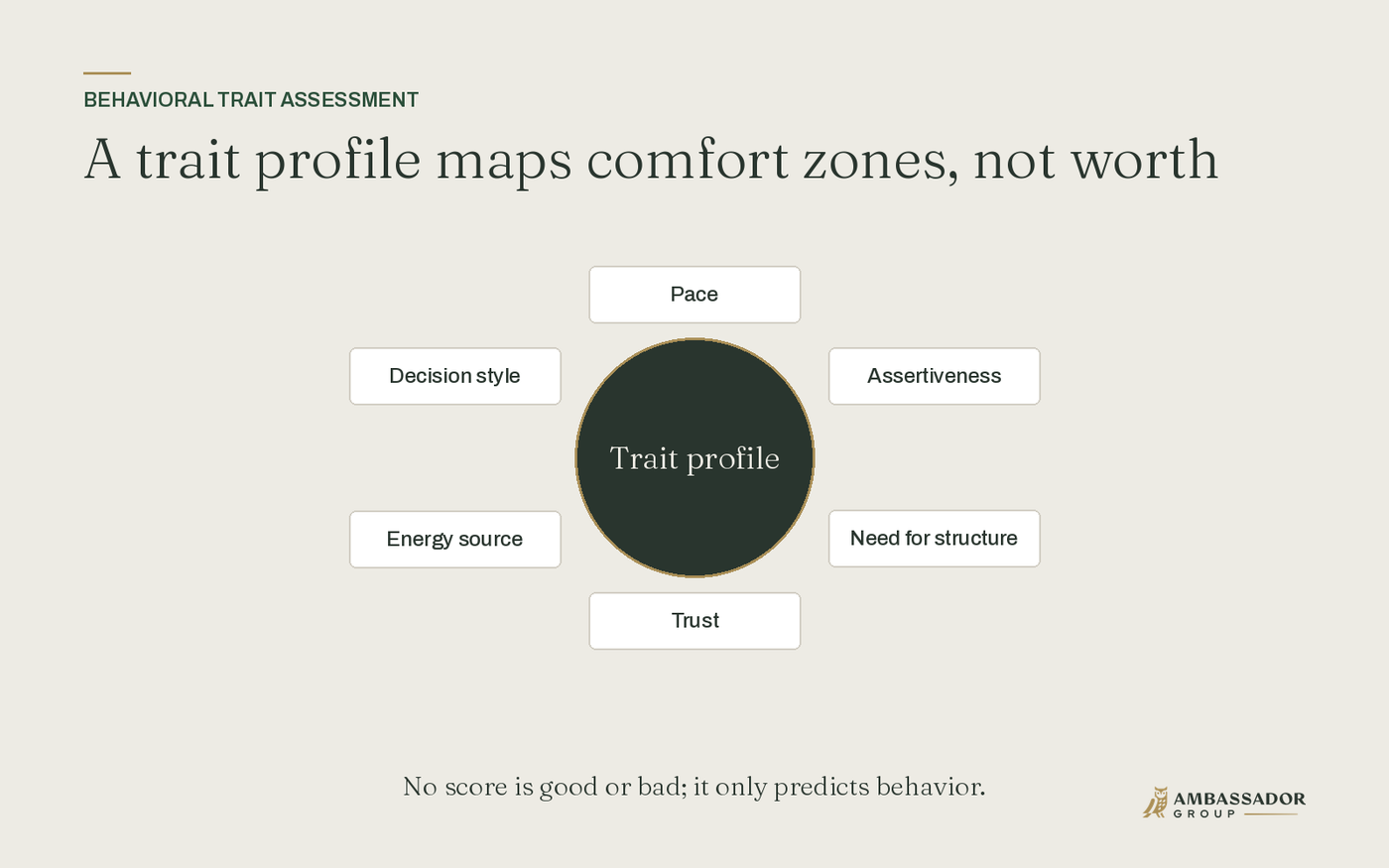
The scores describe behavior, not worth
Picture pace, the rhythm a person likes to work in. A leader who lives at the urgent end of that spectrum moves fast, juggles ten things at once, and gets a great deal done. Attention to detail is rarely his first instinct, because detail slows the rhythm his nervous system is wired for. Pair him with a steadier teammate and the work gets both speed and accuracy. Design his role to demand consummate detail on every line and you will watch the work cost him energy he does not have to spare, and you will read his fatigue as a character flaw rather than a role you built wrong.
The trap is the leader who has never examined his own pace. He drives the whole company at his tempo because slowing down does not occur to him. That tempo permeates the field and the front office, and it surfaces a year later as turnover and burnout, a culture nobody chose on purpose. He will look everywhere for the cause except the one place it lives.
Where the leader becomes the variable
Assertiveness makes this plainest. When a leader scores far to the right, his need to be heard is real, almost physical. He walks into a conversation and starts talking, because his ideas need to get out. The cost is invisible to him: the people at center and left go quiet, and he never hears what they truly think. He has to ask specific questions to pull anything out of the quieter half of his team, and if he never learns that, he runs an organization that only echoes him back. I have watched this play out, and the fix was never a new hire. It was the leader learning when to stop talking, which no resume screen will teach you.
The leaders most certain they have arrived are the ones carrying the largest blind spots into the interview.
Now layer the traits. A candidate high in trust paired with low assertiveness will not push back when something does not make sense, which means a careless leader can walk that person straight into a mistake and never get a warning. A skeptical, forceful candidate will challenge a vague decision, which is uncomfortable and also exactly the protection a gut-driven leader needs. The combinations are close to forty million, and they never repeat. There is no clean bucket to drop a human being into, which is the point. The tool refuses to label, and a leader who wants tidy labels will misuse it within a week.
Emotional intelligence is the stretch
Every trait can be stretched. A person built to recharge alone can work the front of the house and do it well, for a while, at a real energetic cost. That capacity to stretch beyond a comfort zone to reach a goal is emotional intelligence, and it matters more in a hire than experience or raw intelligence, because experience can be taught and the willingness to flex usually cannot. The most valuable thing a behavioral profile gives a leader is a shared language for the conversation about where that person will have to stretch, what it will cost them, and whether the role is honestly built to let them recharge.
That conversation is the bilateral part. A candidate who can see her own wiring can tell you, before she signs, where she will struggle in your shop. A leader who can see his own can tell her the truth about how he runs under pressure. Both parties end up holding the outcome, which is the only version of a match that survives the two-to-three-year mark, the point where the interview honeymoon ends and the real person finally settles in.
Use it after the offer, too
The profile earns its keep long after the hire. When two strong people stop working well together, the answer is rarely that one of them is bad. It is usually two comfort zones grinding against each other with no one naming it: the urgent one wondering why his teammate will not move, the careful one wondering why his teammate will not slow down. Pull the report back out, calibrate your read of who each person truly is, and the friction turns into information you can manage. That is leadership: getting the work done through people, which means designing the work around who they are instead of who you wish they were.
An assessment is a two-dimensional slice of a three-dimensional person, one tool in a belt that also holds the interview, the references, the work sample, and your own judgment. The person who makes the difference is the one wielding the tools, and that person is you. Look honestly at your own profile before your next interview, and ask how many of your recurring people problems are about the candidates and how many are reflections of a leader who has not yet done his own work.