A personality assessment makes the worst possible hiring tool and one of the best possible conversation starters, and most companies get that backwards. The instant a leader treats a PXT profile as a verdict, the instrument starts doing harm: a strong candidate gets screened out for sitting on the wrong end of a curve, and a leader's own blind spots get laundered into something that looks like data. The value of an assessment is in the questions it forces into the open, including the ones about the leader holding it. A leader who cannot see his own wiring cannot read a candidate's, and a profile is one of the few tools that makes both visible at the same time.
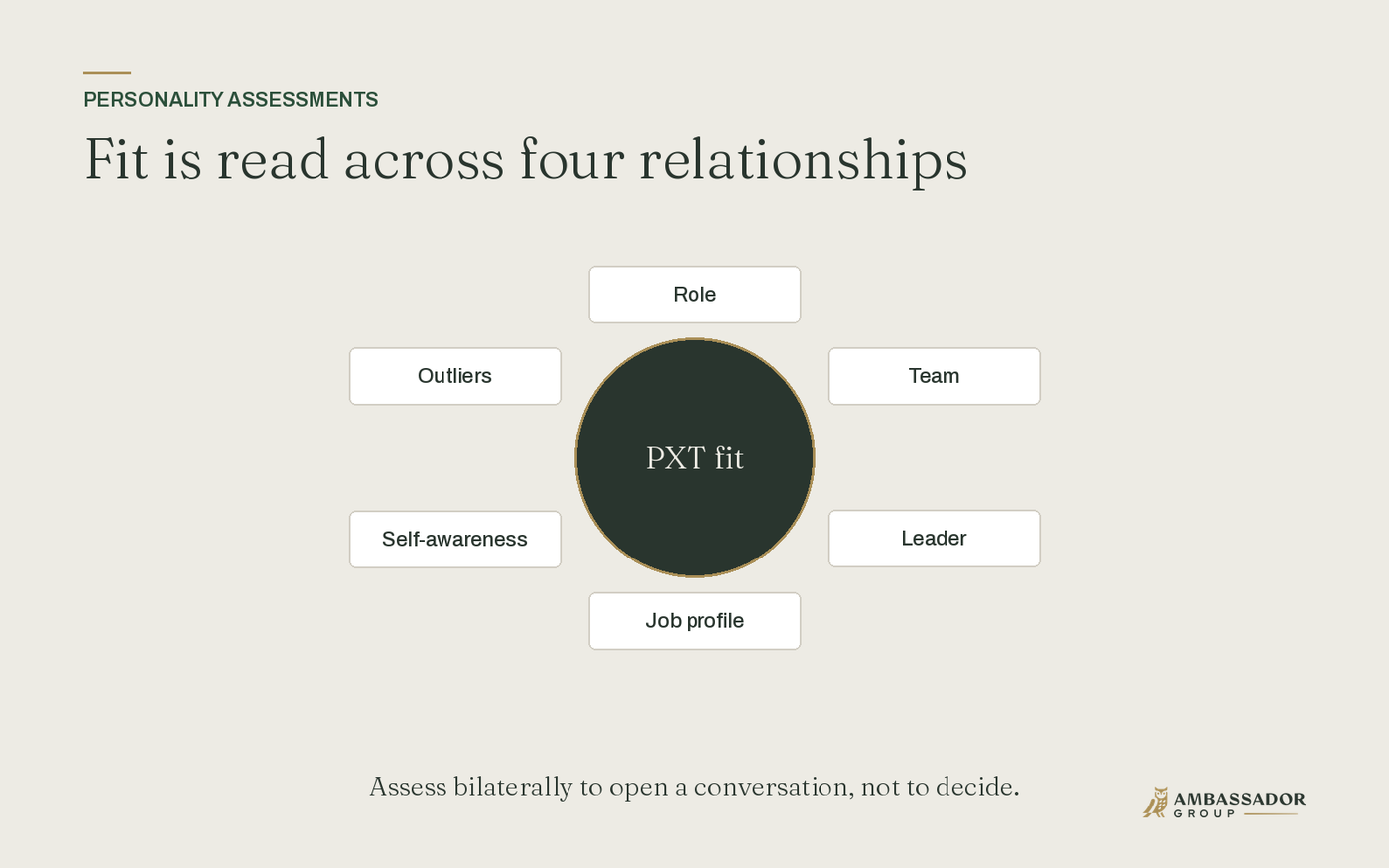
I use the PXT, or Profile XT, for three kinds of fit at once: fit to the role, fit to the team, and fit to the leader. That third one gets skipped most often, and it matters most.
Assess the leader alongside the candidate
There is an old line that people do not quit jobs, they quit leaders. If that is true, then assessing the candidate alone tells you half the story. So I run the assessment bilaterally: the leader gets profiled alongside the candidate, and the real object of study becomes the relationship between the two profiles.
Those profiles are often different, and difference is where both the friction and the strength live. Two people who process stress, pace, and detail in opposite ways can build something neither could build alone, or they can grind each other down for a year before anyone names why. The deciding factor is awareness. A leader who can see that a candidate is wired differently can manage that difference on purpose. A leader who never looks reads everyone through his own defaults and calls it judgment, then wonders why a capable person kept missing what felt obvious to him.
A profile does not tell you whether two people will work; it tells you what they will have to talk about if they want to.
Put the whole team on one page
Lay every team member's profile on a single report and the spectrum of personalities becomes visible at a glance. The people sitting at the extremes are the ones to study most closely. An extreme can be a real source of strength: a relentless driver, an obsessive finisher, someone whose intensity raises the standard for everyone around them. Paired with self-awareness, that intensity is an asset. Paired with no self-awareness, the same trait turns corrosive and can pull a team apart from the inside.
The point of seeing the spread is to start a conversation, not to sort people into keepers and problems. What does this candidate understand about their own edges? What does the team understand about how they come at the work? What does the leader understand about the mix already in the building? A team without a shared language for these differences has no real way to navigate conflict when it arrives, and conflict always arrives. The assessment gives everyone the vocabulary before the friction, instead of after the damage.
Consider how this plays out on a real project team. A field-driven superintendent who moves fast and decides early sits next to a project manager who wants every assumption documented before anyone commits. On paper that is a strong pairing, speed checked by rigor. In practice, without a shared read of each other's wiring, the superintendent experiences the PM as a brake and the PM experiences the superintendent as a liability, and the friction shows up as missed handoffs, defensive emails, and a job that runs hotter than it should. Put both profiles on the table early, name the difference out loud, and the same two people can divide the work along the grain of how they are built. The tool did not change either person. It gave them a way to talk about a tension that was always going to be there.
Fit to the role, with eyes open for the outlier
The PXT has profiled many people across construction roles, superintendents, project managers, estimators, and aggregated a broad picture of where successful people in each role tend to cluster. Generally a strong PM lands in one region of the spectrum, a strong superintendent in another. That pattern is useful, but not for predicting whether a given candidate will succeed. It is useful for spotting the outlier and knowing to have a conversation about them.
Picture a superintendent who runs slow and detailed, exceptional on a high level of finish, but not driving the project at the pace the schedule demands. That gap is exactly the kind of thing you want surfaced before the offer, not discovered in month three when the job is already behind. The assessment will flag it, and more importantly it gives you the language to raise it directly: here is a real strength, here is where it may cost you, here is how it gets managed. Handled with awareness, that outlier can become the candidate's edge. Left unspoken, it becomes the reason the relationship quietly fails.
That bilateral honesty is the entire point. Both the candidate and the company own the outcome of the match, and informed commitment is what makes one durable. A profile read as a verdict robs both sides of that, because it ends the conversation before it starts. A profile read as a prompt does the opposite: it gives a leader and a candidate an honest look at the wiring on both sides of the table and a reason to talk about it like adults before they decide to build together.
So the next time an assessment lands on your desk, resist the urge to read it as a score. Read it as a list of the conversations you have not had yet, starting with the one about yourself, and you will use the tool the way it earns its keep.