Most leaders walk into an interview asking one question: is this candidate good enough for the company. It feels like rigor. It is the wrong question, and it quietly puts the entire weight of the hire on the wrong person. A leader who cannot see his own role in a hire cannot see the candidate clearly either, because he is reading the person without accounting for the largest variable at the table: himself. Since you control the interview, the job, and the environment, the bulk of the responsibility for whether this hire succeeds sits on your side of the table, not theirs.
The thing worth building in an interview is informed commitment. The candidate should understand what they are committing to, and the strength of that commitment should be real. That means they grasp the actual challenges of the role, the hard decisions it will demand, and the outcomes they are accountable for producing. A commitment made in the dark is a guess dressed up as a yes.
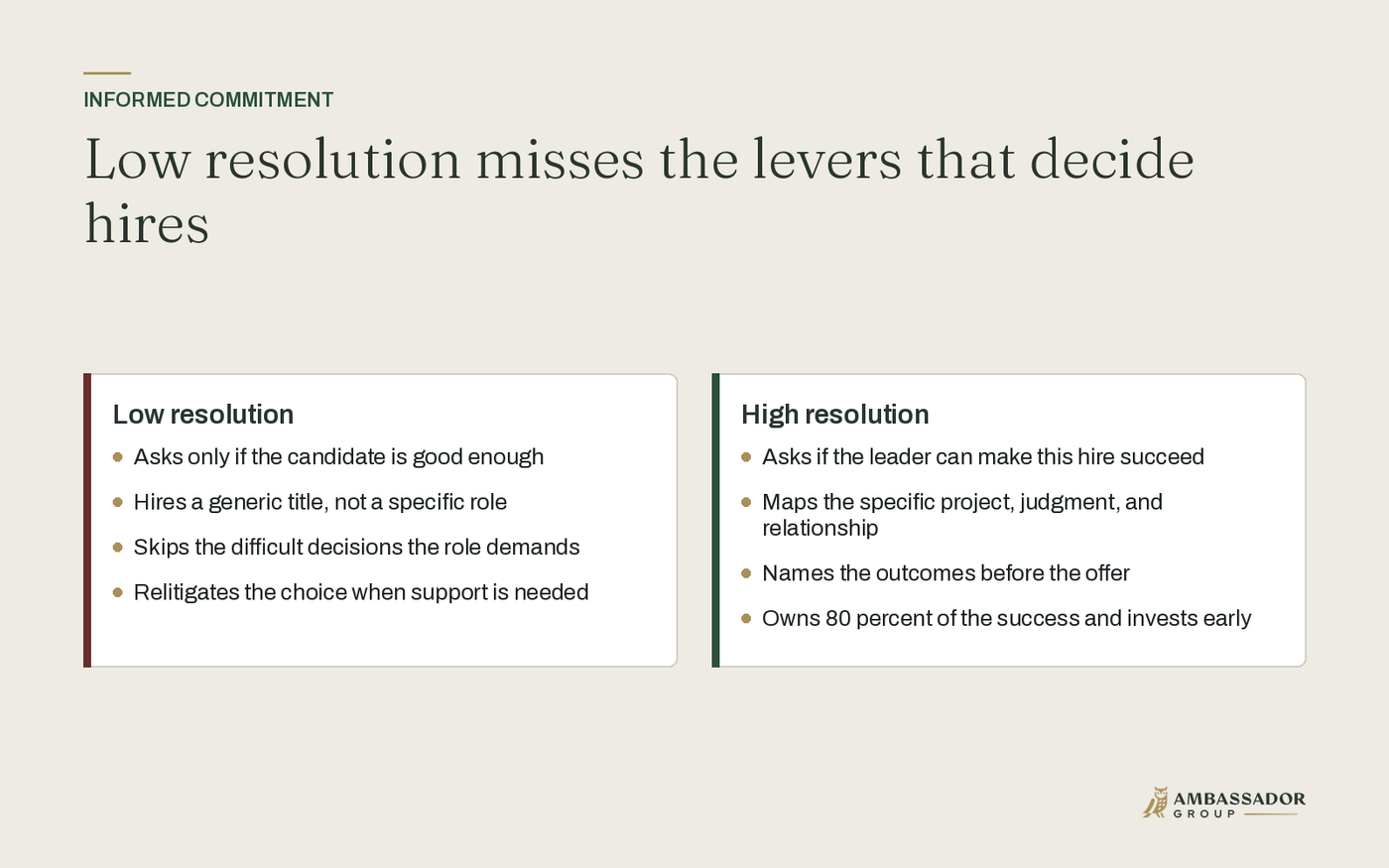
Generic understanding produces shallow commitment
You cannot develop informed commitment from a generic job description. When the person interviewing does not understand the particular nuances of the role, their ability to help a candidate commit to it honestly drops to almost nothing. They can describe a title. They cannot describe the week.
Picture a superintendent search run by someone who has never carried a schedule. The interview covers years of experience, software, a few war stories, and a salary band. What it never touches is the specific pressure of this job: a difficult owner's rep, a design that keeps changing, a foreman who needs to be developed rather than replaced, a closeout process that has burned the company twice. The candidate says yes to a role they were never shown. Three months later, the surprises arrive, and both sides feel misled. Neither was lying. The interview operated at too low a resolution to produce a real commitment.
High resolution is the whole game. The more precisely you think through the challenges of the job, the strengths and gaps of the person, and the gap between the two, the more grounded your own commitment becomes. When you hire someone after that kind of examination, you know you are reasonable to be committed to their success, because you have measured what their success will require.
The reframe that changes the interview
Here is the question worth carrying in instead. Set aside whether the candidate is good enough, and ask: am I a good enough leader to help this candidate succeed against the challenges of this role. Do they have the emotional intelligence, the experience, the intellectual capacity, and the character to use my support, the company's processes, and the leadership available to them and solve the problems the job will throw at them.
That reframe is more demanding, because it makes you accountable for the part you control. Most leaders hire someone they judge good enough, then never think through the level of investment that hire will need from them. So when the candidate hits a wall and support is required, the leader is caught off guard. Instead of getting busy serving the person and doing the work he should have known was coming, he starts relitigating the decision in his own head. He questions the fit. He second-guesses the hire.
The hiring mistake is committing to someone without first counting what your commitment will cost.
The candidate feels that questioning. It does not read as thoughtfulness. It reads as a loss of confidence, as micromanagement, as a leader who is no longer sure. That is the opposite of the support a person needs in the months when they are learning a hard role. The hire was sound. The leader's failure to prepare for his own part is what turns it sour.
Hire for the specific, not the category
Low-resolution thinking shows up most in how leaders name what they want. Another PM. Another superintendent. As if the title were the job. You are never hiring a category. You are hiring for a specific leader relationship, a specific project, a specific kind of judgment under a specific kind of pressure.
Two project managers with identical resumes are not interchangeable. One thrives on a fast, owner-driven custom home where the client changes the kitchen four times and the schedule bends weekly. The other does his best work on a long, technically demanding commercial build where the discipline is in the submittals and the sequencing. Drop each into the other's job and you can manufacture failure out of two genuinely capable people. The title told you nothing. The resolution would have told you everything.
So interview for the specific. What does this exact role require, and where will this exact person be strong and weak against it. Where are the gaps, and who covers them, you or them or a process. When you can answer that with precision, you can onboard with precision, train with precision, and support with precision. The same clarity that protects the candidate protects you, because it tells you in advance where you will need to show up.
What to do before the next interview
Understanding a person quickly is hard. I have been matching people into construction roles for fifteen years and repped this problem inside my own firm, and I do not have it solved. People are not always transparent in an interview, sometimes about things they do not know about themselves. Reading judgment, character, and the real shape of someone's strengths through that fog is genuinely difficult, and pretending otherwise helps no one.
What raises your win rate is higher resolution. Before the next interview, do the work the interview cannot do for you. Map what this specific role will demand in its hardest weeks. Name the kind of judgment it rewards. Be honest about where your own leadership style will help this person and where it will get in their way. Then build the interview to test fit against that map rather than against a vague sense of whether someone is impressive.
In the version of this that works, every hire you make is one you are fully accountable for, because you gauged the risk, the reward, and the investment each one needed before you ever extended the offer. You will not hit that perfectly. No one does. But the leaders who keep raising their hit rate are the ones who stopped asking whether the candidate was good enough and started asking whether they had done enough to make the commitment informed on both sides. Walk into your next interview owning your eighty percent, and the candidate across from you will finally be committing to something real.