When you hire someone, you hand a near-stranger millions of dollars in liability, access to your culture, and a claim on every dollar you spend training and carrying them. You make that handoff on the strength of a few hours together. Think about how slowly trust forms everywhere else in adult life, and the hiring problem comes into focus: you are trying to know a person well enough to bet the business on him, with almost no time and almost no context. A leader who has not reckoned with how little those few hours reveal will fill the gap with his own assumptions, and a leader who cannot see his own assumptions cannot see the candidate underneath them.
The challenge gets harder because the interview is a performance. People are trained to show up a certain way, to wear the veneer that interviews reward. Hospitality matters in an interview, so you are not trying to strip that away. You are trying to see past it, to read how a person is built underneath the version he brought to the table, and to do it under the kinds of pressure that are fair to apply in a conversation.
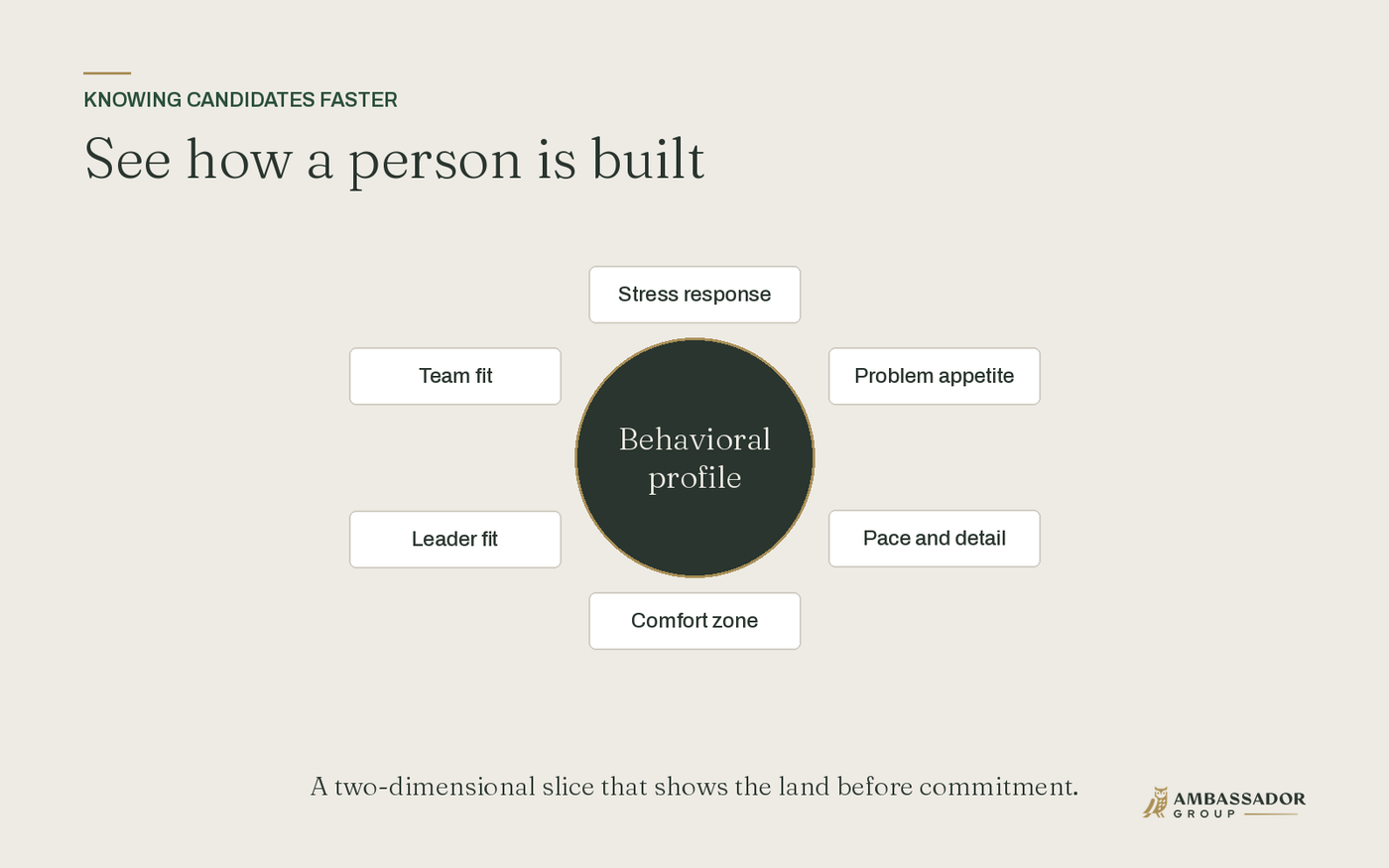
A two-dimensional slice of a three-dimensional person
This is where a behavioral assessment earns its place. A good personality assessment is a two-dimensional slice of a three-dimensional person. It will not tell you whether to hire someone, and it is not comprehensive. What it gives you is a vantage point you understand, a consistent way to see the lay of the land before you commit. It shows you how a person tends to handle stress, what kind of problems energize him, how fast he likes to move, how much detail he can hold, and whether he is built for the particular challenge you need solved.
The word that matters there is tends. The assessment describes a comfort zone, not a cage. People stretch. The value is knowing where the stretch will be, so you can decide whether the role asks for stretching the person can sustain or stretching that will wear him down by month six.
Two conditions make the tool work, and skipping either wastes it. First, you have to have taken it yourself, ideally with your team, and calibrated against it until you can read a profile without re-learning the legend each time. Second, you have to know what you are looking for, which means knowing your own culture, the role's real demands, your personality, the team's personality, and the specific problem the hire exists to solve. The assessment does not pick a winner. It hands you a clearer picture and leaves the judgment where it belongs, with you.
Salmon do not climb trees
The reason this matters runs straight through the most common hiring mistake I see. A leader who has never examined his own wiring assumes his way of solving a problem is the way to solve it. He reads every candidate through his own defaults and calls it judgment. Picture people as animals for a moment. A salmon and a monkey are both capable, but hire the salmon to climb a tree or the monkey to swim the ocean and you have engineered failure for everyone. There are behavioral profiles hardwired to fit certain roles, certain cultures, certain leaders, and the leader's job is to figure out which profile fits his.
Most of the time the resume is right and the hire still fails, because nobody checked whether the person was built for the way this company works.
I have sat inside hundreds of construction companies, and the differences hide under the surface. A leader with a deep penchant for detail runs a company that esteems precision and moves deliberately. A leader programmed for speed is hardwired to compromise toward urgency; he is not careless, his thinking optimizes for pace. He needs to know that about himself. His people need to know it. And when he hires, he needs to evaluate how a candidate works inside that specific tempo, not in the abstract. Two Bay Area builders can put up the same structure and run completely different shops underneath, with different missions, different values, and different balances of speed against accuracy. Organizational self-awareness, knowing what your company truly values when it cannot value everything, is as important as knowing yourself.
Trade the data, do not hoard it
The strongest way to use these tools is bilateral. You see the candidate's profile, and the candidate sees yours. You put both on the table and talk about how the two of you are going to work together. That turns the assessment from a verdict on the candidate into a collaboration about the relationship. Here is my profile, here is yours, here is where you and I will probably grind against each other, here is what I will need to do to lead you well.
That last part is the heart of it. When you hire someone, you are saying he is worthy of joining the organization and committing every resource you have to making him successful. As a leader you control most of the equation: the culture, the team, the training, the onboarding, the interview, the job itself. The candidate owns his performance, and people still do not always work out, but the share you control is the larger one. So you want people built for the challenges you put in front of them, and you want to know in advance where you will have to lead differently than your instinct.
This is why informed commitment outlasts optimism. Hire someone through rose-colored glasses, certain he will never strain your process or test your patience, and you have set you both up, because the friction is coming. There will be rough seas. The question is what each of you looks like when the heat is on, and you can rehearse that honesty early by putting the real data on the table before the first hard week arrives.
The objection is always time. These tools take real investment to learn, and a busy leader can talk himself out of one. But hiring carries more weight than anything else you do. Get it right and a lot of downstream problems solve themselves; get it wrong and they generate themselves, as anyone who has tried to unwind a bad hire already knows. You will never make hiring perfect, because humans are too complicated for that. You can make it less volatile, and the leader who invests in seeing people clearly is the one who decides how much of that chaos he keeps.