Most people who leave a job do not leave over anything that appeared on their resume. They leave because they do not fit the work, or they do not fit the manager, or they do not fit the team. Almost none of that is visible in an application, and almost all of it is behavioral: how a person interacts, how he chooses to show up under a particular kind of task, what he does when the pressure changes shape. A leader who cannot see those patterns in himself will not see them in a candidate either, and hiring is exactly where that blindness turns into turnover a year later. A structured behavioral assessment exists to make the part below the waterline visible before you commit, so the leader is reading the whole iceberg instead of the tip an interview shows.
I have used the Profile XT for years now, and the value is best described as seeing around the corner. A resume tells you what a person has done. It does not tell you how he is wired to do it, where his comfort zone sits, or what you will have to do to manage him well. The assessment gets at those things early, gives you sharper interview questions to probe them, and tells you in advance what leading this person is going to ask of you. That last piece is the one leaders skip and pay for, because the work of managing a mismatch is the work nobody planned for.
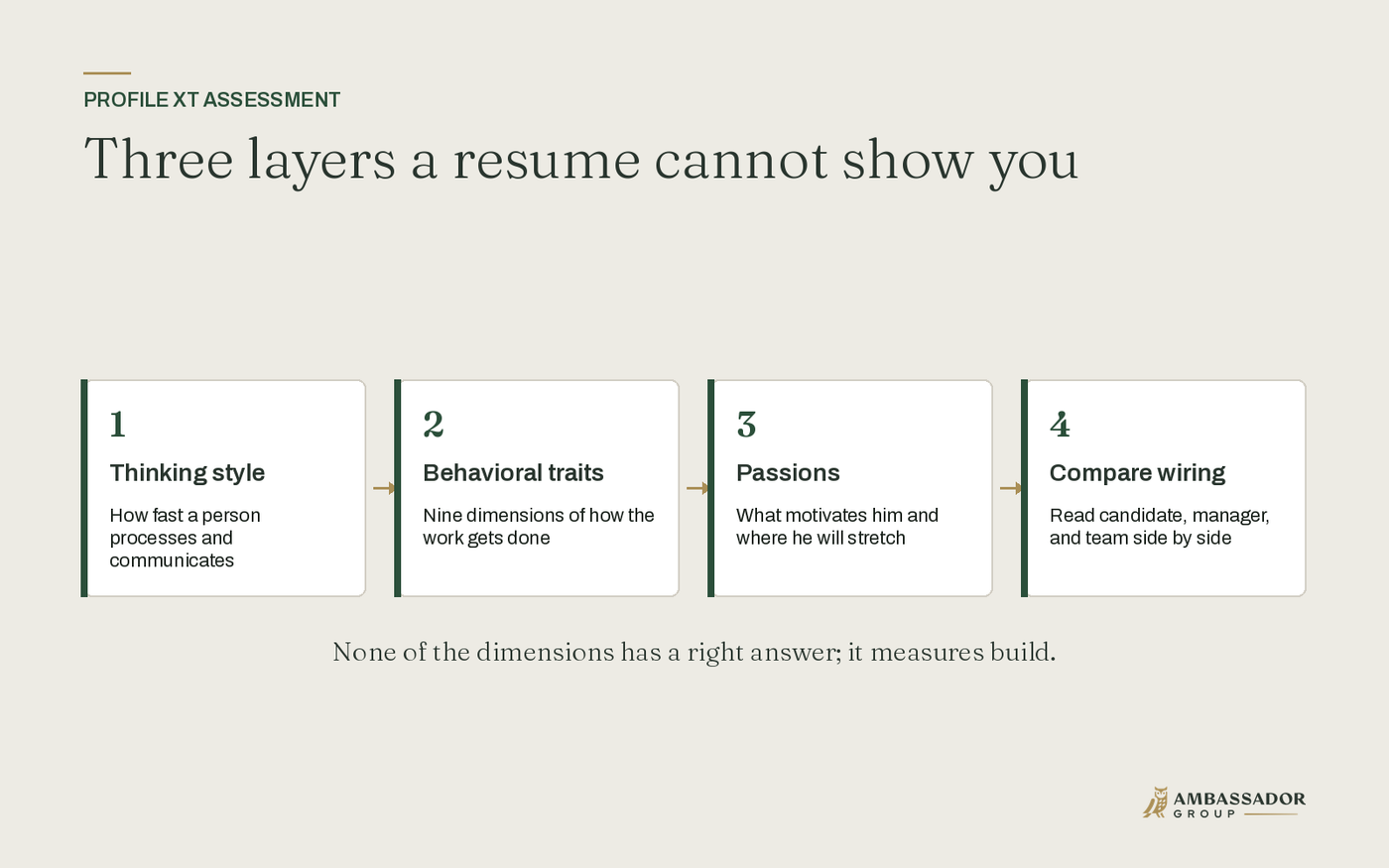
Three layers, nine dimensions, one honest picture
Kim Leon, who has read thousands of these assessments since 1997, breaks the tool into three layers. The first is thinking style, the cognitive piece: how quickly a person processes information and how he communicates it. The second is behavioral traits, which describe what the work will look like when this person is doing it. The third is the passions layer, what motivates him, what he is drawn toward, and therefore where he will and will not want to stretch.
Inside the behavioral layer sit nine dimensions, and naming them is what makes the conversation high-resolution. Pace is how many things a person likes to have going at once. Assertiveness is the need to be heard. Sociability is the familiar introversion-to-extroversion range. Conformity is whether a person wants rules, structure, and process or prefers to operate without them. Outlook runs from trusting and positive to skeptical and guarded. Decisiveness measures appetite for risk in decisions, quick and unbothered on one end, risk-averse on the other. Accommodation runs from pleasing others at any cost to staying locked on the goal regardless of feelings. Independence is whether a person would rather do the work alone or on a team. Judgment runs from deciding by facts and data on one end to deciding by gut and intuition on the other.
None of these has a right answer. The assessment is measuring how he is built, which is a different question entirely.
A worked example: pace
Pace makes the point concrete. A leader high on pace can take many things coming at once, jump from project to project, get interrupted and return to exactly where he was without losing the thread. Adding new work is his contribution; it is how he keeps the business moving. A person low on pace wants one or two things in front of him, holds tight attention to detail, and dots every i. Put those two on the same team without naming the difference, and the leader reads the detail-oriented person as too slow while pushing more onto his plate, and the more he pushes, the more details that person drops. Both are doing exactly what they are wired to do.
Most leaders see their own way of solving a problem as the right way, and read everyone who differs as a performance problem instead of a different build.
Name the dimension and the conversation changes. The detail person can say, my strength is precision, so give me two or three priorities at a time if that is what you want me to protect. The leader can decide whether the role genuinely needs that precision or needs someone built further toward speed. Either way the expectation is set in daylight, before the mismatch becomes resentment. Everyone can stretch, but stretching is not the comfort zone; it is where a person lands when you ask him to operate against his natural setting, and that is sustainable in doses and corrosive as a permanent demand.
Bring the manager and the team into the assessment
The reason the assessment grows more useful when the hiring manager and the immediate team take it too is the same reason people leave: they leave managers and teams they do not fit. Knowing how the candidate is wired tells you only half the story. Knowing how the manager and the team are wired lets you compare the two and surface the likely friction points before the hire, while they are cheap to plan around rather than expensive to discover. There is almost always a friction point or two; a profile that lines up perfectly with everyone is not how humans work. The goal is knowing which risk you are taking and whether you, this manager, and this team are equipped to navigate it.
Used well, the assessment is a way to look candidates side by side and ask which one presents the least risk for this role, this manager, this team, and which one you are genuinely built to manage. It is also a kindness to the candidate. When the process reaches the final person, the data gets shared with him: here is where the job will ask you to stretch, here is how the organization plans to support you through it, here is how you will be coached. A candidate who has stretched in that exact area before, and does not want to again, gets to say so before committing. That disclosure protects everyone, because there is always a honeymoon, and the real person tends to emerge a year or two in. Showing both parties what the real person looks like ahead of time is the whole point.
Interviews push both sides toward looking good, and looking good is the enemy of the transparency that durable relationships need. A shared assessment counters that pull. It lets both people go into the work with informed commitment, having seen around the corners and disclosed the truth about goals, wiring, and the challenges they will have to solve together. Run your next search this way and you trade a hopeful guess for a clear-eyed conversation, which is the trade only the leader can choose to make.