
Pull up your interview notes from the last finalist you met and read the first line. If it says "sharp, good energy, would fit the team," you have a record of how the conversation felt to you and almost nothing about what the candidate has done.
I call that low-resolution interviewing. It produces impressions. High-resolution interviewing produces evidence: what the candidate did, under what conditions, with what result, checked by the interviewer assigned to check it. The difference shows up on paper before it shows up on the jobsite, and the paper is already in your files. Leaders who can't see themselves clearly can't see candidates clearly, and your notes are the most honest mirror you have of how you interview.
Two kinds of sentences in your interview notes
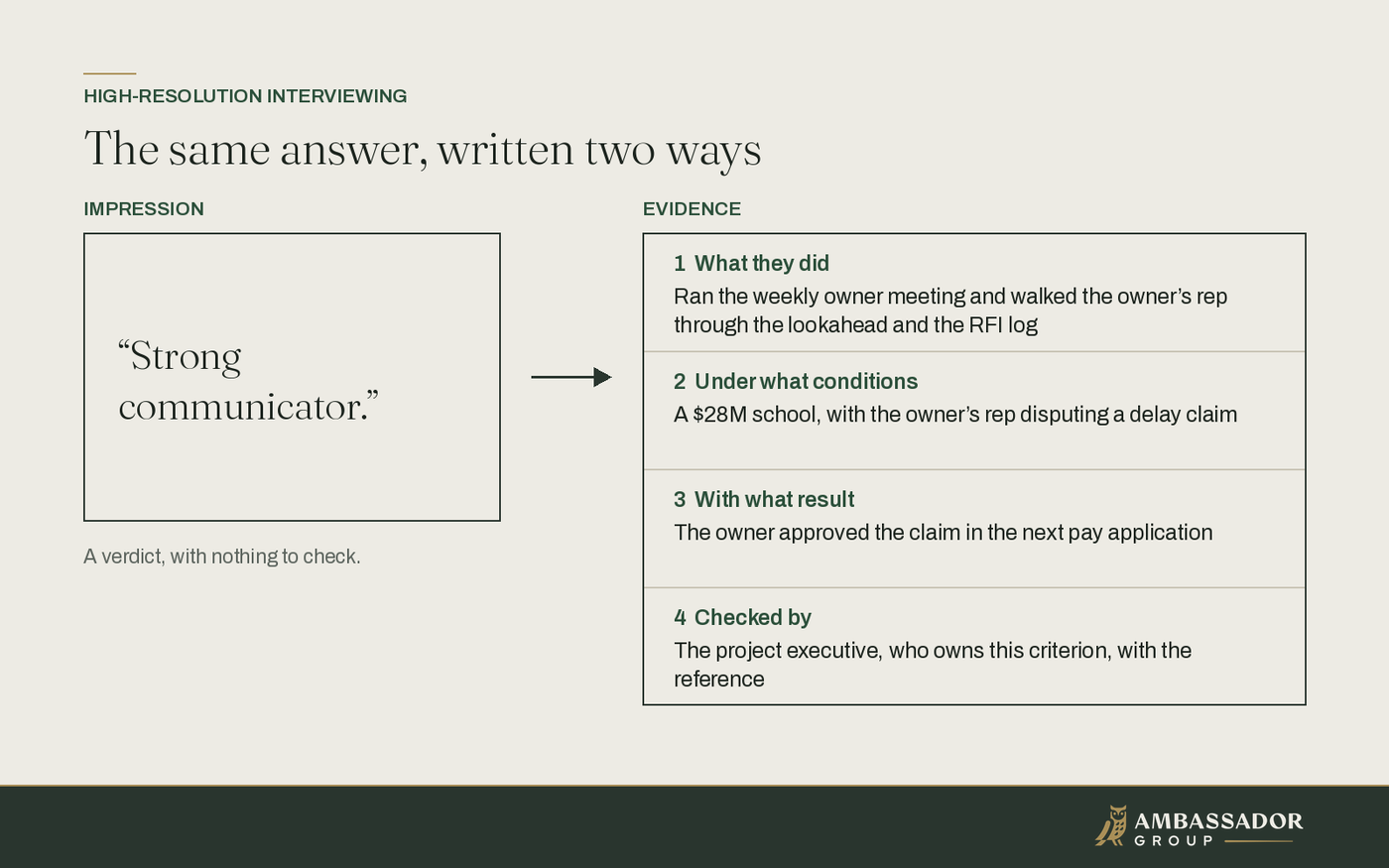
An impression is a verdict about the person. It runs on adjectives: confident, organized, strong communicator, good culture fit. Evidence is an account of an event. It runs on past-tense verbs, names a situation, and ends in a result someone could check.
Take a superintendent search for a $40M outpatient medical building on an aggressive schedule. Two finalists: Jordan, polished, from a national builder, and Riley, a general foreman stepping up. The same interview reads differently in each resolution.
- Impression: "Jordan is a strong communicator."
- Evidence: "Jordan ran the weekly owner meeting on a $28M school. When the owner's rep disputed a delay claim, Jordan walked them through the three-week lookahead and the RFI log, and the owner approved the claim in the next pay application. Project executive to confirm with the reference."
- Impression: "Riley knows safety."
- Evidence: "After a trench near miss on their last site, Riley stopped excavation for half a day and rewrote the plan with the competent person. No recordables in the 14 months that followed, by Riley's account. Safety director owns this criterion and will verify with the former safety manager."
The impression lines are shorter, and they feel finished, which is what makes them risky. Each one is a conclusion with the facts that produced it thrown away, so nobody in the debrief can test it, and the next interviewer has nothing to build on.
The four parts of a piece of evidence
A note counts as evidence when it holds all four parts. A note missing one is partial and needs a follow-up before the debrief.
- What they did. An action the candidate took, in the first person. "The team recovered the schedule" tells you about the team.
- Under what conditions. Project size, delivery method, schedule pressure, who else was involved, what was going wrong.
- With what result. A date, a number, an outcome, including the ones that went badly.
- Checked by whom. The interviewer who owns that criterion, plus the follow-up or reference that confirms it.
The fourth part is where interview processes most often go blurry. Four interviewers each hear a pleasant version of the same story and nobody owns the follow-up. When one person owns each criterion, the check has a name attached to it, and "I couldn't confirm that" becomes a finding instead of a gap nobody noticed.
Why impressions feel like evidence
Memory rebuilds a conversation every time you recall it, and it rebuilds around the verdict. By the time you write notes the next morning, "sharp" has replaced the three answers that made you think so. If you can no longer reconstruct those answers, the adjective is all that survives into the debrief.
Polish makes this worse. A fluent candidate like Jordan generates strong impressions quickly, because fluent speech is easy to listen to. A candidate like Riley, who answers in specifics and pauses to get the numbers right, can generate a weaker impression from a stronger record. In a debrief run on impressions, the most confident adjective tends to win.
The adjective also describes you. "Sharp" usually means "I liked how they talked." "Not a culture fit" often means "they reminded me of someone who did not work out." Across years of reading client panels' interview notes, I have found that the ones heaviest with adjectives tell me more about the interviewer's reactions than about the candidate. That is the self-awareness problem in its most practical form: an interviewer who reads their own reaction as a fact about the candidate will hire the people who produce the reaction they like.
Three signs you ran a low-resolution interview
Your notes are mostly adjectives
Count them. If the page has more adjectives about the person than past-tense verbs about events, you collected impressions. Your rating will rest on those impressions whether you meant it to or not.
Every answer came back as "we"
"We brought the job in on time." "We had a tough owner." A candidate can describe a whole project in the plural without ever showing you their part. Low-resolution interviews accept the "we" and move on. High-resolution interviews ask one more question: "What did you do, personally, and what would have happened if you hadn't?"
You can't name what you didn't test
Ask yourself which job criteria you never tested. If the answer is "I covered everything," the coverage was probably thin across the board. An honest record includes "not tested" next to the criteria you didn't reach, so someone else can pick them up before the decision.
Turn one impression into evidence this week
Run this on the notes from your most recent interview. It takes about twenty minutes.
- Mark every line I (impression) or E (evidence). Use the four parts as the test.
- For each I, write the question that would have produced evidence. "Strong communicator" becomes "Tell me about the last time an owner disagreed with you in a meeting. What did you say, and what happened next?"
- For each E, check the fourth part. If no one owns the check, assign it.
- Rate each criterion only where you have evidence, and write "not tested" everywhere else. Another interviewer or a reference call can cover a "not tested." A rating built on an impression looks like data, so nobody thinks to correct it.
The ratio of I to E on your page is a fair reading of the resolution you interviewed at. Run the same check after your next interview, and the ratio will start to move.
Build it into your whole process
The Hire in 4K course on learn.ambassadorgroup.com builds this into a full interview process: one owner per criterion, one evaluation form written alone before anyone talks, and one 1 to 4 scale that rewards evidence with specifics. Anyone can request access. If you want the philosophy behind it first, start with Hire in 4K and Hiring in Full Resolution, and for the self-assessment side, Four Stages of Hiring Competence.
Your notes from the next interview will show which resolution you ran, and you get to decide that before the candidate arrives.
The short version.
- What is low-resolution interviewing?
- Low-resolution interviewing produces impressions: verdicts about a candidate such as "confident" or "good fit" with the facts behind them lost. You can spot it in your notes when adjectives about the person outnumber accounts of what the person did.
- What counts as evidence in an interview?
- Evidence has four parts: what the candidate did, under what conditions, with what result, and who checked it. A note missing any of the four is partial and needs a follow-up before the decision.
- How do I get evidence when a candidate answers with "we"?
- Ask what they did personally and what would have happened if they hadn't. The second question separates the candidate's contribution from the team's result.
- Should I rate a criterion I didn't get to test?
- No. Write "not tested" and hand it to another interviewer or a reference call. A rating built on an impression looks like data and misleads the debrief.


