
The worst superintendent hire I ever helped a builder make interviewed beautifully. He was warm, he had run big jobs, he told a clean story about a hospital that finished on time. The owner shook his hand and told me afterward it was the easiest yes he had given in years. Eight months later that same owner was driving to the site at 6 a.m. to settle disputes the super should have handled himself. The candidate had not changed. What failed was the way I looked at him. I judged him in low resolution, and low-resolution judgment is the leader’s failure, not the candidate’s. I could not see him clearly because I had never gotten clear myself about what the role demanded.
I have spent more than a decade as a matchmaker watching capable construction leaders run interviews that feel productive and reveal almost nothing. The pattern is consistent. A superintendent is the person who turns a set of plans into a standing building through other people, and most interviews never test the part that decides whether they can do that. A scorecard fixes this. A form holds no magic. It works because it forces a leader to make private judgment explicit, and a judgment you have to write down is a judgment you can examine before it costs you.
Why a gut feeling fails for this role
A superintendent lives at the intersection of schedule, trades, safety, quality, and the owner’s confidence. Those are five different jobs, and a candidate can be strong at two of them and quietly dangerous at a third. A single overall impression averages all of that into one number, and the average hides exactly the gap that will hurt you. The warm storyteller scores high on presence and buries his weakness on conflict, and presence is the thing an interview rewards by default.
The other problem is the leader, not the candidate. When I do not know what good looks like on a given dimension, I fill the silence with whatever the candidate is best at performing. The fact that I cannot tell a strong schedule answer from a fluent one is a reflection on my preparation, not on the person across the table. Naming the five dimensions before the interview is how I stop grading the candidate on charisma and start grading them on the work.
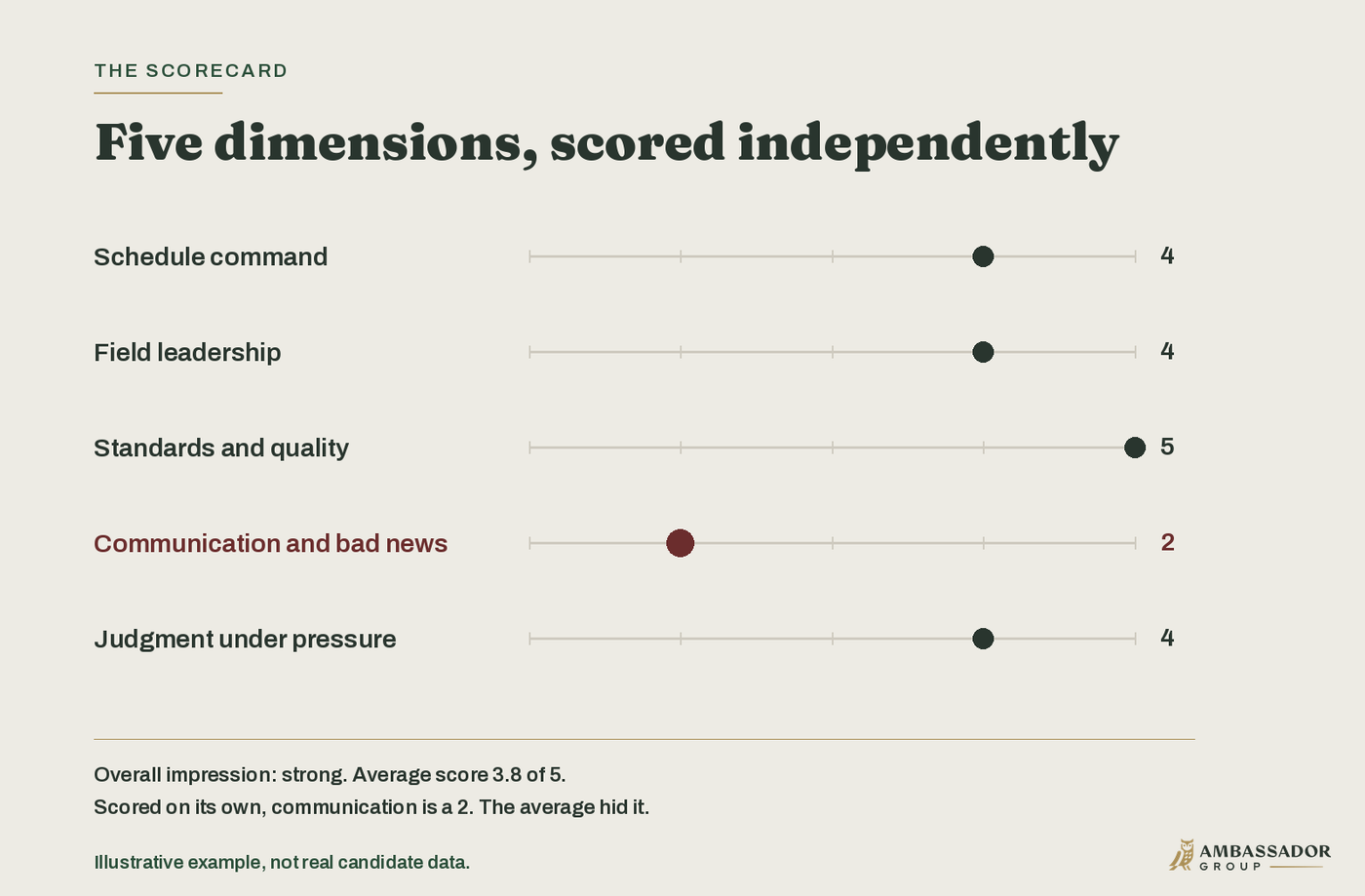
The five dimensions to score
Score these independently. Each gets its own number before you form any overall view, because the moment you decide you like someone, every later answer bends to confirm it.
Schedule command
Can they build a schedule they believe, defend it against optimism, and recover it when it slips. A superintendent who cannot tell you how they would claw back two weeks after a concrete delay is a superintendent who will hand that problem to you.
Field leadership
Watch how they talk about trades and subs. Do the crews follow them because they lead, or do they only describe policing and writing people up. The tell is whether subs call them before a problem becomes a change order, which only happens when a super has earned trust in the field.
Standards and quality
Ask what they refuse to let slide. A strong answer is specific and a little stubborn: a particular detail they will stop the job over. A weak answer is a general promise that everything will be done right, which means nothing has been decided in advance.
Communication upward and outward
How do they handle the project manager, the owner, and bad news. The dimension that separates a good super from a great one is what they do the day a job goes sideways, before anyone has asked. Surfacing a problem early is a skill, and avoiding the hard call is the most expensive habit in the field.
Judgment under pressure
Give them a collision, not a quiz. The schedule, the budget, and a safety concern all push against each other on the same morning. What do they protect first, and how do they explain the trade. There is no single correct answer here, only the difference between a reasoned answer and a reflex.
The scenario questions that reveal each one
Resumes describe outcomes; scenarios reveal judgment. For each dimension, put the candidate inside a real morning and make them decide.
- Schedule command: “You are three weeks in, the slab pour slipped ten days because of the inspector, and the owner wants the original finish date. Walk me through your next week.”
- Field leadership: “A framing sub you need for the next four months is doing sloppy work and getting defensive when your foreman raises it. What do you do this week.”
- Standards and quality: “Tell me about a detail you have personally stopped a job over, and what it cost to stop it.”
- Communication: “You learn on Tuesday that you will miss a milestone the owner cares about. Describe exactly what happens next and when.”
- Judgment under pressure: “Same day, a trade is behind, the budget is tight, and you see a fall-protection gap. Rank what you handle first and tell me why.”
The point is not the answer they rehearsed. It is whether their reasoning holds when you ask the second and third question they did not see coming. The same discipline shows up in a construction project manager interview, where the role differs but the way you have to see the person does not.
How to compare candidates without fooling yourself
Three habits keep the scorecard honest. First, score each dimension on its own, in writing, before you discuss the candidate with anyone, so the room does not converge on the loudest opinion. Second, score your own confidence alongside the candidate: a five you are unsure about is a different decision than a four you can defend, and admitting the difference is the discipline. Third, compare candidates dimension by dimension rather than as whole people, because two supers with the same overall score can be opposite hires, and the column where they differ is usually the column that matters for your job.
A scorecard does not make the decision for you. It makes your judgment visible enough that you can stand behind it, and it turns a hire from a one-way bet into a match where you and the candidate both understand what the role demands. The superintendent you remember hiring well is the one you saw clearly, and seeing clearly is something you can prepare for. You already know which of the five dimensions you tend to skip. The only question is whether you will build the column for it before the next interview.
The short version.
- Why does gut feeling fail when hiring a superintendent?
- A superintendent lives at the intersection of schedule, trades, safety, quality, and the owner's confidence, which is five different jobs, and a candidate can be strong at two of them and quietly dangerous at a third. A single overall impression averages all of that into one number, and the average hides exactly the gap that will hurt you.
- What five dimensions should a superintendent interview scorecard measure?
- Schedule command, field leadership, standards and quality, communication upward and outward, and judgment under pressure. Score each independently, with its own number, before forming any overall view, because the moment you decide you like someone every later answer bends to confirm it.
- What interview questions reveal a superintendent's real judgment?
- Scenario collisions rather than quizzes: a slab pour that slipped ten days while the owner wants the original finish date, a sloppy framing sub you still need for four more months, a day when the schedule, the budget, and a fall-protection gap all compete. The point is not the rehearsed answer; it is whether their reasoning holds through the second and third question they did not see coming.
- How do I compare superintendent candidates without fooling myself?
- Three habits keep a scorecard honest: score each dimension in writing before discussing the candidate with anyone, score your own confidence alongside the candidate, and compare candidates dimension by dimension rather than as whole people. Two supers with the same overall score can be opposite hires, and the column where they differ is usually the one that matters for your job.
- Does a scorecard make the hiring decision for me?
- No. It makes your judgment visible enough that you can examine it before it costs you and stand behind it afterward. A form holds no magic; it works because it forces private judgment to become explicit, turning the hire from a one-way bet into a match where both sides understand what the role demands.


