There is an old joke that the difference between a philosopher and a large pizza is that a pizza can feed a family. Louis tells it on himself, a man who studied the humanities and then spent twenty years discovering how directly analytical thinking and problem-solving transfer into the work of building businesses. His arrival at Ambassador Group is worth pausing on, not as a personnel note, but as a small case study in the thing that makes hiring hard to get right: a strong match forms when both people can see themselves and each other clearly, and act on what they see.
What stands out in how Louis describes the decision is that nobody pretended. He had followed the work for more than a decade, found it insightful, and was curious enough to start offering his own ideas about where it could go. The seed got planted in a single honest sentence, the admission that this work would be hard to do without him. That sentence only lands because both people were willing to name what they truly thought rather than perform the version that sounds good in an interview. The leaders who own their hiring process are the ones who can do exactly that: see their own gaps plainly enough to say them out loud.
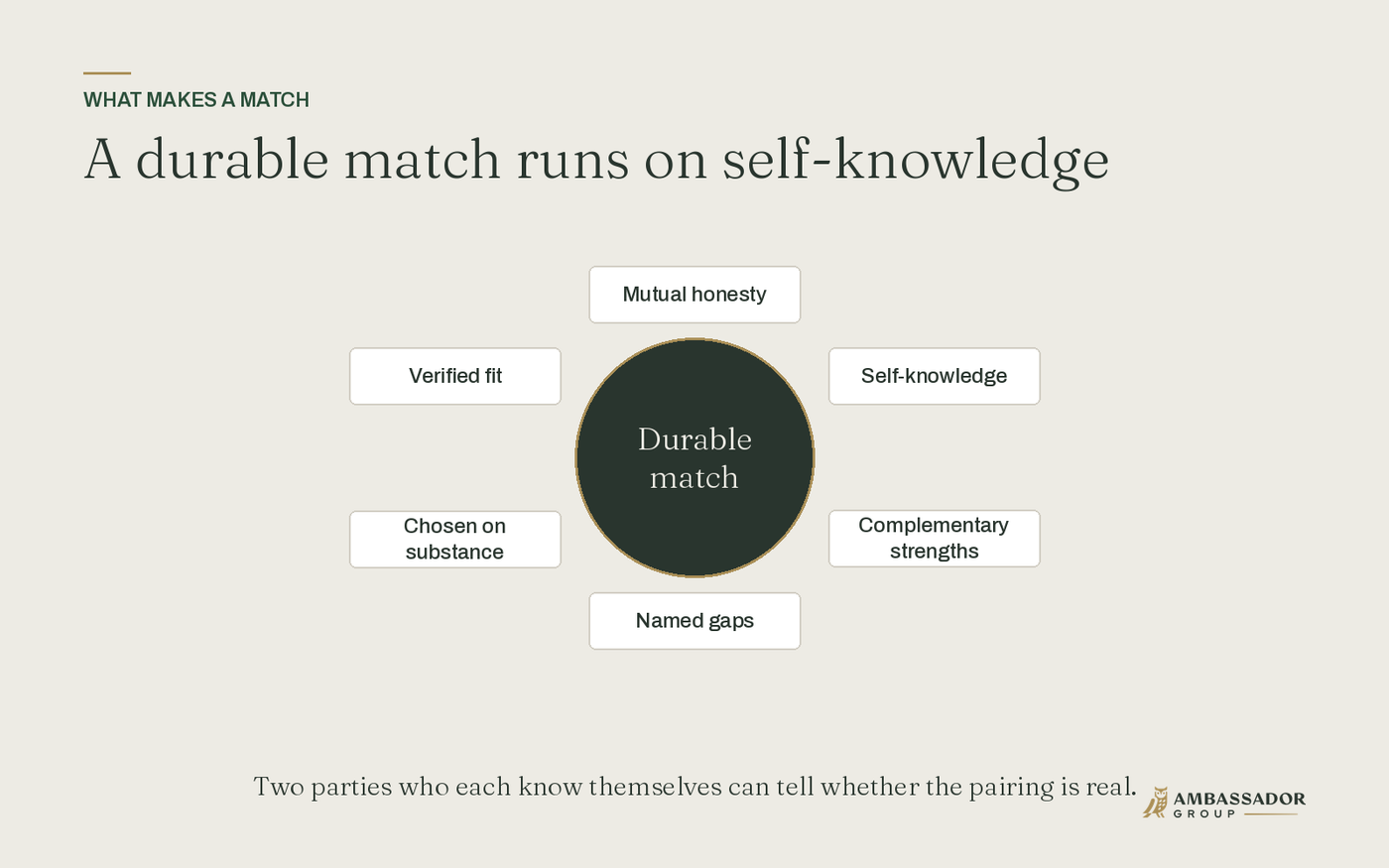
A match runs on self-knowledge, on both sides
Louis is precise about why the fit holds, and the precision is the lesson. He names what he is built for. He loves developing leaders and building teams. He loves strong internal operations, casting vision and helping implement it. He loves being alongside a business as it scales, managing that scale and helping drive it. He had recently finished a long arc of doing precisely that, and now he gets to start near the beginning again, this time carrying twenty years of retained skill into an accelerated growth phase from a higher baseline.
That is a person who has examined his own wiring closely enough to know which problems energize him and which ones drain him. It is also the reason the fit is not a gamble. He did not talk himself into a role and hope it would suit him. He recognized a body of work that happened to be complementary to his own strengths and weaknesses, and he moved toward it with his eyes open. A durable match almost always looks like this from the inside: two parties who each know themselves well enough to tell whether the pairing is real.
Fit is not chemistry you feel in the first conversation; it is the overlap two people can name once they each understand what they are built to do.
The work itself was the test
Notice what drew him. The pull was the character of the work itself, ahead of any title or compensation number. He describes it as a pure business, all the good stuff and only the good stuff he loves about business, present in one place. The reason he can say that is that the work is about helping other leaders build aligned teams where people get to do meaningful work among meaningful relationships. He compares it to taking the marshmallows out of the cereal box and eating only those.
That is a useful way to read any opportunity, from either side of the table. A leader hiring well asks what the actual texture of the work will be for the person, not how the role looks on an org chart. A candidate choosing well asks the same thing about himself: which parts of this would feel like the marshmallows, and which parts would feel like the rest of the box. Louis chose toward the work, and a choice made on the substance of the work tends to outlast a choice made on the surface of the offer.
What leaders can take from it
The pattern here is repeatable for anyone trying to bring the right person into a growing company. First, the honesty has to be mutual and early. The seed for this partnership was a true sentence about need, not a recruiting pitch, and that honesty set the tone for everything after. Second, fit is something the candidate has to be able to verify, which means the candidate needs enough self-knowledge to check the work against his own strengths and weaknesses. A leader who wants that kind of informed commitment has to give the candidate something real to check against.
Third, the strongest additions to a team are people who are strong exactly where the existing team is not. Louis describes work that is complementary to his own profile, and complementary is the operative word. A leader who hires more versions of himself builds an echo. A leader who can name his own gaps, the way the honest sentence in this story named one, can bring in a person whose strengths sit precisely where his own thin spots are, and the company gets stronger for the difference rather than louder for the sameness.
The story is short, and most of its value is in how quietly the fit was earned: two people who each knew themselves, told the truth about what they saw, and chose the work on its substance. Look at your own next addition and ask whether you have given that person something honest enough to choose against, because the quality of their commitment will only ever match the quality of the truth you offered them.