A candidate with twenty years in the industry can walk into your company and make poor decisions from day one, and the resume will not have warned you. I have watched it happen enough times to stop being surprised by it. The reason is rarely a lack of competence. It is that good judgment is defined differently from one company to the next, and a leader who has never named his own definition has no way to hire for it. Hiring is where a leader's philosophy becomes visible, and judgment is the part of that philosophy hardest to see and most expensive to get wrong. A leader who cannot articulate what good judgment means in his shop cannot recognize it across the table, and he will keep mistaking experience for the thing he is short on.
Every company defines good judgment against its own core values, its mission, its goals, and its processes. A decision that reads as wise in one firm reads as reckless in another. So a candidate's judgment can be genuinely strong and still misfire inside your walls, because it was calibrated to a different set of rules. The leader's job is to define that calibration, then onboard, train, and hold people accountable to it.
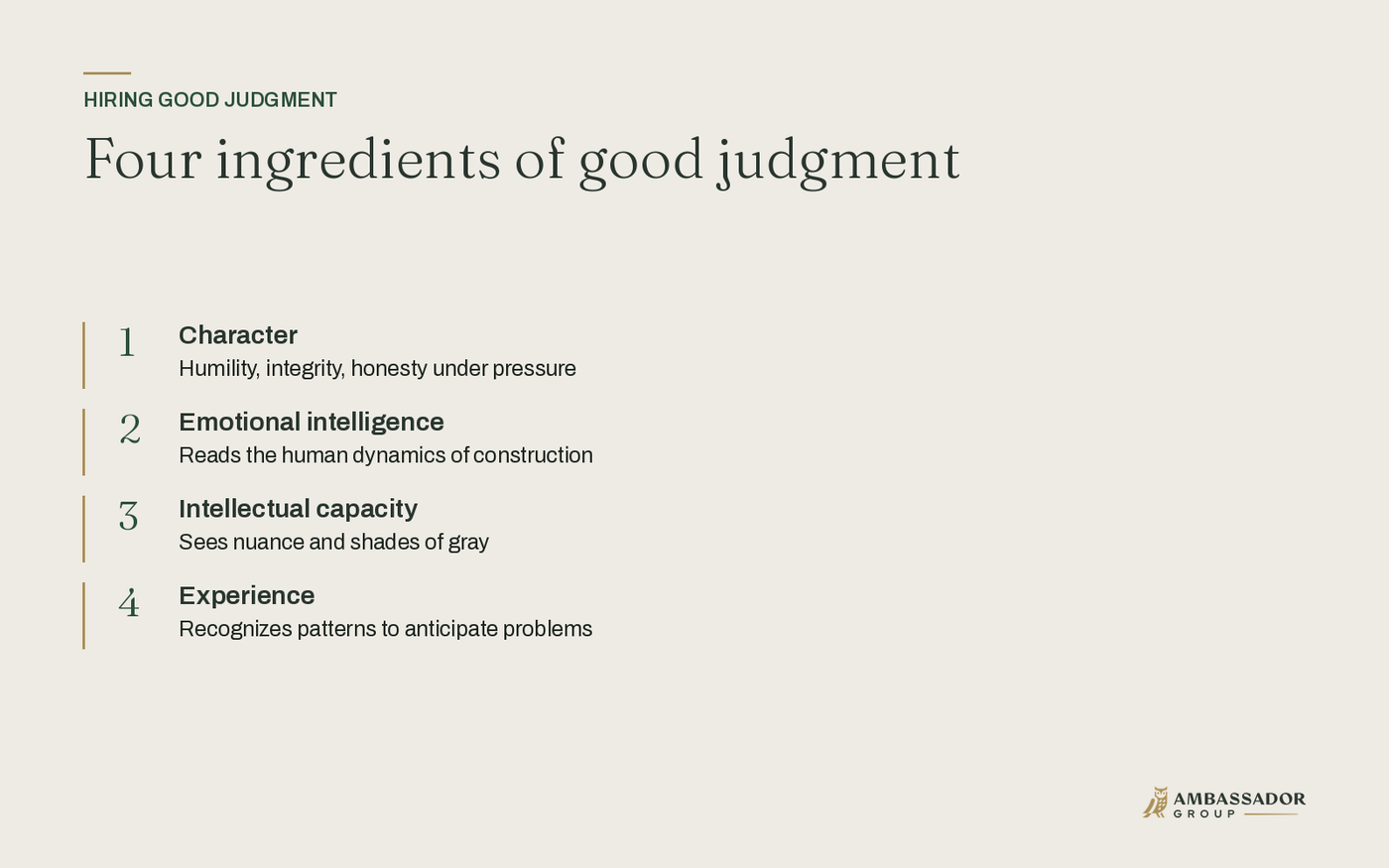
Four ingredients of judgment
It helps to break judgment into parts you can evaluate one at a time. I see four: character, emotional intelligence, intellectual capacity, and experience. The simplification is deliberate, and you can add to it, but those four carry most of the weight. What makes the model useful is watching what happens when one is missing.
Take strong experience paired with poor character. That combination produces decisions that are clever and self-serving, judgment bent toward manipulation rather than the right outcome. Now take strong character, good intellect, and deep experience, but thin emotional intelligence. That person makes defensible calls and is rough on everyone around them while doing it, a pattern common in construction and costly to a team. Take strong character, strong emotional intelligence, sharp intellect, but thin experience, and you get someone who reasons well yet cannot forecast, because they have not lived through enough cause and effect to see the problem coming. Each missing ingredient bends judgment in a different direction, and naming which one is short tells you what you are looking at.
Evaluate the four without interrogating
You can assess these in an interview, mostly by creating openings rather than firing questions. Character shows up when you give someone room to talk about a mistake. If they show you a misstep, ask why, without backing them into a corner where shame is the only exit. What you are watching for is humility, honesty, and the willingness to own a result. Intellectual capacity shows up in how a candidate handles a problem with shades of gray, whether they can hold nuance or flatten everything into a rule. Emotional intelligence shows up in how clearly they understand that the people are the hard part of this work.
In construction, the building is the easy part. The humans are the hard part, and judgment is mostly about how a person handles the humans.
Experience is the one most people read correctly and weigh wrongly. The question is what those years taught a candidate about patterns, about which decisions lead to which outcomes, about how a problem on a project announces itself before it fully arrives, rather than how many years they logged. A superintendent or project manager with real pattern recognition can anticipate trouble a less seasoned person walks straight into. That forecasting ability, not the year count, is what experience is supposed to buy.
The company is a painting of its leaders
Here is the part most leaders skip. Before you can hire for good judgment, you have to be self-aware about your own definition of it. What character, what emotional intelligence, what intellect, and what kind of experience tend to produce the decisions that succeed inside your organization specifically. Until you can say that plainly, you are hiring against a standard you have never written down, which means you are hiring on feel.
Every company is an expression of its leadership to a remarkable degree. A business is like a painting: it reflects the strengths and weaknesses of the people who lead it, often to a degree those leaders do not recognize in themselves. I have been inside hundreds of firms, and again and again the behaviors I see in the field trace straight back to the people at the top, through what they actively built and what they passively allowed. If poor judgment keeps surfacing in your people, the honest first question is what in your own leadership is producing it.
Once you can define good judgment for your team, the rest of the system gets clearer. You can point to a specific situation, an RFI handled a certain way, and say plainly: this is what good judgment looks like here, this is the output it produces. Take a superintendent who finds a discrepancy between the structural drawings and the field conditions. In one company, good judgment means stopping work and routing the RFI before a dollar is spent. In another, it means proposing a fix and keeping the schedule moving while the paperwork catches up. Neither is wrong in the abstract, but only one fits your firm, and a candidate cannot read your mind about which. That clarity is what lets you communicate the standard to a candidate during the interview, set real terms instead of vague hopes, and then onboard and hold them accountable to something concrete rather than a feeling you never managed to name.
Before your next search, write down what good judgment means in your company and which of your own patterns it reflects, because the clarity you build there is the clarity you will hire against for years.