Most hiring authorities in construction decide on three things: their gut, the candidate's years of experience, and the pedigree of the company they are leaving. None of those is worthless. Gut can register emotional intelligence your conscious mind has not caught up to. A strong prior employer can imply a real process. Years can stand in for competence. But each one is a proxy, and a leader who hires on proxies alone is making a judgment he cannot see clearly, about a person he has not examined closely, against a standard he has never written down. Hiring is where a leader's discipline becomes visible, and these three shortcuts let him skip the part where he has to own the decision.
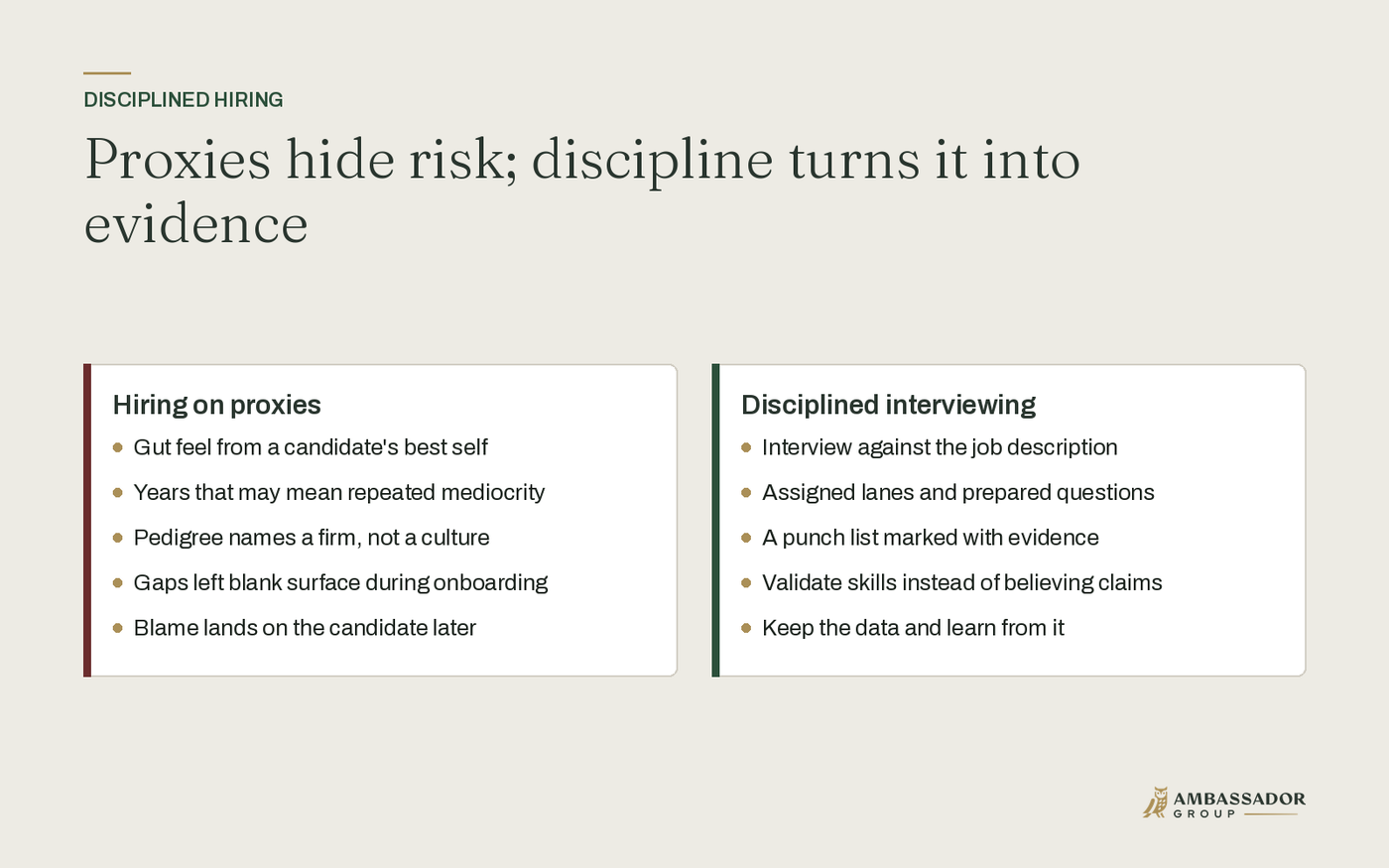
Look at what each proxy hides. Gut feel forms in a controlled setting where the candidate is performing his best self, never under the pressure that the job will apply by week two. Years of experience can mean twenty years of mediocrity inside a mediocre shop, or twenty years of doing the work with a philosophy that runs against everything your company believes. Pedigree tells you a name, not a culture, and two firms doing identical work can run on opposite leadership styles, communication habits, and processes. The risk does not announce itself. It hides in the details the gut never inspects, and a leader discovers it later, at full price.
Interview to the job description
You already built the instrument. You wrote a mission, a set of values, and a job description. Disciplined hiring is the simple, hard act of holding the interview against that infrastructure on purpose. The same way a good construction project runs on disciplined project management, a good hire runs on disciplined interviewing: assigned lanes, prepared questions, real feedback, and a structured debrief where interviewers are accountable for the observations they made.
The test is concrete. At the end of an interview process, you should be able to walk a punch list, item by item, showing where the candidate aligns with how the job is truly done and where he does not. Run the job-description requirements as one punch list and the core values as another. If you cannot mark those items with evidence, you did not interview, you socialized. The gaps you leave blank are precisely the risks that surface during onboarding, when you start questioning your own judgment about a hire you never properly assessed.
Stop blaming the candidate
The second mistake follows the first, and it is rarely malicious. When the hire goes sideways, the leader blames the candidate for not being who he seemed to be. Sometimes the candidate was authentic and the interview never reached the depth that would have surfaced the mismatch. He said he was a strong project manager, and for his definition of the role he was telling the truth. His concept of the job and yours were different by a wide margin, and nobody validated the difference, so two people talked right past each other and called it a hire.
You are eighty-five percent in charge of the decision to hire someone, because you know your organization and the candidate does not.
That ratio is the whole accountability argument. The candidate cannot see your culture, your leadership, or how your values show up under stress. You can. So the burden of assessment sits with you, and so does the burden of helping the candidate assess you honestly enough to commit with open eyes. A leader who phones in the interview and then faults the candidate is grading his own failure and handing the candidate the demerit.
Interview to reduce four kinds of risk
Interviewing is relationship development with higher stakes, and its real job is reducing risk. There are four categories worth naming. Environmental risk lives inside the company: leadership quality, culture, how the team handles stress and conflict. Candidate risk is whether the person has the aligned ability the role demands. Interviewing risk is the precision of the process itself, the discipline that turns a conversation into evidence. Onboarding and retention risk closes the loop, because people quit leaders more often than they quit companies, which points environmental risk right back at the person doing the hiring.
The level of precision you interview at is the level of risk you remove. Three to seven hours of interview time, multiplied across every interviewer, adds up to dozens of expensive hours. If that time produces no high-resolution observations, only a general good feeling, you spent the money and bought little protection. Validate skills instead of believing claims. Ask a candidate to walk you through his process, then describe how the work runs at your shop, and watch where the two diverge. Your gut will still speak, and you should listen, but your job is to convert that signal into an observation you can name, test, and write down.
Keep the data and learn from it
The reward for disciplined interviewing arrives over years. When you retain the data from each hire and each instance of turnover, you can go back and find the exact gap: the expectation never set, the skill never validated, the value never pressure-tested. You tear the engine apart and study why it failed, the way you would not accept a doctor who told you only that you were sick. Every mishire becomes a correction to the process rather than a wound you absorb and repeat.
Run the full cost before you decide the interview is overhead. There is the salary and benefits of every interviewer's time, the opportunity cost of those people not billing work or solving client problems, and then the real bill of a mishire: any matching fee, the onboarding sunk into someone who left, the morale damage, the customer who watched the turnover and drew conclusions about you. Set that against the cost of one more careful interview and the math stops being close.
This discipline is a competitive advantage precisely because it respects the people you hire. A candidate is wagering his career, his time with his kids, and his shot at a better life on your judgment, and he is doing it with far less information than you hold. Build the process that honors that asymmetry, and the next person who joins your company will be someone you can stand behind, because you did the work to know.