
You can trace almost every failed leadership hire back to a single missing document. Not a bad resume, not a weak interview. A role nobody ever made clear, hired into by a leader who assumed clarity he did not have. Hiring is where a leader's judgment becomes visible, and nowhere is that judgment tested harder than when you bring an outsider in to run something you built. The fix is not a better operator. It is role clarity, the work a leader does to define the role before the search ever starts.
I got a call this week from a builder I respect. Sharp, fast-growing, several companies under him. He wanted to hire a general manager, a player-coach to run everything outside of sales. His last one was excellent and stayed the better part of a decade. Now he is gone, and the role needs filling. Reasonable ask. I have run this search many times.
Then I asked the question I always ask: how clear is the role?
"Very clear," he said. "We're all aligned."
So I pushed. How is it encoded? Is it written down? How would a new person actually learn what good looks like here?
"We were never great at documenting things."
That gap, between I am clear and I could hand someone the clarity, is where leadership hires go to die.
The water a smaller company runs on
Every company runs on a body of knowledge nobody wrote down. How decisions get made. What a good margin looks like on this kind of job. Which corners never get cut. How you talk to a client when the schedule slips. Your existing team swims in it without thinking, the way a fish does not know it is in water. They absorbed it over years, through projects and problems and a hundred small corrections.
Now you hire from the outside. That person comes from a different aquarium, different water, different chemistry, and you are asking them to run yours. In a large company there is enough structure, enough written process and enough peers, that an outside leader can find the current. In a smaller company, most of the operating knowledge lives in the founder's head and a few long-tenured people. There is far less to catch a newcomer who is guessing.
This is why hiring senior people into smaller companies is genuinely dangerous when it is done casually. Not impossible. Dangerous. The role is load-bearing, the water is invisible, and the failure is slow.
The slow, expensive failure
Here is the shape it takes. The interviews go well. Everyone feels good. You send it. The new leader steps in, and for a while it is fine, because early problems are small and everyone is on their best behavior. Then a real decision comes and they make the call their old water taught them to make. It is a defensible call. It is just not yours. A client relationship cools. A standard you cared about quietly slips. A good employee starts looking around.
None of these is a firing offense on its own. That is the trap. By the time the pattern is undeniable, you have a deeply embedded, highly load-bearing person you are no longer sure about, and a large sum in hidden cost already spent. Now unwinding it is its own crisis.
Trace it back and ask where the lever was, the one place you could have pulled to prevent all of it. It is almost never the interview. It is the definition of the role that should have preceded the interview. You were hiring against a picture that lived only in your head, so you could not test for fit, and neither could the candidate.
Build the role backward from outcomes
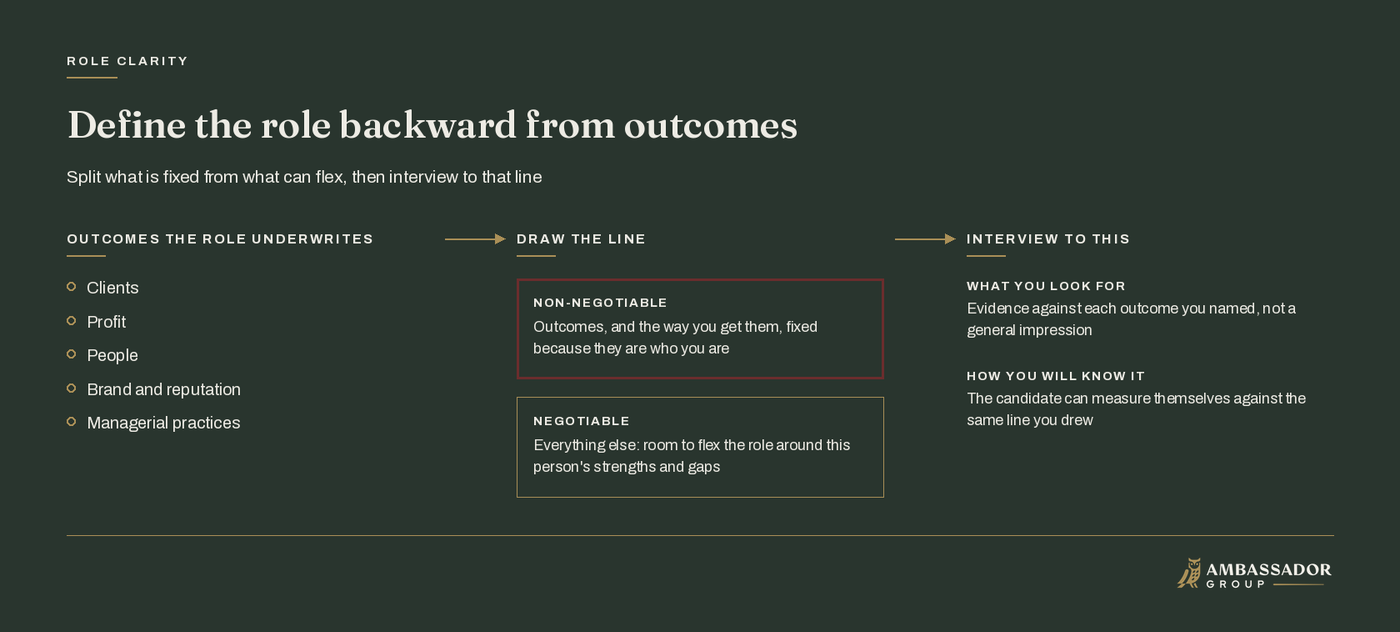
The move is to stop describing the role as a list of duties and start defining it as a set of outcomes the person is accountable for underwriting. Underwriting is the right word. A senior hire is a risk decision, not a transaction, and the person is taking on responsibility for results, not just tasks.
So name the outcomes. What is this leader on the hook for with clients? With profitability? With your people? With brand and reputation? What managerial practices do you want measurably better a year from now? You already have a vision for what this hire changes in the business. The work is dragging it out of your gut and onto the page.
Separate the non-negotiable from the negotiable
Then draw the line between non-negotiable and negotiable, and draw it in two places. There are outcomes that are non-negotiable, and there is a way of achieving them that is non-negotiable because it is who you are. There is also room, usually more than leaders expect, to bend the role around a specific person's strengths and gaps. Knowing which is which before you interview is what lets you flex on purpose instead of discovering your hard lines by watching someone cross them. An assessment like the PXT Select is useful here, less as a verdict and more as a way to pressure-test where a real person fits against the role you just defined.
Clarity is not fixity
An honest word about clarity: it does not mean fixity. Roles in a growing company shift, and some of that shifting is good leadership, the ongoing work of fitting the role to the person and the person to the role. Roles are allowed to move. What they cannot do is move silently. The current version should always be knowable and owned, with every real change named rather than discovered through disappointment. A leader is allowed to raise the bar. A leader is not allowed to raise it silently and let a good hire fail against a standard they could not see.
Role clarity is bilateral, or it is nothing
The part most leaders miss: your clarity is the candidate's clarity. When you do not have a sharp concept of the role, the person across the table cannot form one either. They are guessing at what you want, you are guessing at whether they will deliver it, and both of you call the mutual fog chemistry.
Get the role defined and everything downstream gets sharper. You know what you are looking for. You know how you will recognize it. You can set expectations that mean something and build accountability against them. And the candidate can measure themselves honestly, which is the first and best filter you have, because the ones who see they are not a fit will often tell you before you have spent a year finding out. This is the same discipline that lets a leader own the outcome of a hire instead of blaming the candidate, and its absence is one of the clearest signs a leadership hire is heading for the ditch.
Defining a leadership role well is slow, and it is uncomfortable, because it forces you to make explicit the things you have carried implicitly for years. That discomfort is the work. It is cheaper than the alternative by an order of magnitude.
The short version.
- Why is hiring a senior leader from outside riskier in a smaller company?
- A smaller company runs on unwritten norms that only a few people hold. There is far less written process or peer structure to catch an outside leader who is guessing, so a load-bearing mis-hire surfaces slowly and expensively.
- What does it mean to define a role backward from outcomes?
- Instead of listing duties, name what the person is accountable for underwriting: outcomes with clients, profitability, people, brand and reputation, and the managerial practices you want improved. The role is the set of outcomes, not the task list.
- How do non-negotiables and negotiables fit into role clarity?
- Separate the outcomes and methods that are fixed because they are who you are from the parts you can flex around a specific person's strengths and gaps. Knowing which is which before you interview lets you flex on purpose instead of discovering your hard lines when someone crosses them.
- Is role clarity the same as a fixed, unchanging role?
- No. Roles in a growing company shift, and some of that is good leadership. The standard is that the current version is always knowable and owned, and every real change is named rather than discovered through disappointment.


