
The three names your finalist handed you will all say hire this person. The candidate chose them for exactly that reason. Calling all three and collecting the yes gives you the feeling of diligence without the information.
I treat a hire the way an underwriter treats a policy. The interview surfaces the story; the reference check verifies it. Skip the verification and you carry the same risk blind. And how a leader runs this step reveals how clearly that leader sees people. A hiring manager who wants the comfortable answer will get it on every call. Getting the true answer requires building a call that can produce one, and owning that work instead of delegating it to a formality.
Why most reference calls are theater
By the time most hiring managers dial a reference, the decision is made. The interviews went well, the team liked him, the offer letter is half drafted. The call exists to confirm a choice, and everyone on the line knows it. Dates, titles, a few warm adjectives, done in eleven minutes.
Three forces guarantee that outcome. The candidate curated the list; nobody volunteers the boss they clashed with. The reference wants to help someone they like. And you want the hire to work, because the role has been open since spring and the backlog is growing. Every incentive on the call points toward yes. You have to pull honest signal against that grain.
References still carry signal. The standard questions are what waste it. "What are their strengths and weaknesses" invites a rehearsed answer from a friendly witness. Change the questions and the same witness starts giving you evidence instead of praise.
Set up the call so honesty is possible
I open reference calls by moving the frame from verdict to fit: "I am trying to set him up to succeed if he takes the job, and that starts with understanding how he works." A reference who thinks you are hunting for a reason to reject will defend the candidate. A reference who believes you are planning for the candidate's success will describe him. Description is what you came for.
Then calibrate the witness before weighing the testimony. Ask how they worked together and for how long. Ask what the company and the projects looked like during that stretch. A reference who watched your finalist daily through a brutal hospital job outranks one who shared an office for six months of steady work. Weight everything that follows accordingly.
Reference check questions that get honest signal
- "Would you hire him again tomorrow? For what role?" The first half gets a reflexive yes. The second half is the real question. An old boss who would bring a superintendent back "to run one of our smaller jobs" just told you the ceiling as he sees it.
- "Where did he need the most support from you?" Softer than asking for weaknesses, and more concrete. Every strong performer needed support somewhere. A reference who claims otherwise is protecting, not describing.
- "Tell me about a project that went sideways while he was on it." Every construction career includes one. You are not evaluating the failure; you are listening for what he did on day two of the problem, and whether the reference's account matches the one you heard in the interview.
- "How did he handle the money conversations?" Change orders, buyouts, a sub going under mid-job. Money under pressure is where character stops being theoretical, and references get specific fast when you name the situations.
- "How would his crews and subs describe him?" The view from above is usually the most polished. The view from the field is where leadership either exists or does not.
- "Who else saw his work every day?" The candidate gave you the curated exhibit; this question reaches past it. Get the candidate's permission before making that call, and never touch his current employer. I have written before about why backdoor references poison trust.
- "What advice would you give his next manager?" Framed as help, not judgment. Even protective references answer this one honestly, because answering it well serves the person they are protecting.
Role-specific probes
Project manager. Ask about a specific buyout or a contested change order. Then ask whether his forecasts moved gradually month to month or all at once near the end. A PM whose bad news arrives early is worth more than one whose numbers hold until they collapse. Pair the answers against your PM interview notes.
Superintendent. Ask how the schedule survived pressure, and whether trades asked to be on his next job. Subs vote with their feet, and his old manager watched them do it. The same trajectory logic from the assistant superintendent guide applies here.
Estimator. Ask about a bid he missed, high or low, and what changed in his process afterward. An estimator without a miss story has either never been trusted with real work or is not telling you the truth.
What hesitation is telling you
The pause before the repeat-hire answer carries more information than the answer. So does faint praise scaled to the role: "showed up every day, solid guy" is a fine reference for a laborer and a warning for an operations director. Watch for answers to questions you did not ask, and for scope that quietly narrows ("on that project, he was fine").
One caution: the reference who will confirm only dates and titles is usually following company policy, not sending a coded message. That is when the sixth question above earns its keep. Move to the people who are free to talk.
Stop sign or landing plan
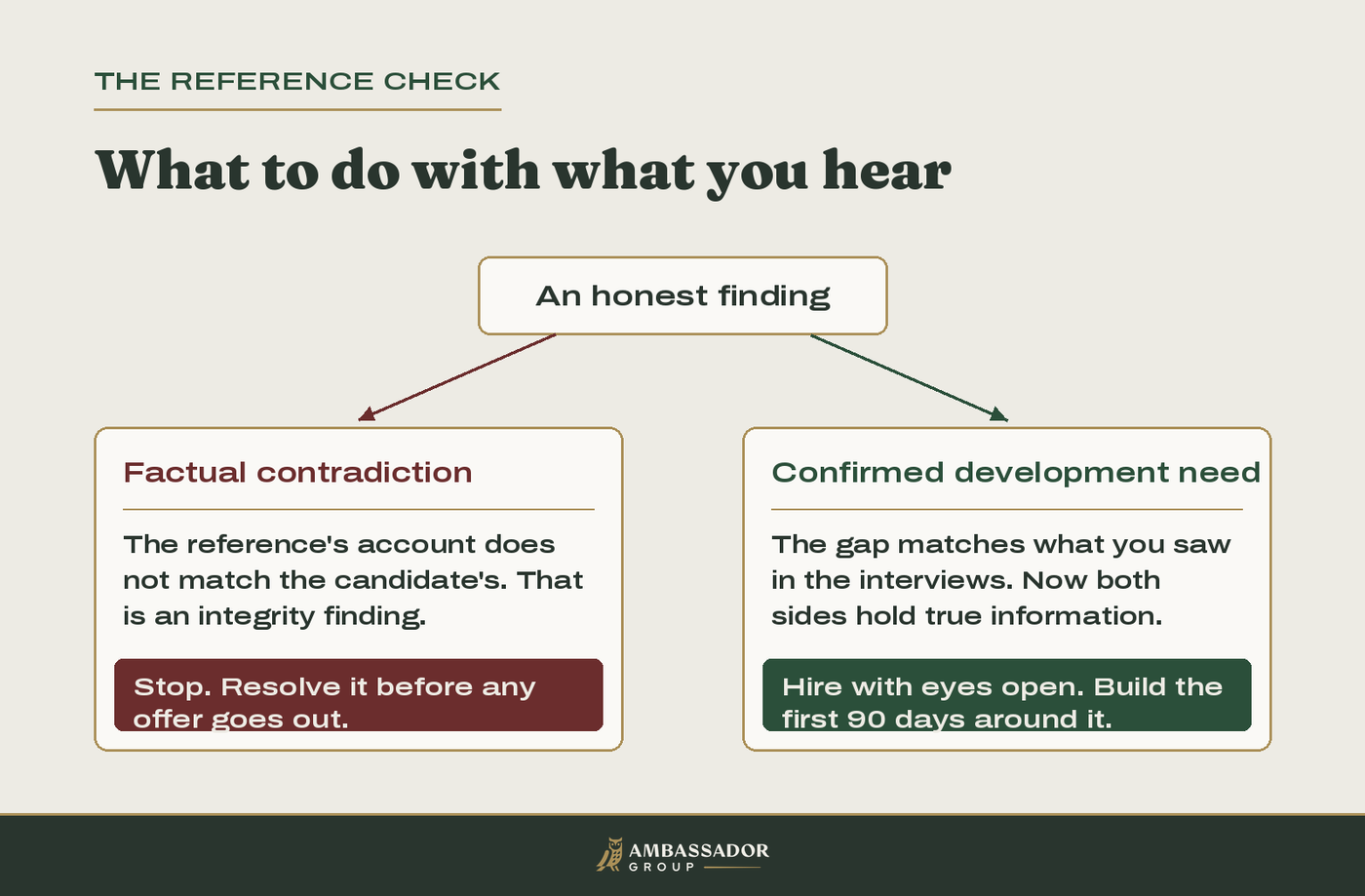
Most of what an honest reference call produces should shape the hire, not stop it. A confirmed development need that matches what you saw in the interviews is onboarding input: build the first 90 days around it and tell your new hire what you are doing and why. That is what a real match looks like, both sides working from true information.
The stop sign is different in kind. When a reference's factual account contradicts the candidate's account of the same project, the job he claims to have run, the number he claims to have carried, you no longer have a development finding. You have an integrity finding, and no amount of skill outweighs it. Two references independently hesitating on the same trait is a pattern; one reference contradicting the resume is a finding you resolve before any offer goes out.
The names on the list are the easy part. What you ask, and what you are willing to hear, decides whether the check protects the hire or merely blesses it. That part belongs to you.


