
Burnout rarely comes from working too hard on something that matters. It comes from pouring energy into a long horizon with no nearer point where the effort pays you back. The work is good. The timeline is the problem.
I have watched strong leaders run themselves flat on projects worth building. The cause was rarely effort or discipline. The reward simply sat two years out, and nothing closer marked the road. A leader who cannot read their own wiring for effort and reward will not catch it failing in the people they lead. Reading your own sustainability is the same muscle you use to read a candidate or a crew. It starts with seeing yourself clearly, and the design of it is the leader’s job to own, not something to delegate to a wellness benefit.
What a gratification window is
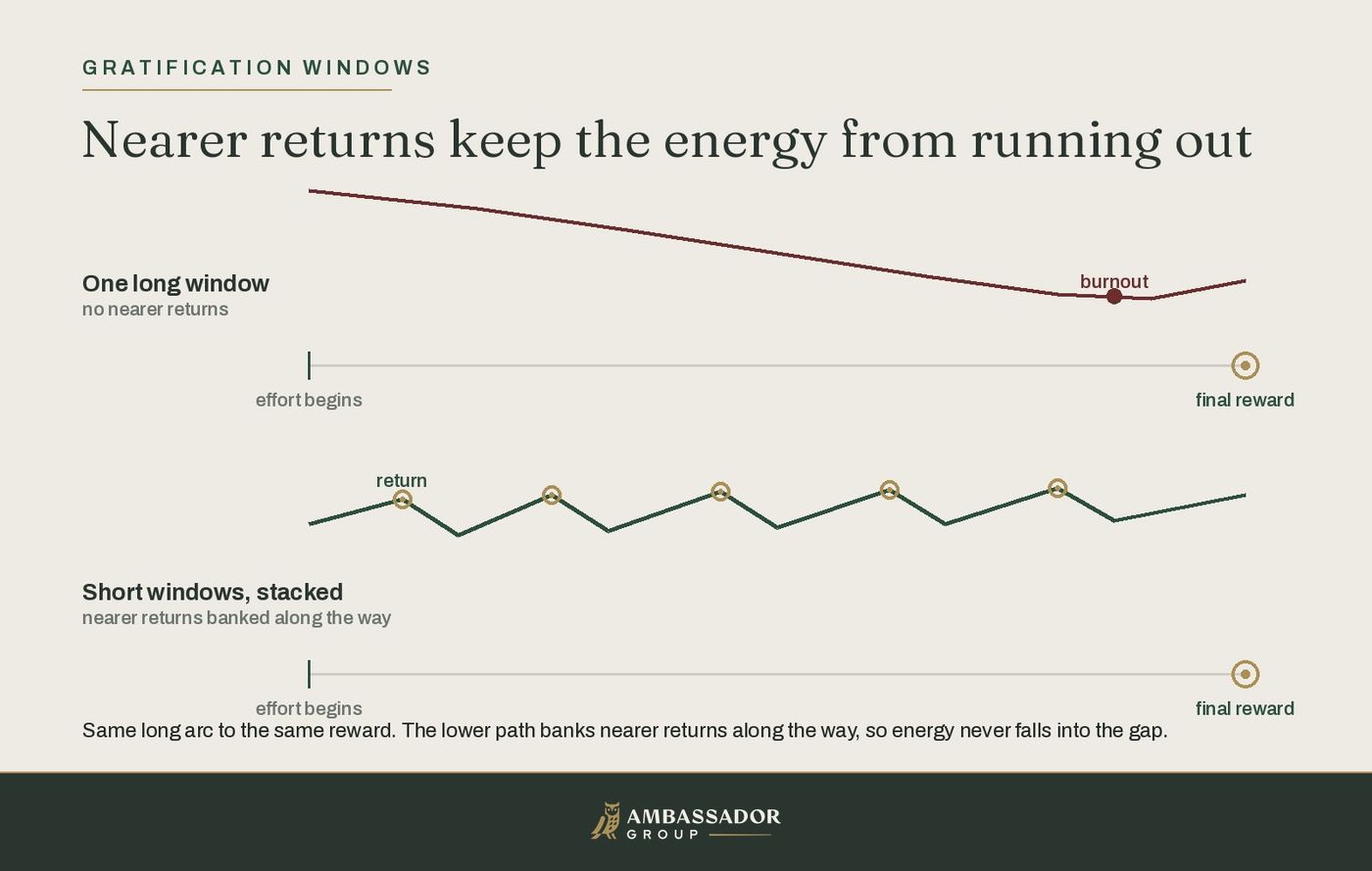
A gratification window is the gap between when you spend energy and when you feel a return on it. Some windows are short. You cook dinner and an hour later you eat it. Some are long. You start a company or run a job, and the real payoff can sit years downstream. Neither length is wrong on its own. The trouble starts when too many of your windows are long at once and nothing nearer hands the work back to you. Effort goes out. Nothing comes back for months. That gap is where people quietly empty out.
Why the long windows burn people out
Humans run on cycles of effort and reward. Stretch the cycle far enough and the mind stops believing the reward is coming. The payoff can be real and still arrive too late to keep you upright. Burnout is more than tiredness. It is the moment your output stops connecting to anything you can feel.
Construction makes this concrete. A superintendent can give three years to a job and feel almost nothing until the owner walks the finished building. Three years is a long time to operate on faith. The most committed person on the crew is often the one closest to the edge, because they invested the most energy against the same distant return. A long, unbroken window manufactures that disconnect on purpose, even when the destination is worth the trip.
The defense is a kind of agility. It means noticing which window you are inside and adjusting before the gap hollows you out, rather than gritting harder. Most people push through a long window and call the exhaustion a character test. The better move is to read your own state, name what you are running low on, and go find a nearer return on purpose. That noticing is a skill, and like any skill it improves with use. The leaders who last track the distance between their effort and their reward, and refuse to let it run unmanaged.
Designing for nearer returns
You cannot always move the finish line. You can build markers before it.
Break the long arc into milestones you stop to mark. A permit approved, a foundation poured, a design accepted: call these wins and register them, instead of treating them as waypoints on the way to the ribbon cutting. The brain needs to bank a few of them to keep going.
Count relational returns. A client’s thank-you, a quiet save by a teammate, an apprentice who finally gets it. These are returns. Treating them as too small to count is how you starve yourself between the big payoffs. People are not inventory, and neither is the satisfaction of work done well.
Stack short windows under the long one. Pair the multi-year build with daily and weekly returns you control: a hard problem solved, a skill sharpened, a body that moved, a family ritual kept. The long game needs the short game to survive it.
The leader owns the team’s windows
This is where it stops being a personal habit and becomes leadership. Your team is running windows too, and most of them never got to choose the length. If the only thing a crew ever feels is the grind, with the payoff parked at an opening eighteen months out, they will flame out before they reach it, and you will read it as a people problem. It is a design problem, and it belongs to you.
There is a second way a leader manufactures burnout, and it is quieter than the long window. Heroics come easily to you, so you expect them from everyone, without ever deciding to. What reads to you as an ordinary week reads to your team as a sprint they can never stop running. The window problem is about time. This one is about calibration: an outlier setting the pace for people who were never built to hold it. Both empty the same tank. Neither is intentional, which is exactly why you have to look for them on purpose.
Thoughtful leaders install visible progress and real acknowledgment along the route. This is the relational side of the same skill. A leader who can read their own windows can read a quiet superintendent’s, and can say the specific thing that closes a window the person did not know was open: naming the save they made, the problem they solved, the standard they held. Skeptics will call this soft. It is how durable teams get built, and it is the kind of care you cannot buy back once someone has checked out.
A simple version costs nothing. End the week by naming, out loud and to the person, one return that already came in. The same discipline that wins a new hire in the first ninety days, where you set early proof points so the person feels traction fast, keeps a ten-year veteran from quietly going dark in year three.
Recognizing your windows will not make the work shorter or the road easier. It keeps the work connected to something you can feel while you do it. Burnout grows in the vacuum between effort and reward. You decide how long you let that vacuum run, for yourself and for the people who take their cue from how you treat your own.
The short version.
- What is a gratification window?
- A gratification window is the gap between when you spend energy and when you feel a return on it. Cooking dinner has a window of an hour; starting a company or running a big job can have a window of years. Neither length is wrong on its own; trouble starts when too many of your windows are long at once and nothing nearer hands the work back to you.
- Why do long projects burn people out even when the work matters?
- Because humans run on cycles of effort and reward, and when the cycle stretches far enough, the mind stops believing the reward is coming. Burnout is more than tiredness; it is the moment your output stops connecting to anything you can feel. A superintendent can give three years to a job and feel almost nothing until the owner walks the finished building, and three years is a long time to run on faith.
- How do I build nearer returns into a multi-year project?
- Break the long arc into milestones you stop to mark, like a permit approved or a foundation poured, and register them as wins rather than waypoints. Count relational returns such as a client's thank-you or an apprentice who finally gets it. Then stack short windows under the long one: daily and weekly returns you control, like a hard problem solved, a skill sharpened, or a family ritual kept.
- What can leaders do about burnout on their teams?
- Own the team's gratification windows, because most of the crew never chose the length of theirs. If the only thing a crew feels is grind with the payoff parked eighteen months out, they flame out before reaching it, and that is a design problem belonging to the leader, not a people problem. Install visible progress and real acknowledgment along the route, and end each week by naming one return that already came in, out loud and to the person.


