
There's a big difference in outcomes between a demanding leader and a leader who backs high expectations with clarity and support. From the outside the two can look alike. Both want excellence and both set a high bar. What separates them is what they do when the path to that bar isn't obvious, and nowhere does that show faster than in how they hire.
I know the first type well, because I am one. I'm a demanding leader in recovery.
Recently I spent a few hours with the second type: the owner of a custom residential construction company who has spent decades building the kind of organization most owners say they want. I'll use his words throughout, because he describes the difference better than I can.
The demanding leader
The demanding leader wants excellence and doesn't know the path to it. They make up for that gap with pressure and threats. When results fall short, they blame, coerce, judge, and discard.
I grew up watching this. My father was an entrepreneur, and he ran a business full of friction because he didn't understand most of what this article is about. He had a combination I see in founders all the time: indomitable and, at the same time, tragically blind. Put those together and you get someone willing to leave their hand on the burner for a remarkably long time. He suffered for the whole life of that business. So did everyone who worked in it, and so did my family.
None of it had to be that way. That's the part I keep coming back to.
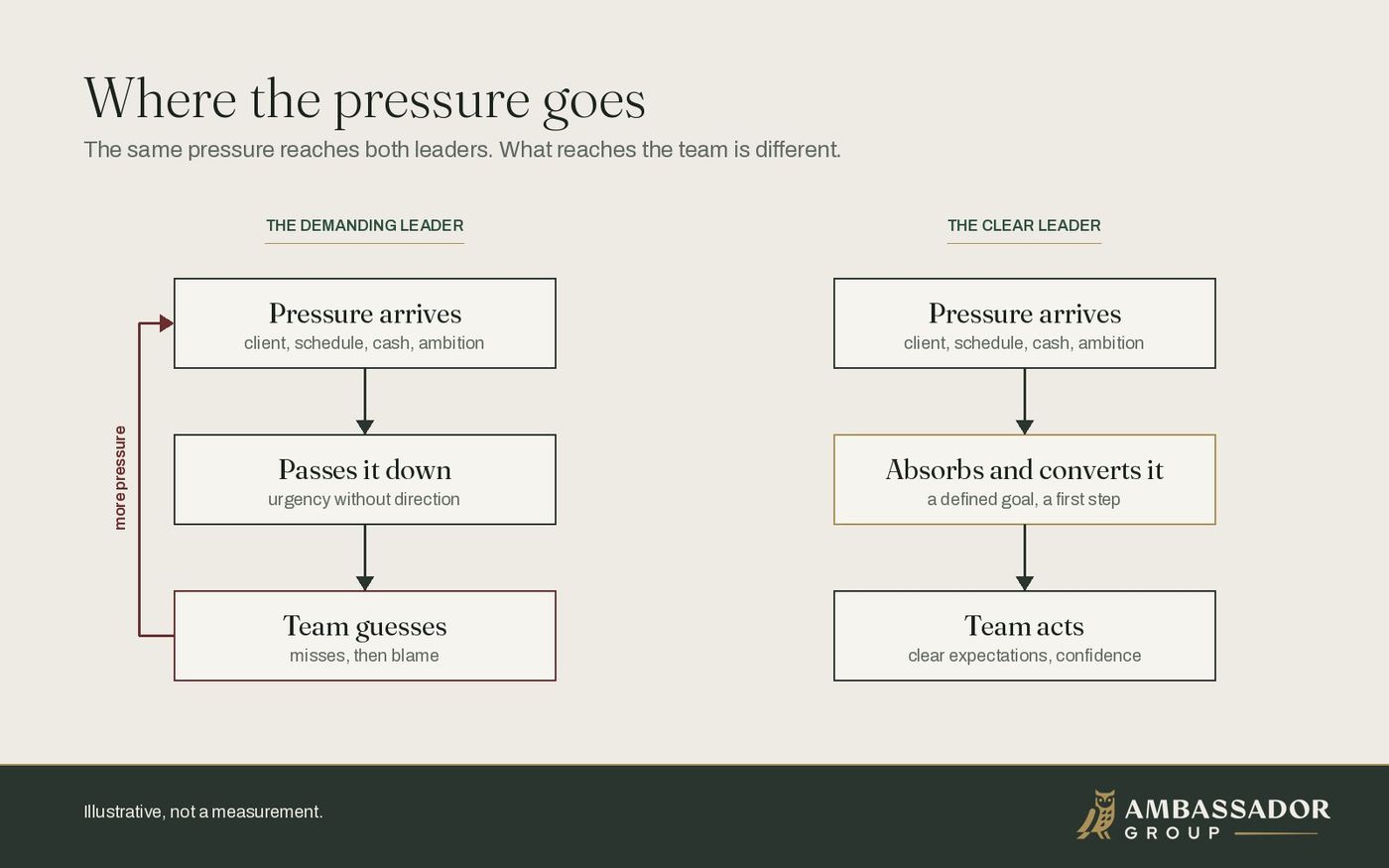
The pattern comes from a gap between ambition and understanding. The leader can see where the organization should be, can't see how to get there, and pressure fills the space. Pressure feels like action, but all it does is move the leader's discomfort onto everyone below them. Relentlessness without direction spreads the suffering across more people.
The clear leader
The clear leader accepts that it's their job to direct people precisely toward the goal. When the team misses, the clear leader looks at themselves first.
The builder put it in three words: "Clarity generates confidence." His team doesn't have to guess what good looks like. "We try to set really clear expectations," he told me. "It's kind of across the board."
His standard is higher than most, and he set it through who he hired: "I wanted to hire people who were so good, with so much experience, that I was going to be the dumbest guy in every room. I would be learning from them while at the same time leading."
Absorb the pressure, convert it into clarity
Total clarity isn't always possible. Markets shift, priorities collide, and some problems don't come with a map. The danger is filling that gap with pressure, leaning harder on your people and hoping urgency produces the answer. It rarely does.
A good leader absorbs the pressure instead of passing it down. The builder calls this part of his job "catching bullets." When a demanding client or a difficult situation comes at the team, he steps in between. "It's asking too much of my team to manage a complex project and then manage the complex personality of the owner."
The pressure lands on him, and what reaches his team is something they can act on.
Bottlenecks and the quick-fix hire
The difference shows up most when an organization hits a bottleneck.
The demanding leader reaches for the fastest fix in view instead of working out its root cause. Aggressive hiring is the common example. I hear it from the recruiting side every month. An owner tells me, in effect, "I have a bottleneck, and if I hire someone with 'operations manager' on their resume, the problem goes away."
Often the bottleneck has more to do with communication, morale, or process than headcount. The new hire shows up ready to help and gets pushed through the same constraint as everyone else, one they can't control and the leader can't see. Then the leader's solution is more pressure.
The builder is facing that exact decision right now, and he's refusing the shortcut. He knows he needs more operational leadership, but he won't hire until he can define the job. "Every time I sit down to write it, I find myself writing a glorified production manager job description," he said. "You get that one wrong, and it's a big unwind."
He made the same call on growth. When the business was expanding faster than its foundation could hold, he stopped taking new clients: "I just said, okay, we're going too fast. I want to make sure we've got the building blocks in place." Where a demanding leader would push harder through the strain, he slowed down and fixed the system.
How the clear leader works
The clear leader thinks from first principles and runs root cause analysis on repeat. They see people failures as downstream of their own: recruiting, hiring, onboarding, training, and leadership.
These ideas are old. Toyota built its management system around one habit: go to the problem. Leaders are expected to stay agile enough to go down to whatever level the problem lives at and see it for themselves before they decide anything. The paths are well worn. The leader's job is to find them and walk them.
You can see the results in his retention. Nobody above carpenter has left his company by their own choice, and he has never lost a superintendent. He once interviewed about 150 people to hire four. When the pandemic hit, he kept his whole core team employed, because he had come to see the people inside the four walls of his business as his real client.
He also owns his misses. Describing a candidate he lost, he didn't blame the market or the candidate: "I can think of one candidate that I really flubbed." The comp request surprised him, he hesitated, and a competitor moved first. The miss was his, and he knows exactly where it happened.
Organizations like his make business look effortless, and that ease is the visible result of a great deal of work underneath. As he put it, "It's about execution in our business. It's not about sales. Sales is the easy part."
The leader is the ceiling
Clear leaders are passionate about leadership as a lifelong craft, and the reason is simple. They've realized they are the organization's main bottleneck.
If every people failure traces back to recruiting, hiring, onboarding, training, and leadership, then each of those leads to one person. The organization can't outgrow the clarity of the person running it. Hire around a leader's blind spots and the hires inherit them. Pressure a team past the limits of its direction and the team stalls at those same limits.
That's why the builder reads, studies, and keeps redefining his own job after decades in business. "Look, it's a journey," he told me. "It's filled with challenges." He treats his own leadership as the constraint he's always working on.
The demanding leader looks for the bottleneck everywhere except the mirror. The clear leader looks there first.
What the builder reads
He hands books to his whole company. Three he pointed me to:
What It Takes, by Stephen Schwarzman. The Blackstone founder grades talent on a ten point scale and argues for hiring only the people who raise the level of the firm.
Mindset, by Carol Dweck. He gave a copy to every employee, on the logic that the field needs a growth mindset as much as the office does.
Who Not How, by Dan Sullivan and Benjamin Hardy. It names his approach to the operations role he's still defining: "This is not a how problem for me, it's a who problem for me."
Recovery
What stayed with me was the work I could see underneath his results. Every expectation came with the support to meet it, and every miss led back to a question he asked himself.
It was a good reminder of the leader I'm working to become. The instinct to push still shows up when I'm uncertain. Recovery means catching that instinct, taking the pressure onto myself, and turning it into something my team can use.
You already know where your team is waiting on clarity from you. The next move is deciding what pressure you'll stop passing down.
The short version.
- What is the difference between a demanding leader and a clear leader?
- Both set a high bar. The demanding leader fills the gap between ambition and a known path with pressure and blame. The clear leader takes on the job of directing people precisely toward the goal and looks at themselves first when the team misses.
- How does a leader absorb pressure instead of passing it down?
- They step between the pressure and the team, whether it comes from a difficult client, a schedule, or cash. What reaches the team is a defined goal and a first step, not urgency without direction.
- Why does hiring expose the difference between these leaders?
- At a bottleneck, the demanding leader hires the fastest fix in view, often a title on a resume. If the constraint is communication, morale, or process, the new hire runs into the same wall. The clear leader defines the job before hiring for it.
- What does it mean that the leader is the ceiling?
- Recruiting, hiring, onboarding, training, and leadership all trace back to the person running the company. The organization cannot outgrow that person's clarity, so clear leaders treat their own leadership as the constraint they keep working on.


