
Five of you walk out of a strong final interview for a project manager and gather to decide. The most senior person speaks first, leans back, and says the candidate "felt a little soft on the numbers." Four others walked in with their own read. Within ten minutes, three are nodding along to soft-on-the-numbers and the fourth has gone quiet. The group just turned five independent judgments into one, and nobody noticed it happen.
This is anchoring, and it is a leadership failure before it is a group failure. Leaders who cannot see themselves clearly cannot see candidates clearly, and the debrief is where a leader's blind spot is most expensive. A leader who will not structure the conversation lets the most confident read overwrite everyone else's. The fix is not sharper interviewers. It is a better process the leader owns, and it starts with one rule: written feedback before anyone talks.
How five judgments become one
Anchoring is the mind's habit of latching onto the first number it hears and adjusting from there. In a debrief, the first strong opinion is that number. Seniority makes it heavier. Everyone else privately calibrates toward it, often without registering the pull. You think you are hearing five data points. You are hearing one, repeated with variations. This does not take a panel of five to bite. With two interviewers, the first confident read still bends the second.
The cost is specific. You lose signal. Five interviewers who each saw the candidate from a different angle are worth five angles only if those angles survive contact with each other. The moment the group hears the loudest read first, the quieter reads bend toward it, and the person who saw the problem keeps it to themselves. You cannot weigh a dissent you never hear.
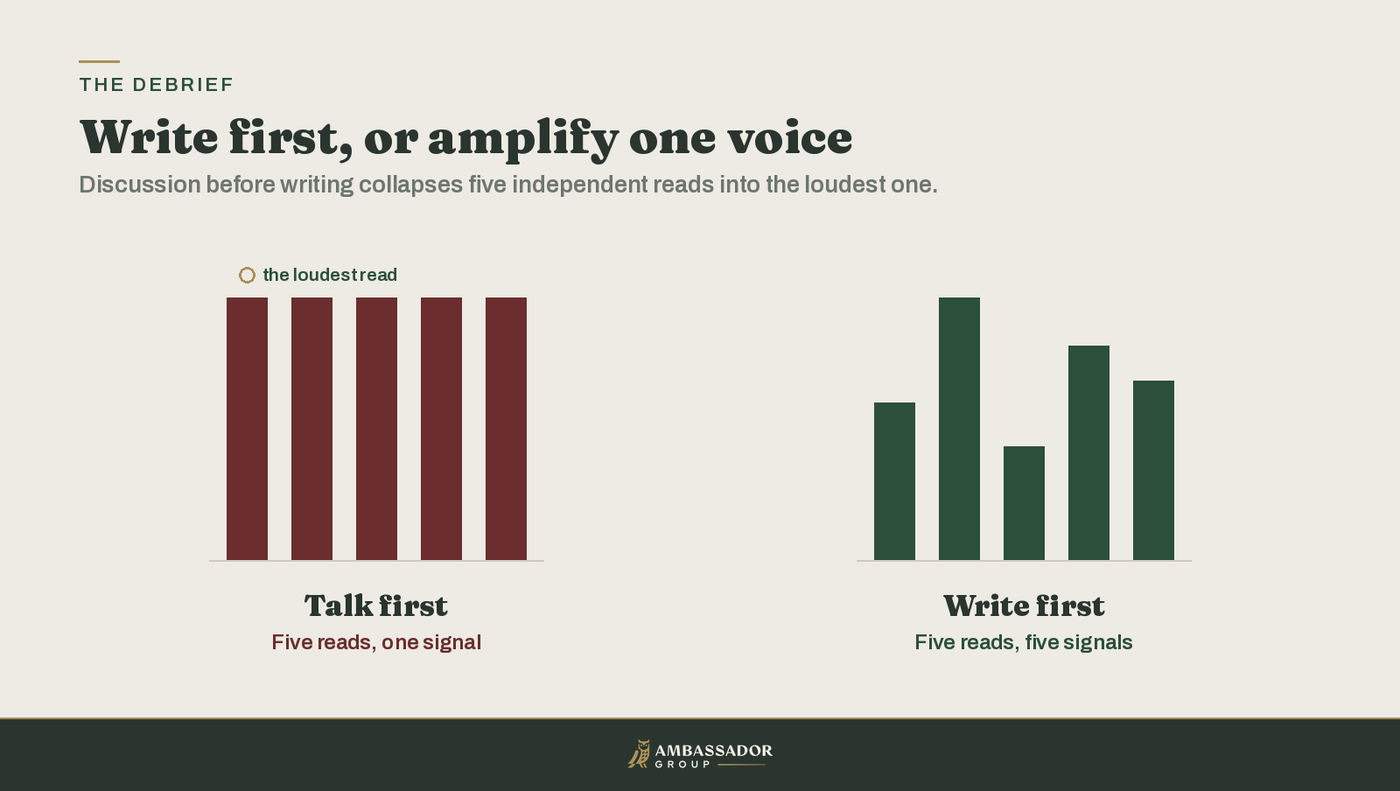
Write first to protect the signal
The countermeasure is boring and it works. Require each interviewer to commit an evidence-backed judgment to paper before the group meets, and before anyone compares notes in the hallway. No conferring. No pre-calibration. Each person writes what they saw, what it means, and how sure they are, alone. This is the load-bearing rule of a disciplined interview feedback system, and it is the one most teams skip.
Writing first does three things. It captures each read while that read is still independent. It forces evidence, because a blank field under "what did you observe" is harder to fill with a vibe than a spoken "I liked her" is. And it puts the judgment on the record with a name attached.
That last part carries more weight than it looks. When an interviewer knows the reflection will be read, compared, and kept, writing it down changes how they behave. A reflection you have to sign is a reflection you think harder about. The written form is an accountability instrument as much as a diagnostic one: being required to put an evidence-backed judgment on the record makes people underwrite their read instead of floating it. This is also why the questions on the form matter, and why it pays to have each interviewer prepare for the feedback form before they ever sit down with the candidate.
Walk the forms, not the personalities
Writing first pays off twice. The second payoff is the debrief itself.
Most debriefs have no structure. They open with an open floor, and an open floor is an invitation for the most confident voice to set the agenda. You get a conversation that follows personality, not evidence.
When every interviewer has already submitted a written reflection, the meeting has a spine. You walk the forms. Go accountability by accountability, or question by question, and read what each person independently concluded, ideally straight from the notes they took while interviewing. Now the structure of the meeting comes from the evidence on the page, not from who happened to speak first.
Three things surface the moment you walk the forms this way:
- Agreement. Where four of five independently flagged the same strength, you have a real signal, not an echo of one person.
- Disagreement. Where two people read the same answer in opposite directions, you have found the exact spot to dig. That split stayed invisible in a vibe-based conversation because the quieter read never made it into the air.
- Gaps. Where three forms say "did not assess" on whether the candidate can hold a schedule once the job starts slipping, you have found a hole in the interview itself, not in the candidate.
A debrief run this way cannot be hijacked by the loudest read, because the person with the loudest read is one column among five and has to meet the same evidence standard as everyone else. Disagreement stops being friction to smooth over and becomes the most useful thing on the table.
Writing first protects each read from the others. It does not protect all five from a blind spot they share, the charming candidate everyone independently likes. That is what deep reference calls and assessments are for, and it is why the forms are a first line, not the whole defense.
What the leader owns
None of this happens on its own. Someone has to decide that feedback goes in writing before the debrief, build the form that asks for evidence and not adjectives, and hold the line when a senior person wants to "just talk it through" first. Two things make the rule stick: keep the form short enough to finish in fifteen minutes, five fields and not a survey, and refuse to open the debrief until every form is in. That is the leader's job, and it is the cheapest insurance in the whole hiring process. It is also one rung on the longer climb toward interviewing mastery: the discipline to trust a process over a gut.
The reflections stay useful after the decision, too. The evidence each interviewer captured before the hire becomes the raw material for onboarding. The named strengths become the things to build on. The flagged risks become the first check-in agenda. The gaps become what to watch through the first ninety days. You build the form once to protect the hiring decision, and the same reflections carry into the work that follows.
Your next debrief will either surface five independent judgments or amplify one. The difference is whether the writing comes before the talking, and that is a choice you make before anyone sits down.


