
The most dangerous interviewer in any company is the one who has done a thousand of them. They will tell you they have a gut for people, that they know in the first five minutes, that twenty years across the table have taught them to read people. They are wrong, and the structure of their job guarantees they will never find out. Leaders who cannot see themselves clearly cannot see candidates clearly, and interviewing is the one leadership skill built almost perfectly to hide that fact from the person practicing it. The fix isn't better candidates: it's better leaders who own the process, starting with an honest account of how little the process has taught them.
The claim I will defend is uncomfortable: most experienced interviewers mistake comfort for skill. Two decades of interviews build the comfort and leave the skill untouched, and from the inside the two feel identical.
The skill that never compounds
In most work, repetition builds competence because the feedback is fast, clear, and honest. A framer who sets a wall out of plumb sees it out of plumb. A pitcher who hangs a curveball watches it leave the yard. The mistake shows itself, so a thousand reps make you better.
Interviewing is the opposite kind of work. Researchers who study how people acquire skill draw a line between kind learning environments and wicked ones. In a kind environment, feedback is immediate and accurate. In a wicked one, feedback is delayed, noisy, confounded, or missing entirely, and sometimes it points the wrong way. Hiring carries more wicked features than almost anything else a leader does.
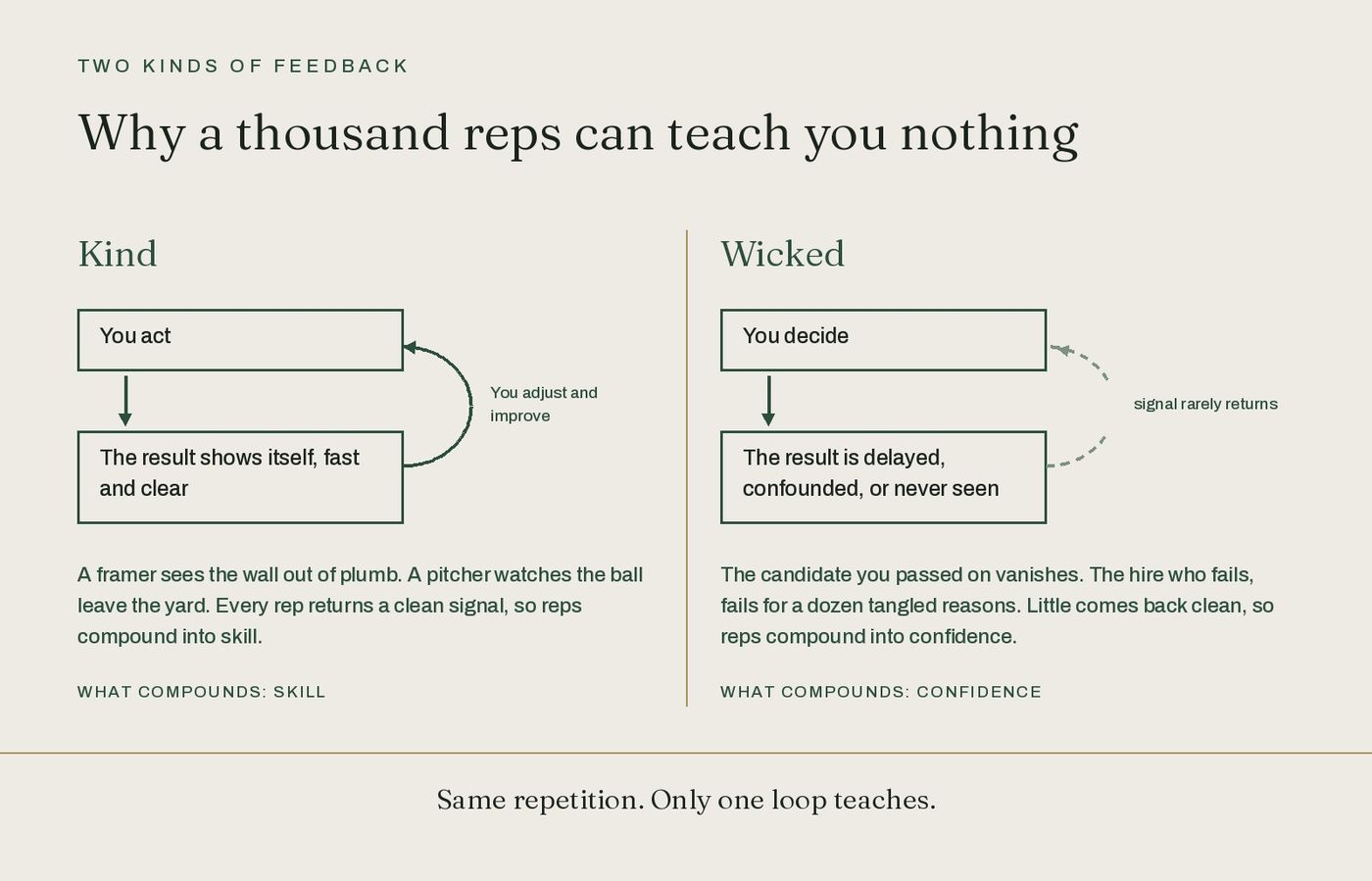
This is most true when you are interviewing a stranger across a conference table for a project manager, estimator, or operations role you fill once or twice a year. It is less true when you have watched someone run a job, or when three superintendents you trust have worked alongside them. This industry still has that signal, and it is kinder than anything a tech company gets. But the gut you built on jobsites does not transfer to an hour with a resume, and even the hire you know by reputation carries a wicked half: you see who you brought on, never who you passed over.
Consider what feedback an interviewer receives. The candidates you reject vanish. You never learn that the estimator you passed on went on to carry three of your competitor's jobs, unless the market is small enough that word drifts back, and even then it arrives as gossip, not as a graded test. Your false negatives are mostly invisible by construction. Your false positives are more tangled: when a hire fails, the failure is buried under onboarding, management, market shifts, team chemistry, and a dozen other variables. A superintendent who cannot run a job is often visible by the second pay application, but fast failure only tells you the pairing broke. It does not tell you whether the interview misread the person, the role is a meat grinder, or the project was a bad bet to begin with. And the one person who could talk you through it, the employee walking out the door, has every incentive to smile and say it was a great opportunity and the timing was not right.
So the interviewer runs conversation after conversation and gets almost no clean signal from any of them. The wall is never plainly out of plumb. The curveball never leaves the yard where they can see it. They are practicing in the dark and calling the silence success.
Why repetition breeds confidence instead of accuracy
If interviewing gave no feedback at all, that would be survivable. You would at least know you were guessing. The wicked part is that it gives you enough to feel expert and almost none of the kind that would make you expert.
Two well-studied traps compound here. The first is the one Dunning and Kruger described, and it is not that unskilled people are overconfident. It is that the same knowledge you need to perform a skill well is the knowledge you need to recognize you are performing it badly. If you cannot tell a strong answer from a fluent one, you also cannot tell that you cannot tell. The deficit and the blindness to the deficit are the same deficit. The second trap catches the experienced rather than the novice: a thin conversation produces a coherent story about a person, the story feels like insight, and the feeling never gets punished. Psychologists call it the illusion of validity, and confidence that outruns accuracy is exactly what it predicts.
Interviewing sits where both traps run deepest: the skill is hard to see from the inside, and almost nothing corrects you from the outside. A weak interviewer walks out of every conversation with a clear verdict and a warm sense of their own judgment, receives no disconfirming evidence for a year, and files each interview as more proof that their instincts are sound. Twenty years of that does not produce twenty years of skill. It produces twenty years of hardened confidence resting on a foundation nobody ever tested.
The trap is worst where judgment is the product. The owner known for reading people, the executive whose veto ends the discussion, the HR leader whose title certifies them as the expert: for each of them, admitting miscalibration is not a casual gap but a threat to their standing, so the disconfirming question goes unasked, least of all by the person it would most implicate. This is a structural risk, not a personal failing, and it rises with authority. In a fifty-person general contractor, the person with the most confidence, the most say over the decision, and the least incentive to test whether the confidence was ever earned is often you.
Interviewing is a theory-of-mind problem
Strip away the ritual, the questions, the scorecards, and one cognitive act is left: building an accurate model of another person's mind. Their real motivations, not their stated ones. What they know versus what they can recite. How they will behave under a pressure that is not present in the interview. This is theory of mind, the capacity to hold in your head that another person carries beliefs, intentions, and knowledge different from your own, and to reason about the contents of that separate mind. It is the work. Everything else is scaffolding around it.
It is harder than it looks, because interviewing runs in layers. You are modeling the candidate. The candidate is modeling what you want to hear. The interviewer worth anything is tracking the candidate's model of them, catching the moment an answer is being shaped to a perceived expectation rather than reported straight. When a candidate says they left for new challenges, the literal words are worth nothing: they are the socially sanctioned script. The signal lives in the gap between what they said and the internal state that produced it. Was there conflict? Boredom? A manager they could not stand? Only an interviewer already imagining the candidate's unspoken reasons thinks to ask the question that opens the gap.
The most common failure is projection: assuming the other mind works like yours. You find a problem trivial, so you read a candidate's hesitation as weakness rather than unfamiliarity. Or you are struck by fluency that is only shared vocabulary with you, and you score resemblance as merit. The interviewer who cannot separate their own knowledge from the candidate's is running a mirror, not an assessment, and they reward the candidates who most resemble them. In a wicked environment, the cost never reaches them.
The dysfunction you expect a candidate to absorb
Here the failure stops being private and turns unfair. Companies do not only misjudge candidates. They lay an expectation on top of the judgment, and the expectation is corrosive: a good candidate is one who will tolerate the company's own dysfunction.
It rarely gets said out loud, and it runs through the evaluation anyway. The candidate who asks pointed questions about how decisions get made is difficult. The one who left a well-known company after a year because the operation was chaos is a job hopper, a flight risk, not loyal. The one with high personal standards, whose history shows a pattern of moving toward better-run organizations, gets read as someone who will never be satisfied, who thinks too highly of themselves, who will be hard to keep. High standards get filed as a red flag.
Look at what that judgment punishes. It punishes the exact faculty you claim to be hiring for. The candidate who reads an organization clearly, notices dysfunction, and declines to marinate in it is demonstrating live, inside your own process, the discernment you say the role needs. Their willingness to leave a bad situation is that same discernment turned on employers instead of on you. Penalizing it means selecting, on purpose, for the people whose standards are low enough to stay somewhere broken. That is a filter, and it is not filtering for what you think.
Turnover is usually a structural verdict
The same reflex shows up after the hire, when someone leaves. The instinct is to reach for a personnel explanation. Wrong hire. Bad fit. Should have caught it in the interview. Need better candidates next time. The explanation always terminates in the person, because a personnel problem is someone else's fault and a structural problem is yours.
But the pattern usually tells a different story than the last exit does. When good performers cycle through the same role while the roles beside it hold, the people are the variable and the role is the constant: the manager, the comp structure, the way decisions get made, the gap between what was promised in the interview and what waited on day one. One departure is data about a person. The same role turning over twice in eighteen months is a verdict on the role. Audit the constant before you blame the variable.
This is not a claim that every departure is the building's fault. People also leave because they cannot do the work, because someone paid them twenty percent more, or because they have been moving one step ahead of being found out. Flight risk is real, and a superintendent who walks in the middle of your job is a genuine cost, not an imagined one. The discipline is telling those apart: the tell is the pattern across many people, not the story of the person who quit last. What you should stop doing is filing the candidate who left a chaotic operation after a year as disloyal by default, because that reflex selects for the people whose standards were low enough to stay.
I hold a hard version of the ownership question, and it needs its boundary stated plainly. When a hire fails on job fit, and the candidate was honest about their history and the role turned out to be what you described, the failure belongs to the people who built the process, not to the person who walked through it. Not mostly. That one is yours. A fabricated resume is the candidate's lie, though you still own that it survived your process. A role sold as one job and lived as another is your turnover, not theirs. The move worth attacking is skipping those distinctions and landing on "we need better candidates" every time, because that is the one diagnosis that leaves the only variable you govern untouched. The candidate cannot see inside your organization before they join; you can. The candidate did not choose who else sat in the interview, what got asked, what got glossed over, or whether anyone told the truth about the role. You did. Responsibility follows control, and most of the control sat on your side of the table the whole time.
What owning it looks like
None of this improves by trying harder inside the same broken loop. Effort is not what is missing. Feedback and self-honesty are, and both have to be built deliberately, because hiring produces neither on its own. You cannot make hiring kind. You can make it less wicked, and that difference is the whole game.
Start by putting your read on record before you can revise it. Before the debrief, every interviewer writes two lines: what I believe drives this person, and what would prove me wrong in ninety days. That is the entire instrument. The hiring manager reopens that page at day thirty and day ninety, spends ten minutes, and marks each prediction hit or miss. If you do nothing else, do this. It converts a gut feeling, which never has to answer for itself, into a prediction, which does. A no that was never written down as a prediction does not get to end a candidacy. A hire with no ninety-day check against the original read does not get to be remembered later as a good interview that went bad.
A model of someone's motives is necessary and not sufficient. Move the rest of the evidence out of the interview, where fluency counts for more than it should: the last three jobs walked through in detail, a schedule they ran themselves, a reference who will speak plainly because they still have to work with you. Skip those and the fluent hour becomes the evidence, which is how resemblance keeps getting scored as merit.
Then close the loop the job leaves open. Talk to the people who leave, and treat the fact of the departure and the pattern of who departs as the real signal, because the polite exit speech will not be. When a role churns, investigate the role before you interview the next candidate. In a market this small you will eventually hear how the people you rejected did, and when you do, write it down next to the original no. That autopsy is available to you, and most teams never run it.
None of this exempts the people you hire to help. A firm you bring in to fill the role lives in the same wicked environment, with a worse incentive: it gets paid when someone accepts, not when the read still holds at eighteen months. Any firm worth keeping can show you the predictions it made and how its recent matches performed against them. Ask for that record, and hold whoever you hire to the same standard you are now holding yourself. If nobody in the conversation can produce it, everyone is guessing, and at least you know to price that in.
And stop reading high standards as a threat. When a candidate scrutinizes how you operate, that is the assessment running in the direction it is supposed to run. The interview was always bilateral. The candidate is underwriting you while you underwrite them, and the ones sharp enough to do it well are the ones worth having.
Here is how you would know none of this describes you: you can show your last ten written reads and how they aged at ninety days, the questions you asked that tied to the actual work, and what you changed after your last two misses. If you have that, you are calibrated, and the argument does not apply to you. Most leaders cannot, not because they are weak, but because nothing in the job ever required them to keep score.
The interviewer who has done a thousand interviews has not necessarily learned a thing, and the hard part is that they are the last to know. You cannot buy your way out of that with better candidates. You can only build the missing feedback yourself and look honestly at what it shows. The mirror was always pointed back at the leader. The only question is whether you are willing to look.
The short version.
- If I have interviewed people for twenty years, why would I be bad at it?
- Because interviewing gives almost no honest feedback. The candidates you reject vanish, and when a hire fails it happens eighteen months later, buried under management, market shifts, and team changes you cannot untangle from the read you made in the room. Repetition builds confidence, not accuracy, when nothing ever corrects you. Twenty years of that can harden a gut that was never tested.
- Is a candidate who left three jobs in five years a flight risk?
- Sometimes. People do leave because they cannot do the work, because someone paid them more, or because they were staying one step ahead of being found out. But the tell is the pattern across many people, not the story of the one who quit last. Someone who left a chaotic operation because they hold high standards is showing you the exact discernment the role needs, and filing that as disloyalty selects for people whose standards were low enough to stay somewhere broken.
- A role on my team keeps turning over. Does that mean I keep hiring the wrong people?
- Not usually. When good performers cycle through the same role while the roles beside it hold steady, the people are the variable and the role is the constant: the manager, the pay, how decisions get made, the gap between what the interview promised and what day one delivered. One departure is data about a person. The same role turning over twice in eighteen months is a verdict on the role, so audit the constant before you blame the variable.
- What is the smallest thing I can do about this?
- Before the debrief, every interviewer writes two lines: what they believe drives this person, and what would prove them wrong in ninety days. The hiring manager reopens that page at day thirty and day ninety and marks each prediction hit or miss. That is the whole instrument. It turns a gut feeling, which never has to answer for itself, into a prediction, which does.
- How would I know if I am already good at this?
- You can show your last ten written reads and how they aged at ninety days, the questions you asked that tied to the actual work, and what you changed after your last two misses. If you have that record, you are calibrated and none of this applies to you. Most leaders cannot produce it, because nothing in the job ever required them to keep score.


