
The most rigorous interview you'll sit is also the fairest one, and it's built to work in your favor.
Most people brace for a demanding interview process like it's something to survive. That instinct is backwards. The interviews that cost good people the job they wanted are rarely the hard ones. They're the careless ones.
A hiring process is the clearest look you'll get at how a company thinks before you ever accept its offer. A company that can't evaluate itself honestly won't evaluate you honestly either. The rare one that has built a disciplined interview is showing you something up front: it can see people clearly, you included. That head start is worth more to you than the comfort of an easy interview.
Where good candidates get lost
Picture the ways a loose process fails you:
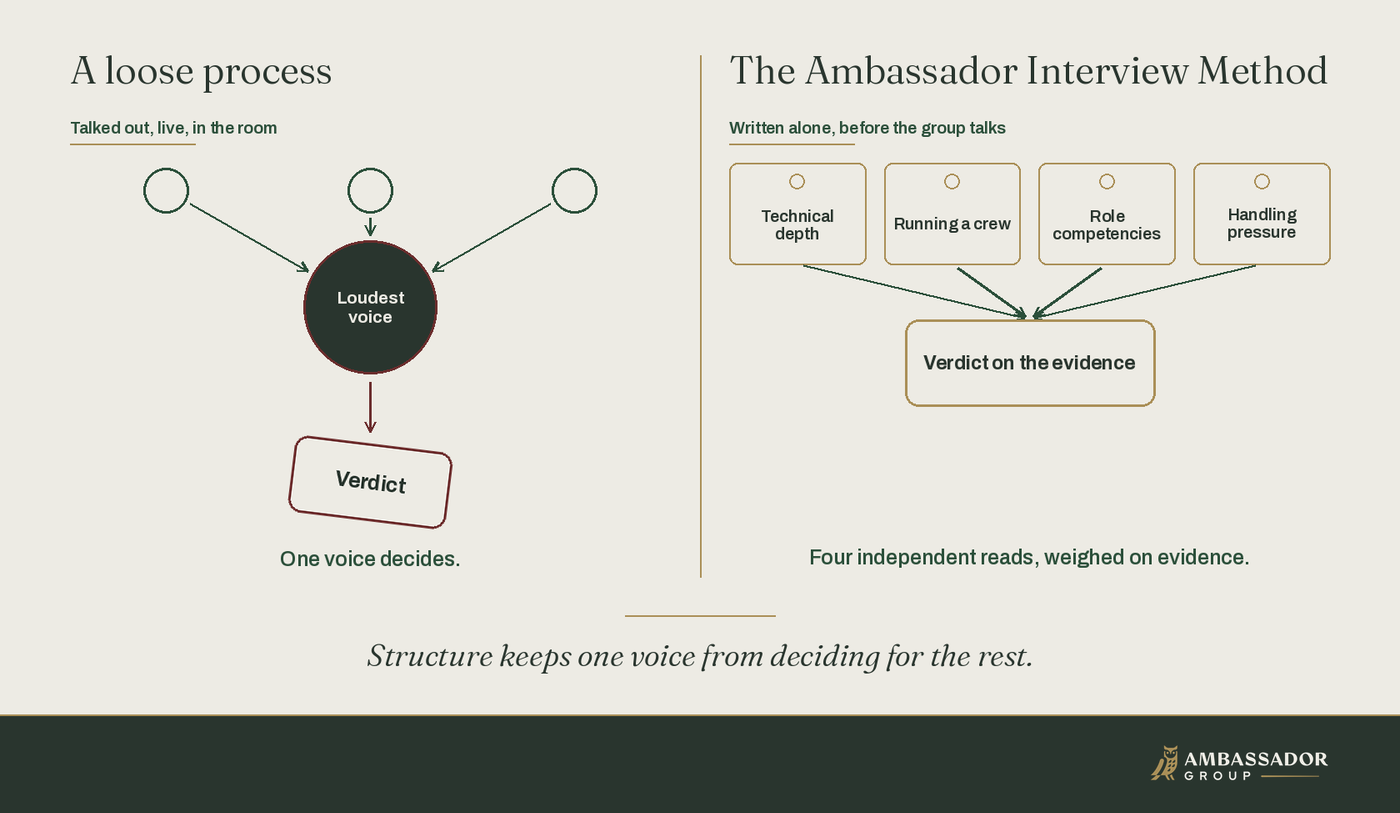
- A panel that never compares notes until everyone's together, where the most senior or most confident voice sets the verdict in the first thirty seconds and everyone else quietly falls in line.
- An interviewer who was double-booked and half-listening, and who walks out remembering a vibe instead of your answers.
- Four rounds that circle the same three questions and never touch the thing you're best at.
- A culture-fit call nobody can quite explain, which often comes down to reminded me of me.
When the process is loose, you're the one holding the risk. You get read wrong, and you rarely find out why.
A company that runs the Ambassador Interview Method has built its process to strip those failures out. From where you sit, four things stand out.
One disclosure on where this is coming from: Ambassador Group represents the candidate as fully as the company doing the hiring. That is the reason for the straight talk. A process that reads you accurately is the one that works for you, not only for the employer.
The four things you'll notice
Every conversation has a job
Before you show up, each interviewer is assigned one specific part of the role to assess: technical depth for one, how you run a crew for another, how you'd handle the parts of the job that break under pressure. Nobody is there just to get a feel for you. So every conversation has a purpose, you're not answering the same three questions four times, and, most useful to you, somebody is specifically watching for each of your strengths. Nothing you're good at slips past because no one thought to ask about it.
Your words are what count
Interviews are recorded and transcribed. It can feel formal at first. It works in your favor. Your evaluation rests on the words you said, on the record, rather than on a distracted interviewer's fuzzy memory or a first impression that hardened in the opening two minutes. A shaky start won't define you once you find your footing. A strong answer stays on the record instead of evaporating. Polish stops being able to outrun substance, and if substance is your strength, that's the whole game.
The evidence outranks the loudest voice
This is the one that matters most, and you'll never watch it happen. Before the team talks, before a hallway comment or a text between rounds, every interviewer writes down an assessment alone, backed by specific evidence, and commits to it. Only then do they compare. Two things follow. No one's read of you gets anchored by the most senior or most self-assured person on the panel. And the interviewer who noticed something real in you is read on the merits, before anyone senior can talk over it. You're judged on the weight of the evidence gathered before anyone spoke.
You're measured against the job
The job description is the scorecard, the way a spec sheet tells you whether the work came in on tolerance rather than whether it looked right from the truck. Every question and every evaluation traces back to one thing: whether you can do the work the role requires. That protects you from the outcome candidates hate most, being turned down for a reason no one can name. If you can do the job, it shows up in the evidence. And if the fit is genuinely wrong, you learn that honestly and early, which, as the next section shows, is also on your side.
What to expect walking in
The four points above are what the method guarantees: how you're evaluated. A company that takes the method seriously tends to pair it with a candidate experience to match. Expect the following, so none of it catches you off guard:
- Several focused conversations instead of one long grilling, and possibly a role-fit assessment. Each session runs shorter and more pointed than the catch-all interview you’re used to, because every interviewer has a defined job.
- A two-way street, and they'll say so. A company using this method expects you to evaluate it as hard as it evaluates you. Ask the real questions. Push on whatever would make or break the job for you.
- Deal-breakers on the table early. The good ones name the hard facts up front, how pay is structured, travel, what the first ninety days really demand, instead of letting you discover them after you've resigned somewhere else. Do the same: if something's a deal-breaker for you, say so early.
- A decision you can understand. Because the evaluation is written down against the role, a good company can tell you where you landed and why, in specifics. Expect clear next steps instead of a black hole.
- Recording, handled straight. You'll be asked before anything is recorded, and it's done professionally. The transcript is what lets your best answers count for exactly what you said.
How to get the best results
Come in clear on what your job is here. It is to understand the role in full and to judge whether the company is right for you, while they judge the same about you. Winning an offer you would be wrong for serves no one. Treat the process as what it is: a thoughtful evaluation both sides run together, working the same evidence toward one honest decision. You hold half of it.
This structure rewards evidence over charisma. Use that.
- Lead with specifics. "I brought the project in under budget" is weak. "We were tracking 8% over at 60% complete, and here are the three changes I made and where we landed" is evidence. Adjectives don’t survive the transcript, so give it something worth recording.
- Answer the question in front of you. Each interviewer is working a lane. If someone's digging into how you handle conflict on a jobsite, that's the assignment, so go deep there instead of steering back to your highlight reel.
- Assume everything you say is on the record, because it is. That's an advantage. Stay consistent, stay honest, and let the transcript remember your best answers for you.
- Interview them back, for real. Use your own questions to find out whether this is a place you'll succeed. A match that lasts is the goal on both sides.
- Prepare hard, then drop the performance. Polish gets discounted here by design. A rehearsed pitch helps you less than a straight account of what you've done, what you haven't, and what you're working to grow into.
Why the rigor is on your side
A process this thorough can feel like a lot. It helps to know why it’s built this way. The same rigor that would screen you out of a job you’d be wrong for is the rigor that lands you in the one you’re right for. Careless processes produce mismatches: the role that looked great and fell apart six months in. This one is built to get the decision right, for both sides, the first time.
So when the next process you enter looks demanding, read it as a signal about the people running it, and let that help you choose.
The short version.
- Why would a company record my interview?
- To evaluate you on what you said rather than on a busy interviewer's memory. The transcript protects you: a strong answer stays on the record, and a shaky opening doesn't get to define the whole conversation. You'll be asked before anything is recorded.
- Does a more rigorous process mean I'm less likely to get the job?
- No. A disciplined process is more likely to catch the strengths a loose one misses, and it measures you against the real job instead of a gut feeling. If you can do the work, structure helps you rather than hurts you.
- Why are there so many interviews?
- Each interviewer is assigned one part of the role, so the conversations divide the work instead of repeating it. Expect a few focused sessions, each shorter and more purposeful than a single catch-all interview, and sometimes a role-fit assessment.
- How should I prepare for an interview like this?
- Bring specific evidence over polished lines: numbers, decisions you made, and how they turned out. Answer the question each interviewer is asking, and use your own questions to judge whether the company is right for you.
- What is the Ambassador Interview Method?
- A structured way of running interviews built to keep evaluation honest. Each interviewer assesses one defined part of the role, interviews are transcribed, everyone writes an independent assessment before the group talks, and every judgment is measured against the job description. For you, that means a fairer, more accurate read.


