
If your interviewing isn't dialed, the quality of your recruiting barely matters. A strong slate of candidates run through a weak process still ends in a bad hire. Good recruiting has to marry good interviewing. Good interviewing has to marry good onboarding. Good onboarding has to marry good training. Break any link and the whole chain gives, and the people you bring on pay for it first.
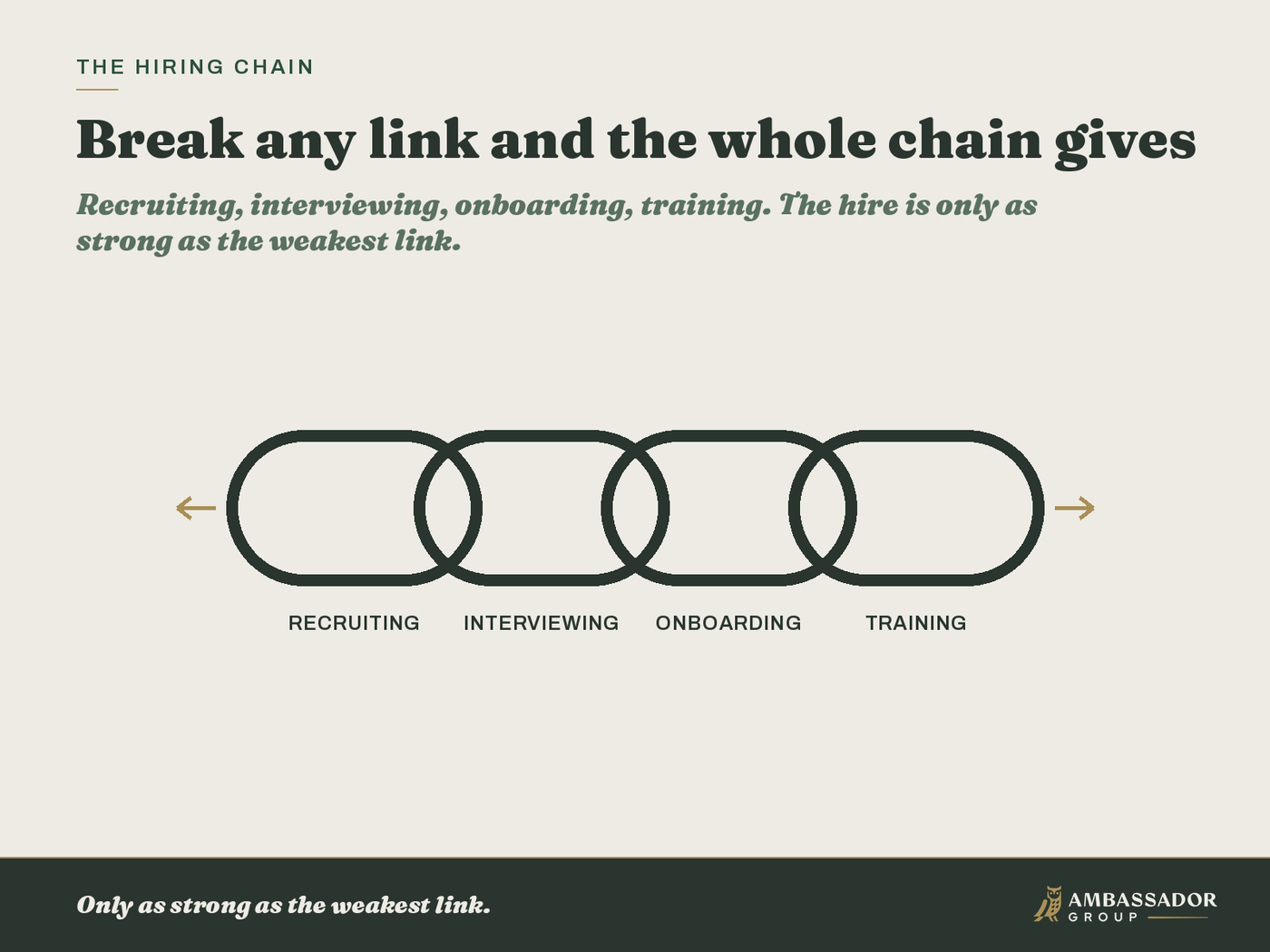
The part most leaders miss sits underneath all of it. The interview is where your judgment becomes visible. The candidate brings themselves. You bring everything else: the role definition, the questions, the process, the call at the end. So the lever that moves the quality of a hire is the clarity of the person running the room. See yourself accurately and you start to see the candidate accurately. That is the whole game, and it starts with you.
The ten disciplines
Want to dial your interviewing? Start here.
- Plan, prep, and pregame every interview, and prep the candidate too. Walk in with a gameplan built on a real understanding of the role you are hiring for. If you do not have one, at least be honest that you do not yet know the role well enough to build it. Admitting that gap is the first honest act of preparation, and it is far cheaper than discovering it in month three.
- Be investigative, not observational. Most interviewers watch a candidate perform and call it data. An investigator digs for the evidence the candidate did not plan to hand over. The difference between investigative and observational interviewing is the difference between a verdict you can defend and a hunch that happened to be right.
- Make the candidate prove qualification, not assert it. Anyone can claim they can run a fast-track schedule or hold a tense owner meeting. Build the questions and scenarios that force the proof onto the table. Your job is to design the moment that makes them show you, not the one that lets them tell you.
- Have every interviewer write down their read before anyone talks. Opinions, observations, beliefs, and concerns, all on paper before the debrief opens. The instant the first confident voice speaks, the room starts agreeing with it. Written-first feedback kills the groupthink and leaves you with a real data set instead of an echo of whoever spoke first.
- Move with urgency and speed, but never haste. Velocity is moving fast with purpose. Haste is moving fast in panic. One earns you good people on a tight timeline. The other has you reopening the same search in six months and paying for it twice.
- Own that the quality of the hire is yours to underwrite. When a hire fails, look hard at the process you ran before you look at the resume you read. Treat every candidate the way an underwriter treats a risk: name what could go wrong, then decide to accept it, engineer around it, or walk away. That posture is the heart of hiring in high resolution.
- Give every interviewer a scoped role, and hold them to a written determination. If everyone is assessing everything, no one is accountable for anything. Assign lanes. Require a verdict in writing. Vague enthusiasm in a hallway is not a determination, and it will not protect you when the hire goes sideways.
- Interview to the job description. Onboard to it. Train to it. Review to it. One document should govern the entire arc. When you interview to the job description and keep using the same standard through onboarding and review, you stop measuring people against a target that drifts every time it is convenient.
- Stay agile. No single process fits every candidate, every role, every level. Be dynamic enough to adapt the format to the person in front of you, and disciplined enough to hold your standards while you do. Agile is not the same as loose, and a process you abandon under pressure was never a process.
- Respect the interview. It is art and science. It is anthropology and psychology. It is friendship-building and interrogation inside the same hour. It is often a million-dollar decision made over the course of an afternoon. Treat it like the bet it is.
The discipline underneath the other ten
The most dangerous interviewer in any company is the low-EQ leader with low self-awareness who is certain they read people well. I have sat across from plenty of them, and so have you. They have never studied themselves, so they carry no calibration for the instrument they are using to study everyone else. The confidence is the symptom, and it is the easiest one to mistake for skill.
Two things decide where you sit: how sure you are that you read people well, and how often you test that read against reality. Find yourself on it honestly.
The leader who has never turned the lens inward sits in the top left, sure of a read they have never once tested. Getting out means moving right before you move up: test the read more often, and let earned confidence follow the evidence instead of leading it. It is the same climb mapped in the Four Stages of Hiring Competence, and the worst interviewers are the ones who never start it.
Guard yourself here, because this blind spot is most invisible to the people who have it.
To study yourself is to learn how to study others.
Study yourself first. It is the only way you will ever learn to read anyone else.
The short version.
- Why does great recruiting still produce bad hires?
- Because a strong slate of candidates run through a weak interview process still ends in a bad hire. Good recruiting has to marry good interviewing, good interviewing has to marry good onboarding, and good onboarding has to marry good training. Break any link and the whole chain gives, and the people you bring on pay for it first.
- What is the difference between investigative and observational interviewing?
- An observational interviewer watches a candidate perform and calls it data; an investigator digs for the evidence the candidate did not plan to hand over. Anyone can claim they can run a fast-track schedule or hold a tense owner meeting, so design questions and scenarios that force the proof onto the table. The difference is a verdict you can defend versus a hunch that happened to be right.
- How do I stop groupthink from deciding my hiring debriefs?
- Have every interviewer write down their read before anyone talks: opinions, observations, beliefs, and concerns, all on paper before the debrief opens. The instant the first confident voice speaks, everyone starts agreeing with it. Written-first feedback leaves you with a real data set instead of an echo of whoever spoke first.
- Should every interviewer assess everything about a candidate?
- No. If everyone is assessing everything, no one is accountable for anything. Assign each interviewer a scoped lane and require a verdict in writing; vague enthusiasm in a hallway is not a determination and will not protect you when the hire goes sideways.
- Who is the most dangerous interviewer in a company?
- The low-EQ leader with low self-awareness who is certain they read people well. They have never studied themselves, so they carry no calibration for the instrument they are using to study everyone else, and their confidence is the symptom easiest to mistake for skill. The way out is testing your reads against reality more often and letting earned confidence follow the evidence, because studying yourself is the only way to learn to read anyone else.


