
Most construction leaders in Northern California pay the Bay Area premium the same way: a flat cost-of-living bump added to every role they price, top to bottom. The advertised pay data shows that bump is set wrong. For the roles that run a project, the Bay Area premium is real and large. For the trades and early-career roles, it is close to zero. A leader who underwrites the offer instead of copying a regional table asks a sharper question about each role: what is the premium buying, and is it worth the price? Read that way, the same budget lands a better hire.
The figures below come from Ambassador Group’s read of advertised construction pay across the two metros, limited to roles with enough postings to mean something. Each premium is the gap between the two metros in median advertised pay for the role.

Where the premium lives
Rank the eleven roles by how much more the Bay Area advertises than Sacramento. The premium clusters in the roles that run the job, thins through the middle, and fades to nothing at the entry level.
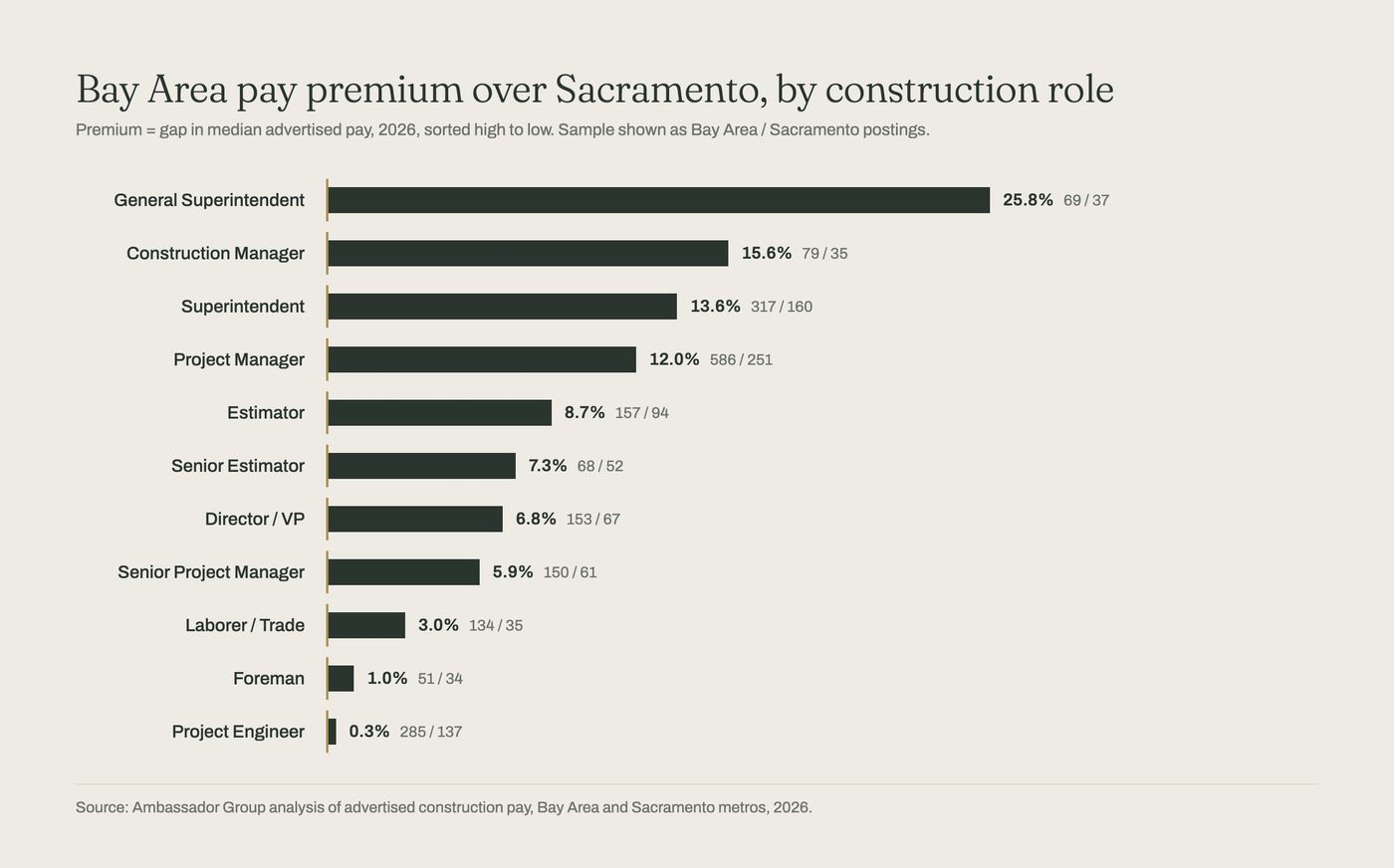
Trust the two figures built on the largest samples. Superintendent runs 13.6 percent higher in the Bay Area, from 317 postings against 160. Project manager runs 12.0 percent, from 586 against 251. These are the people who run the job on the ground, and for them the premium is steady and worth about an eighth of pay.
The two larger numbers sit on thinner ground. General superintendent shows 25.8 percent, but on 37 Sacramento postings, and the title bleeds into superintendent and construction manager often enough that the gap may track who got counted rather than a real difference. Construction manager sits below it at 15.6 percent on a comparably thin Sacramento cell. Read both as a direction, not a number to underwrite against.
Time on site is not what earns it
The obvious read is that the premium pays for standing on an expensive jobsite. The two roles most tied to the site argue against it. A foreman shows a 1.0 percent premium. A laborer or tradesperson shows 3.0 percent. Both draw on thin Sacramento samples, but a flat premium is the safer direction to be thin on: a large gap built on a few dozen postings can ride on a handful of outliers, while a near-zero one is hard to fake. Both roles are on the site more than the project manager who earns twelve percent, and both are nearly flat between the metros.
Two things hold the trades flat. Their pay is set as much by union scale, prevailing-wage rules, and the hiring hall as by any one employer’s judgment, so a Bay Area contractor has little room to open a discretionary gap over Sacramento even when it wants to. And the roles the Bay Area does pay up for are the ones an employer prices itself: the salaried superintendent and project manager who run a complex, high-stakes job where that person is scarce and hard to keep. The premium concentrates where the employer sets the number, and compresses where scale and the hall set it instead. That points to project leadership, not proximity to the work.
Seniority does not explain it either
If the premium rose with rank, the senior version of each role would sit above the base version. It sits below. Senior project manager shows 5.9 percent against the project manager’s 12.0. Senior estimator shows 7.3 against the estimator’s 8.7. Above a certain level the metro premium flattens, and the size of the book drives pay instead.
The executive number understates the gap
Director and VP roles show 6.8 percent, which looks like the same slope continuing. Read it with more care. Executive pay tracks the size of the operation far more than the price of the neighborhood, and scope is a company decision made well above any single metro.
The number also measures the wrong slice. For a field superintendent, advertised base is close to the whole cash number, a vehicle allowance or completion bonus aside. For an executive it is a fraction of a package built on bonus, profit share, and sometimes equity, none of which show up in a posting. So 6.8 percent tells you little about the real executive gap, and you cannot recover the answer from a job listing. Benchmark a VP against the business they will run, not a regional base table.
What the numbers can and cannot do
Read across hundreds of postings, this data is good for one thing: showing where a premium exists and where it does not. A pattern built on 586 project-manager listings is hard to fake. The same data cannot price the person in front of you. A posted number is a stranger’s blended average, and it fails as an individual verdict in eighty documented ways. So use the metro premium to decide which roles deserve a real underwriting conversation, then price each role from your own P&L, your own project, and your own risk. It is a floor for your thinking, never the offer itself.
What it changes for the hire
Underwriting a role means asking what the premium buys and whether the risk it retires is real.
For a superintendent or project manager, it retires a real risk. Price one to a Sacramento number for a Bay Area job and one of two things happens. The candidate signs with the employer who priced it right, or the one who takes the discount leaves once the commute wears on them. Either way the project stalls, and a stalled project costs more than the correct offer ever would.
For a project engineer, the premium buys nothing. The gap is 0.3 percent, on 285 Bay Area postings against 137, so the number is solid and it is a rounding error. A stuck search at that level is rarely a base-pay problem, though Bay Area housing can still make one candidate’s offer uncompetitive, and where it does the answer is a targeted number for that person, not a metro-wide bump. The draw is the work, the people the engineer will learn from, and the path to the next role. A metro-wide raise there spends where there is no risk to retire.
For an executive, the metro is a distraction. The offer turns on the scope of the book and the shape of the incentive, not a base table that leaves out most of the pay.
The habit worth dropping
A flat cost-of-living adjustment is the easiest way to set pay and one of the costliest. It overpays for geography that barely moves the number and underpays for the leadership that carries the job, and it feels prudent the whole time. The advertised pay already prices the difference: about an eighth more for the superintendent and project manager who run the work here, and nothing extra for the project engineer who does not.
Pull up your open Northern California searches and read each offer for what its premium is buying. Which ones are priced by habit?
The short version.
- How much more does the Bay Area pay than Sacramento for construction roles?
- It depends on the role. Advertised pay runs about 12 to 14 percent higher in the Bay Area for the superintendent and project manager who run a job, and close to zero for the trades and early-career roles. A single flat cost-of-living bump misprices most of the org chart.
- Why do trades and laborers see almost no Bay Area pay premium?
- Their pay is set largely by union scale, prevailing-wage rules, and the hiring hall, so an employer has little room to open a discretionary gap between metros. The premium concentrates in the salaried roles an employer prices itself, like the superintendent and project manager.
- Should I add a flat cost-of-living raise to every role for a Bay Area job?
- No. A flat adjustment overpays for geography where the metro barely moves the number and underpays for the leadership that carries the job. Price each role for what its premium is buying, and underwrite the roles that run the project.
- Can I use advertised salary data to set an individual offer?
- Use it for direction, not for the number. Advertised pay shows where a premium exists across hundreds of postings, but a posted figure is a blended average and cannot price the person in front of you. Set the individual number from your own book, project, and risk.


