
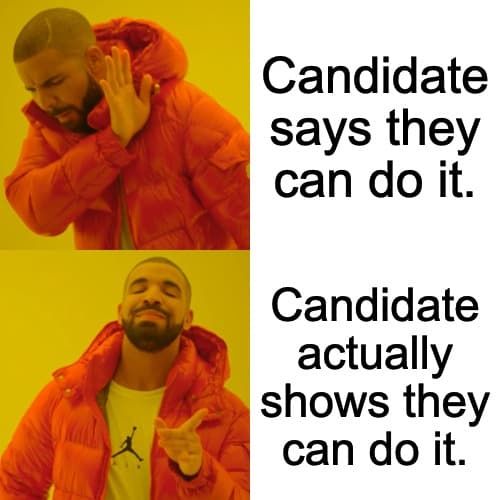
A client recently told me a story that perfectly illustrates the danger of relying on surface-level interviews.
They were hiring for a technical role and built a strong interview plan. One step was a practical work sample, a chance for the candidate to actually complete a project similar to what they’d be responsible for on the job.
But in the moment, the company took a shortcut. Instead of asking the candidate to finish the work sample, they listened to the candidate explain how they would approach it. They accepted the candidate’s confident description as proof enough.
The candidate was hired.
Within weeks it became painfully clear: the candidate couldn’t actually do the work. What should have been caught in the interview became a costly on-the-job failure.
Observational Interviewing
This is observational interviewing at its core, taking a candidate’s word at face value. It feels efficient, even courteous, but it shifts accountability onto the candidate’s ability to tell a good story rather than your ability to verify the truth.
You observe, you listen, you “get a feel.” But you don’t test. And when you don’t test, you gamble.
Investigative Interviewing
Investigative interviewing is different. It takes responsibility for validation. It means you don’t just ask candidates to describe skills, you ask them to demonstrate those skills.
That may mean:
- Completing a case exercise or work sample in real time.
- Walking you through an actual deliverable they created.
- Handling a situational problem where variables are adjusted on the fly.
Investigative interviewers design the process so there’s nowhere for vagueness to hide. They assign accountability across the interview team and press for evidence over impression.
The Cost of the Shortcut
The shortcut my client’s team took felt harmless. After all, the candidate sounded convincing. But that single choice, observing instead of investigating, produced a mismatch that cost credibility, time, and project momentum.
Most importantly, it revealed a blind spot: the team believed interviewing was about listening to what a candidate said, when in fact interviewing is about verifying what a candidate can do.
Raising the Standard
The shift is simple but not easy: stop treating interviews like polite conversations and start treating them like investigative work. It’s not adversarial, it’s responsible.
When you interview investigatively, you move from hoping you’ve made the right hire to knowing you’ve done your part to reduce risk.
As Jim Collins wrote in Good to Great, “You can accomplish any number of impossible goals if you have the discipline to confront the brutal facts.” Investigative interviewing is simply the discipline of confronting facts in the hiring process.
The short version.
- What is the difference between observational and investigative interviewing?
- Observational interviewing takes a candidate's word at face value: you observe, listen, and get a feel, but you never test. Investigative interviewing takes responsibility for validation by asking candidates to demonstrate skills, not just describe them. One shifts accountability onto the candidate's storytelling; the other keeps accountability with you.
- Why is taking a candidate's word at face value so risky?
- Because a confident description is not proof of ability. One company skipped a planned work sample and accepted the candidate's explanation of how they would approach it; within weeks of hiring, it was clear the candidate could not do the work. When you do not test, you gamble, and the failure surfaces on the job where it costs credibility, time, and momentum.
- How do I verify a candidate's skills during an interview?
- Ask for demonstration, not description. That can mean completing a case exercise or work sample in real time, walking through an actual deliverable they created, or testing them with a real-world problem where you adjust variables on the fly. Design the process so there is nowhere for vagueness to hide, and assign accountability across the interview team.
- Is investigative interviewing adversarial to candidates?
- No, it is responsible. The shift is from treating interviews like polite conversations to treating them like investigative work: pressing for evidence over impression. Done well, it moves you from hoping you made the right hire to knowing you did your part to reduce risk.


